 Log in

The Fourteenth Amendment to the US Constitution has been the basis of numerous Supreme Court decisions, yet there is a compelling case for its never having been legally ratified. In this week’s Friday Philosophy, Dr. David Gordon examines those claims.




On 31 July, Amnesty International publicly apologised for publishing an “anti-rights” briefing at the heart of a weeks-long public clash with author J.K. Rowling. The document, “A Growing Threat: The Anti-Rights Movement in the UK,” purported to map a nationwide “anti-rights ecosystem” that included Beira’s Place, the Edinburgh sexual-violence support service established by Rowling in 2022. Transgender-rights activists have long criticised the charity for excluding transgender women from its services.
Rowling was having none of it, and she launched a scathing public attack on an NGO that she said has “become a tyrant that persecutes those who don’t espouse what it decrees acceptable beliefs.” She invited any of the groups named on what she called Amnesty’s “blacklist” to apply to the J.K. Rowling Women’s Fund for legal support. Amnesty quickly realised that it had picked the wrong fight. Its earlier, carefully calibrated expression of “regret” collapsed into a full mea culpa; it withdrew the briefing. The document had been uploaded by mistake, the organisation said, bypassing its established and normally rigorous internal-review processes. An internal investigation was announced, to be followed by an independent external review.
Should any of the women's organisations targeted by @AmnestyUK's recent 'anti-rights' blacklist wish to take legal action, applications can be made to the JK Rowling Women's Fund. https://t.co/iyohnrgVZN https://t.co/D28OInpM5g
— J.K. Rowling (@jk_rowling) July 13, 2026
At a glance, Amnesty’s climbdown seems to close a brief but turbulent chapter in the history of one of the world's most influential human-rights organisations. But if it hopes that its procedural explanation will satisfy critics and end scrutiny of its operations, it is mistaken; it only raises more questions. How, for instance, does a document of this significance—which named more than a hundred British organisations and might have seriously damaged their reputations and funding—reach publication without passing through the oversight that Amnesty claims it applies to all its work? And if that process failed here, why should anyone assume that it has not failed elsewhere?
As senior editor at Human Rights Watch (HRW), I saw the machinery behind major human-rights publications up close. It beggars belief that a complex document like this one about a highly sensitive issue simply slipped out of the door unnoticed. A less fantastical explanation is that it was not a rogue briefing, but the most legally exposed expression of a settled institutional view. In May, Amnesty published a related report titled “Like a Snowball: The Growth and Impact of the Gender-Critical Movement in the UK,” which included comparable characterisations of many of the same organisations and was finally withdrawn on 31 July. Also withdrawn was a parliamentary briefing produced for Pride Month this year that likewise described 51 gender-critical organisations as “anti-trans.”
Amnesty’s approach in the Rowling affair followed the familiar NGO playbook that has allowed human-rights organisations to survive crises for decades to preserve their moral authority and avoid meaningful accountability. First, downplay the incident by framing it as a regrettable breakdown in an otherwise scrupulous system; second, promise an investigation; third, wait for the news cycle to move on. But maybe that won’t work this time. Is it too much to hope that Rowling’s stand-off with Amnesty will finally produce a reckoning for an increasingly unaccountable sector?
A realist might well conclude that there is almost no chance of that. Organisations like Amnesty International—which command budgets that run into hundreds of millions, and even billions, of US dollars—have spent decades surviving controversies and evading scrutiny, even though they exert enormous political and cultural influence. An optimist, on the other hand, might point out that history has a habit of stripping moral halos from individuals and institutions (like the Catholic Church and the Boy Scouts of America) that were once thought beyond reproach. The wheels of accountability may turn slowly, but turn they do.
Last month, the UK Charity Commission opened a compliance case into Amnesty’s handling of the “anti-rights” affair, saying it was “engaging with the charity’s trustees to gather more information.” Public figures have also begun to challenge what they see as the organisation’s ideological direction. “As a former major fund-raiser for Amnesty—I produced the first five “Secret Policeman’s Balls”—I renounce the mob who have taken over Amnesty,” wrote comedian John Cleese on X. “Amnesty used to be about trying to do something about TORTURE.” Iseult White, the granddaughter of Amnesty co-founder Seán MacBride, told the Times that she “would not donate a single penny to Amnesty.” And now, some of those who have spent their working lives in the human-rights sector are also speaking out about the betrayal of foundational principles they witnessed during their careers.
I am one of those people. Shortly after 7 October 2023, I left HRW and co-founded EiGHT, a Swiss-based nonprofit established and staffed by former and current professionals from major global-rights and humanitarian groups. Our mission is to press for greater accountability and external oversight of organisations like Amnesty International, Greenpeace, HRW, and Doctors Without Borders (Médecins Sans Frontières, MSF) which have been allowed to wander unchecked through the legal system, the media, academia, and the halls of power.

Last week I interviewed Chris Bradley, a director of the McKinsey Global Institute and one of the authors of A Century of Plenty, a book about what he calls the machine of progress—workers, skills, investment, invention, energy, cities, trade, and markets—and how they compounded into the most prosperous century in human history. He’s one of the sharpest thinkers I’ve had in front of me. Here’s the conversation.
Transcript
This transcript has been lightly edited for clarity.
CL: Hi, Chris. Thanks so much for joining me today. You’ve got your book out, A Century of Plenty: A Story of Progress for Generations to Come. You’ve got a number of co-authors. I wanted to ask, what made you guys write this book now? Why now?
Chris Bradley: Well, the extrinsic motivation was the firm McKinsey turned 100 this year. And so we thought, well, it’s interesting, because James McKinsey, sitting in Chicago somewhere in 1926—the profession of consulting didn’t exist, but skyscrapers were going up everywhere, and I think it was about, well, there’s this scientific method, what would it look like to apply that to companies? So the 100-year anniversary prompted us to think, as the McKinsey Global Institute, which is the economics think tank of McKinsey, we got challenged: well, if anyone is in a position to maybe step back and say, “What did the world of business learn in the last 100 years,” isn’t it you? And that sowed the germs of the project.
CB: And then we thought, “Oh, well, if you think about the last 100 years, think about the lives of our grandparents and what they were like.” But it really got us thinking—I don’t have any grandkids yet, but if I did have one in 2100, if he or she did the same thought experiment, would they see what we see? And that’s what led to this idea of, well, let’s look back 100 years, but let’s dream about—could we pull off another century of progress like that again?
CL: Yeah, I thought the technique of introducing yourselves and then introducing your grandparents was a really effective one, and it made me think of my own family. So all four of my grandparents grew up in rural Queensland in the sugarcane farming industry, and my great-grandparents ran farms. They all worked in agriculture, all of them. And then my parents went to university and got into services jobs like teaching and speech pathology, and now here I am working in an even less vital area of media. But you can see the progression—agriculture, services, and then something a little bit more creative, and that is a story that is repeated in almost every family.
CB: Well, all of our grandparents’ stories are kind of a reflection of what was happening in the world. So for example, agriculture. In 1925, two-thirds of humans lived on farms, worked on farms. Now it’s like 25 percent, but in countries like ours, like 2 percent.
CL: Right.
CB: And in the same way, my grandfather started life in Dundee, Scotland, a really industrial town, but his life was also the story of almost global geopolitics—World War II in North Africa, then a job in Suez. He ran a school. But then of course the Suez Crisis happened and he had to flee, with a young family—my mum was nine—turned up in Australia starting from scratch in 1952. But even then, if you look at their Australian story, their first house, no indoor toilet, no car. So their whole life is just a… And you step back, and I have this conversation with lots of people: if you add up all those stories of the grandparents, that is the economic story of life. Moving to the city, moving away from the farm, but also being buffeted and influenced by global events.
CL: Yeah. So you guys identify the machine of progress. Can you tell me what the components are of this machine?
CB: So let me simplify it, because there’s eight components. But the real idea is, if you think of a giant statue, and it’s firm, and it stands on a plinth of trust—like you’ve gotta have trust—and then it’s got two big legs. The first big leg is energy. So the world uses ten times more energy than it did. Or if you think about it this way, the average person on the planet uses 1.8 tonnes of crude equivalent per year. Whichever way you put it, if you tried to convert that into human work, that’s about 45,000 hours of work. So like twenty years of work being done for us now.
CB: So basically that’s the new thing that happened, energy. And the second new thing that happened is capital. And capital per worker went up nine times, and many people think, “Oh, that’s a bit of a… What do you mean capital per worker?” We literally just mean stuff, equipment, tools that you have to work with. And if you account for the fact that we actually have nine times more workers than we did in 1925, that means we’ve got 81 times—nine times nine—81 times more capital.
CB: And so the system of economics that produced this growth—it never happened before in human history—really is about how did we get a system that could amass that much capital, which is largely about cooperation and trust, and that much energy, which is about physics and engineering, into one place. And then the other aspects of it are things, well, obviously need workers. So population: the world population went up four times.
CL: Right.
CB: But the number of workers actually went up nine times, and that’s partly farms. It’s partly fertility. We had favourable demographics, but also females—so a doubling of female participation in the workforce.
CB: Cities played an absolutely enormous role. So going from about one in five people living in a city to now almost 60 percent. One stat that I still kind of don’t believe, but it’s true, I’ve checked it, is that if you think about the number of people who live within twenty kilometres of the average human, it’s actually up over a hundred times.
CL: So we’re all living in denser environments.
CB: Yeah. Not only are there more people, but most importantly, we’ve all moved closer together. So just think how much more human interaction. So you need skills and education, technology and knowledge. But there’s one final ingredient in our book that we talk quite a lot about. It’s kind of the unsung hero of prosperity: the firm.
CB: Because I love movies, we all love movies, but I’ve just never seen a movie where Mega Corp was the good guy.
CL: Yeah, right.
CB: But in our book, if you actually think about this, a few hundred companies, two or three hundred, accounts for two-thirds of the world’s R&D.
CL: Research and development.
CB: Yeah, research and development. So the large firm is actually a really important player in this, and it actually makes sense if you think about it. If you go to Indonesia, what you’ll be struck by is almost all commerce is executed in micro business. Like almost all. And there’s no such thing as a rich country that’s only made of micro businesses.
CB: And in a way, if you think about what the process of getting rich is—I remember I talked about capital. The place where that capital’s formed, the definition of a large company is a place where lots of people have agreed to agglomerate over a bigger clump of capital. Does that make any sense?
CL: Yeah, yeah, it does.
CB: So that’s the final bit, is what allows large firms to form. And one of the weird things is if you look at an economy as it grows and it becomes more complex, the firms grow even faster than the economy. And the ultimate sign of the complexity of an economy is what you can do in a modern firm.
CB: So I promise I’m not a shill for big corporates. But we do make the observation that if you wanna see where does human capital form, where do large capital projects happen, where does R&D happen? And by the way, 70 percent of trade also within MNCs, multinational corporations.
CB: So you’d ask the question: why did we spend so much time worrying about this machine of progress? Like why does that even matter? And the reason is, if you wanna ask the question, could we do it again and how do we do it again, you kind of gotta understand the machine, how it’s been done. And maybe if you understand why there’s friction and exhaust and noise today, it’s which parts of that machine are kind of sputtering, so to speak.
CL: Yeah. Well, that brings me to Australia, because you make the point in the book that urbanisation and cities have driven a great deal of progress and, you know, Australia’s one of the most urbanised countries in the world. But our productivity is stagnating. So what’s gone wrong here?
CB: Well, there’s a lot that went right, by the way. But from 1820 to 1920, Australia was the China. Like, we were the fastest growing economy in the world. Isn’t that amazing?
CL: Yeah. And Melbourne had the highest GDP per capita, something like that.
CB: That’s why sometimes I walk down the street in Melbourne or even Adelaide, where I’ve been visiting a bit, or Sydney, and you go, “Why do we have all these amazing buildings from the 1800s?” Like, I thought we were a convict settlement, a penal colony. And you go, “How did all this happen?” And the answer was we had the giantest economic boom, and it was partly because Australia’s really one of the first places where genuinely… Well, you know, there’s lots of pluses and minuses in our history, but one of the pluses, it’s one of the first places where genuinely Enlightenment values were allowed to happen, like the first free press and all that kind of stuff.
CL: Yeah, yeah.
CB: So it wasn’t all bad. And then—
CL: Convicts had property rights when they were emancipated.
CB: Well, that was the big thing, right? So it was this belief, funnily enough, in the democratisation of capital, which created a freer market in some ways. And so we’ve kind of kept up since then. The US has gone further though.
CL: Sure.
CB: There’s periods like in the ’60s and the ’90s where we went faster than the US. But there’s long periods like the ’70s and the ’80s and recently where we fall behind again. And actually, in the last 10 years in Australia, we’ve kind of had almost zero productivity growth. And all of the economic growth that we’ve had in Australia is from population, and also people are working harder, by the way. So if we talk about this machine of progress, there’s something that’s really sputtered out in Australia to make that happen.
CL: Would you argue that energy has something to do with that?
CB: So it comes down to this thing called productivity, which sounds very technical… It’s actually very simple. It’s like, per hour of human effort, how much stuff can you contribute to everyone else? And if you can get more stuff done per hour of human effort—
CL: I can sew more dresses if I have a sewing machine than if I did it by hand.
CB: That’s right. And then the time freed up from that, someone can do something else, and you get this explosion of specialisation and—
CL: I like the example you give of pet haircuts.
CB: Exactly. And we have whole new jobs that—we’ll come later to the impact, I presume, of technology and jobs. But what is the machine that sputtered out? Energy’s part of it. If you look at the maths of Australia’s situation in particular, zero productivity growth and actually the worst disposable income growth performance in the OECD.
CB: For us as Australians, it’s weird, because you and I, we grew up with this narrative of the specialness of Australia—longest time with no recession, the best government finances. And in a way, our narrative about Australia is only just kind of catching up to reality now, and the narrative actually is stasis, and potentially even decline. So you gotta do the why, why, why on productivity. Two mathematical causes. First of all, the non-market sector, which is things like public servants and—nothing disparaging anyone who works in those sectors, or education, health. They’ve grown at like more than two times the rate for 30 years, right? Just for a really, really, really long time. So in Australia 30 years ago, 20 percent of hours happened in the non-market sector, but now it’s almost 30 percent. It’s like a see-from-space kinda shift. That’s the first reason.
CB: But the second reason is we’re just not getting investment to come into Australia. The MGI’s view is about 80 percent of productivity is actually just investment. Right? Just investment. Capital per worker is what we care about, and Australia just stopped investing. So if you go why, dun-dun, okay, well, why did we stop investing—look at the sectors where our productivity growth is the slowest, you get energy and construction. So you can’t build things, and you can’t energise things.
CB: But even if you go why, why, why one layer deeper, I actually think it’s something deeper than that, which is the golden goose that laid all the eggs just got forgotten about. And if you go through any legislation that’s been passed—I would challenge anyone to show me a bit of legislation that has been passed which was purely about driving economic growth and investment. I don’t think you’ll find it. I think our to-do list as a country was just full of everything else except that. The deeper cause is actually, you know, what we talk about in our book is we’ve just given up on the growth train. That if you don’t think growth is good, if you don’t think growth’s for everyone—like it’s fine Elon might be on Mars, but what about the rest of us? And if you don’t think growth’s even possible, then it doesn’t get up the political agenda, and you kind of get this self-fulfilling prophecy.
CL: It seems to me that people can, or societies can, become a victim of their own success. You know, we see that with vaccines. Because we’ve eradicated infectious diseases, we can have these luxury beliefs where, I don’t need to vaccinate my child against smallpox because it’s, you know, a rare disease or it’s been eradicated, and therefore I won’t, and then we get these outbreaks of measles. I should have used the example of measles, not smallpox, but you get the point. Progress can blind us to what gave rise to it in the first place.
CB: Well, we’ve got economic measles. No, you’re, you’re 100 percent right. And I’m fortunate, because the McKinsey Global Institute has this kind of global remit, I have this conversation with people all around the world. But this crisis of hope is not just confined to Australia. In Australia, I think the number from the Edelman survey is one in five Australians believe the next generation’s gonna be better off than the last, which is bizarre when you think about our grandparents’ story. The US is not dissimilar, but in France it’s like 6 percent.
CB: So this is a society that’s kind of given up on growth. Now, why was Australia able to do that? I think luxury is a huge part of it. And, you know, if you’re in Canberra, and you’ve got record high commodity prices that stayed stronger much longer than anyone expected them to do, so you’ve got very healthy tax receipts. You’ve got a property market that has made everyone feel very rich. And by the way, on paper Australia is one of the richest places in the world, if not the richest, if you measure, depending on how you do the currency conversion. But you’ve got a bit of inflation, which flatters the tax receipts. And then you’ve got heaps of population growth, the fastest population growth in the OECD. Actually, our population grows faster than India, faster than Indonesia.
CL: Wow.
CB: And all of those things, if you’re Captain SS Australia up on the bridge, you’re not feeling the engine down below is starting to blow smoke. You’re not feeling it yet.
CL: But we can see with the population that it’s fraying. Social cohesion is fraying. People are becoming upset and angry. And often we don’t identify economic causes, although most people do identify cost of living as being their primary concern. But it seems to me that it’s very easy for the public, the media, and politicians to find scapegoats rather than truly identify the causes of this malaise. And we can see that overseas with, you know, the resurgence of popularity in socialist ideas. You know, certain minorities are being scapegoated. So things are falling apart a little bit.
CL: I thought that your book could have a different title. It reminded me a little bit of Steven Pinker’s The Better Angels of Our Nature, the decline of violence, and I thought you guys could have called it the decline of poverty.
CB: Well, you’re right. I mean, poverty’s gone down from 60 percent of all humans to 10 percent, but it’s really the rise of affluence. If you think about Hans Rosling, right? By the way, Steven Pinker was one of our heroes in writing this book. Hans Rosling, who did this amazing book called Factfulness, about just bringing everyone’s attention to actually the world is better than you think. He has these four levels of economic existence, and the best level, level four, is $32 a day. And since 1925, the number of human beings who can thrive on $32 a day or more has grown 66 times. So the carrying capacity of the world—like the world economy today is 24 times bigger than it was in 1925.
CB: And the reason I say that when it comes to population is these kind of discussions are all outcomes of zero-sum thinking. Now, I’m not talking about—we’ll come back to population and demographics in Australia later, but globally, there’s a temptation to think there’s a lot of people who’ve got enough. Actually, we’re in the middle of a massive demographic crisis. Half of the world already have declining working age population. We can get in these kind of conversations around there’s not enough stuff, someone’s taking away my things, et cetera. They’re really manifestations of zero-sum thinking.
CB: Now, I actually think economics is upstream of everything, and I think if you have zero-sum thinking at the moment, I kind of don’t blame you, because that’s what the economy’s delivering for you. Like if you’re a 30-year-old in our country or in Europe today, in your adult life, you’ve actually never seen economic growth. And you’ve only ever seen taxes go up.
CL: Yeah.
CB: So we need to earn the optimism of people, ’cause the real intergenerational inequality is actually inequality to growth. Like I’ve experienced so much more growth in my lifetime on average than a 30-year-old has. So the reason I say that is it kind of frames this debate, and populism—which is just socialism and right-wing populism—are just both manifestations of zero-sum thinking, of competitive thinking. And actually, ironically, while we are justifiably, I think, worried about the population growth in Australia, at a global level, the biggest problem is lack of population growth.
CL: Yeah. Right. On the lack of growth for younger generations, it reminds me of the book by Robert Gordon, The Rise and Fall of American Growth. Now, his book overlaps with yours quite a lot in that it identifies this miraculous century where we had all of these inventions, household appliances, sanitation, medical progress, and so on. But he is much more pessimistic about the future. And he identifies headwinds, so the demographic headwind, ageing population, and then there are a few others. So how do two analysts, or different schools of analysts, look at the same data but come to wildly different conclusions about the future?
CB: Yeah, I mean, the world is the way it is and has improved the way it is thanks to the magic of 1 and 2 percent. Right? So it’s small amounts of improvement, growing. So for example, we find a bit more copper every year, so we’re doubling copper reserves every 21 years. Or we get better and better at farming, so output per hectare just goes up 1.5, 2 percent a year, just every year. We get way better at energy, so we use less energy per dollar of GDP at the rate of about 1.5 percent a year. And not only that, we get way better at doing it cleanly, so emissions go down, per dollar, 2.5 percent a year. So it’s this kind of 1 and 2 percent.
CB: So in our book, this idea—and we haven’t talked about the main thesis of our book yet, which is universal prosperity is totally possible. I hope we come to that. It’s really a question of do you believe in that 1 and 2 percent keeping on going? And it’s actually a reasonable question, because it’s never happened in human history except really in the last 100 years. Well, the global GDP per head doubled in the 1800s, but it went 6X in the last century. So it’s, we’ve never seen that before. So when we say can we do it again, it’s actually not an unreasonable question.
CB: But you’ve gotta go down to, well, what actually makes that possible? What’s the bill of materials to do that? So you need to have enough materials to make it happen. You need enough energy. You need enough clean air. You need to be able to feed everybody. Right? But you need enough ideas, and we’ll come to that. So because what they’re really saying is the era of big ideas is done, because what makes that 1 and 2 percent work is accumulation of knowledge. Like the amazing thing about our society, and, you know, increasingly urbanised, increasingly educated, is it’s just not forgetful. And because it’s not forgetful and it can do a lot of experiments, we have so much asymmetry, so asymmetric exposure to good stuff.
CL: So knowledge is compounding.
CB: Compounding knowledge, exactly. Now, but that said, the whole middle section of our book is kind of growth on trial. Both is growth good and is growth something we should aspire for? And there are a bunch of reasons why you should feel nervous at the moment. Right? Because we’ve come out of this era—you know, since the Berlin Wall fell down, the world has been a very stable place. Like it’s changed a lot, but it’s changed on train tracks that have been the same. So it’s had a very unipolar setting. It’s had Moore’s Law, which is just basically the main driver of technological progress, and Moore’s Law is the every 18 to 24 months, you double the number of transistors on a chip. It sounds boring and nerdy, but that being true for 60 years is what kind of made—
CL: Nvidia.
CB: Yeah, made all this happen. It’s been a world in which actually demographics got better every year for the world. So under the Christmas tree every year, you got more taxpayers. Right? It was good, good demographics. Where energy, there was plenty, and you could all put it on a ship. So not only was there lots of it, but you could put it everywhere. And finally, you had the biggest simultaneous supply and demand shocks in human history from India and China entering. So you had easy growth and cheap money.
CB: So we had that era. But all of a sudden we’re in this kind of funny phase change where we’re in a new era, and those five realities are all flipping. And this creates a lot of confusion. But I just argue different is not bad. So we’ve got unipolar to multipolar. We’ve got digitisation to humanisation. We’ll talk about AI later, which is actually about three times faster than Moore’s Law, so it’s a whole new curve. We’ve got demographic gift to demographic burden. That’s a serious issue. In Australia, this year is the first year we crossed more 65-plus than under-16. And we’ve got energy going from something that you just didn’t think about, so a country like Australia, we’re the biggest diesel importer in the world. And you could do that, but in a world where actually maybe energy is contentious. But also we’ve got this whole electrification thing.
CB: And then finally, easy growth and cheap money. We’re all scratching our heads and going, “Well, where’s the easy growth and cheap money?” And forgetting that for the last 40 years or so, more than one in four humans lived in economies that were growing hypergrowth. More than 5 percent. And now less than 3 percent of humans live in hypergrowth economies, so we’re in a completely different macro environment. So that feels confusing. By the way, I don’t think it’s at all uncertain. I think those things are all known. But they all bring challenges.
CB: Our understanding of progress is that it’s pretty anti-fragile, to use a sense that everything you threw at progress seemed to have made it stronger. Take for example, unipolar to multipolar. Everyone goes, “Oh, it’s scary and it’s bad.” But I’d say, “No, no, no, the Apollo program needed Sputnik.” I think geostrategic competition is gonna be good for the world. So the only one thing, by the way, we found that really could put sand in the gears and stop the engine was collectivism.
CL: Oh, okay. Manifested politically.
CB: Well, Venezuela in 1950 was twice the income of Spain, and now it’s one-eighth. Might be one-seventh, but you know, it’s around that.
CL: Yeah. And that is gaining traction around the world.
CB: Zero-sum thinking. It’s the enemy of all. It’s the underlying mindset. And the irony is, if you do a history of the world, what you see is the world is totally positive sum. But what makes the world where we fail is where our politics are zero-sum.
CL: Yeah. I just wrote an article for Quillette after seeing the Odyssey film, and it got me thinking about technological progress and art. And so it was the invention of the little metal tube that contained paint that allowed painters to go outside of the studio and paint landscapes, which is how we got impressionism. And it was through innovation in industrial chemistry, which created new colours, that allowed Van Gogh to do his sunflowers, his miraculous art that had never been seen before because the colours were new. And so it’s not an original insight, but the idea that art is downstream from technology made me feel optimistic.
CB: But it’s funny you mention that, ’cause I had a spare day in New York. I was stuck for a weekend on a business trip, and I went to the Met. And when you go to see those wonderful paintings, there’s a huge number of paintings of idyllic peasant farming things from that era. So the ironic thing is when they had that great technology of that new paint, what they actually rushed to do was protest against the Industrial Revolution by painting an idealised picture of what peasant life looked like. So many of the paintings—beautiful paintings, by the way—are kind of romanticised visions of village life. And the visions of firms and corporations and machines are all ghastly and scary.
CL: Right. Yeah, I mean, we have to override our sort of psychology. We’ve always been afraid of machines. We anthropomorphise machines. You know, that goes back to Mary Shelley’s Frankenstein. We’re afraid, and we have to sort of overcome those natural biases when we’re afraid of the unknown. But the point you make about firms being so central to progress, I’ve not heard that point being made before. So you identified something like 100 firms out of 8,000 in the world who are driving all of the progress, all of the productivity rather.
CB: That’s right. So the roots of the McKinsey Global Institute, which has been going nearly 40 years, was studying productivity and why it was different. And we would say, “Well, why can McKinsey do that? We’re not academics.” It’s because we had the experience working actually in the industries and bringing those insights. So we’ve always been fascinated with this basic question of where productivity actually comes from.
CB: And the theory is it comes from technology and then this magic word called diffusion. Diffusion—it’s just gonna magically go through an economy. But they forget the actual way diffusion happens is through companies doing radical things. So when we looked at productivity growth and broke it down at the firm contribution level, what we found is—we did it in the UK, Germany, the US, a whole bunch of sectors. What you found is the first 5 percent, the really amazing firms that did breakthrough, we call them standouts, they generated 80 percent of productivity.
CB: And now productivity sounds dry, but if you follow the logic that our life—no one gets out of bed thinking about GDP, but you think about, you know, we have a good education, will a pothole get fixed. But that’s all GDP, and that’s living standards, and the only known way to improve living standards is productivity. So it turns out that if you actually care about people and living standards and you wanna know what the source of that is, it’s actually a few excellent companies at any point. Now, those companies change over time. But companies like in the US, Amazon, Apple, but even things like Delta Airlines. Or in Germany, the retailer REWE—these companies doing big moves to improve their productivity. That’s what actually shifts the dial for people’s lives. I know it sounds strange.
CL: Yeah. But so the mechanism is that they’re investing their profits back into the company, into research and development, and through this research and development they’re inventing new things, right? Is that what—
CB: The mechanism is that they have such a good business model, and they put so much growth and capital into it that the workers generate more per hour.
CL: Got it.
CB: And that’s enough to lift the whole boat. Now, I’m certainly not gonna belittle the role of SMEs. I would acknowledge, though, that one reason America’s richer than Australia is they have less SMEs. They have more large corporates. Like, if you get a house built in America, the firm building that house is a much bigger firm than what would be building your house in Australia. But you know, just by an SME versus a large company, the productivity’s almost double. By the way, there’s no magic to it. It’s just very, very simple. More equipment.
CL: And more institutional knowledge perhaps.
CB: Yeah. I mean, I don’t mean to romanticise megacorp, but it’s like an emblem of human cooperation. Like, everyone working together in a system.
CL: What about the role of human capital? So what if the best firms can attract the best people, and what if it’s the people who are driving this as opposed to the firms themselves?
CB: Well, I think that’s exactly the point. And in fact, when you look at human capital and where the human capital gets grown in society, it’s actually in large companies as well. And we can measure that by looking at what happens to people’s careers as they move in and out of large companies, and you can see that’s where the human capital is. Now, if I tried to disentangle JP Morgan or Commonwealth Bank or BHP or Nvidia down to which of it is the patent, which of it’s that particular bit of equipment or knowhow, the leader, the people—that’s virtually impossible. All we can say is that kind of strange bundle does something pretty magical.
CB: And there’s no other bundle that we know of that can do it. And while sometimes in the era of these giant firms that feels scary, the one satisfaction we can have is that these big giants are constantly vulnerable. So can you imagine 10 years ago people even imagining that Google might be nervous? Can you imagine that? But today.
CL: Yeah. So going back to human capital, I’ve been thinking about it a little bit since the government’s last budget and the changes to capital gains tax and how that’s going to impact startup founders here in Australia. And it seems to me that the last thing you want to do as a country is drive away your most talented people who are going to start creating new businesses. I didn’t see that in your book, the analysis of exceptionally talented individuals like the Albert Einsteins of the world. You know, you say that it’s a small number of firms that are driving progress, but even within those firms, I imagine there’s a small cluster of hyper-productive individuals who are innovating and inventing new things. Can we recognise these talented individuals a little bit more, do you think?
CB: Well, I mean, we come from a fundamental mindset—something we talk about in the book—that everything that you want more of is positively associated with growth and everything you want less of is negatively. So basically you can boil anything down to, like, growth is good, right? And so if you have a mentality that the best thing for society, or as I say, the biggest intergenerational inequality is inequality of growth access—like that’s the thing you really need to fix—then you’ve gotta ask the question, okay, what promotes growth? And what promotes growth is dynamism, entrepreneurship, capital formation, and large standout companies.
CB: Now what’s different—let me use this example this way. When we look at those large companies, we can straightaway explain why the US is steaming ahead. Its productivity growth is like in the mid twos, which we haven’t had in Australia since the ’90s and nor has Europe. Australia’s kind of closer to zero in the market sector, like half a percent. It’s much lower. We’re really being outrun.
CB: So why is it, if my contention is a lot of the productivity growth comes from large firms—not denigrating small firms. By the way, small firms become large firms. And they also employ people. But it actually comes down to the behaviour of these large firms, and in Germany they’re too sticky.
CL: Okay.
CB: So what you see in the US is a lot of the fact that these large firms improve their productivity is ’cause they pull more labour in. And the big firms that aren’t doing well let more labour out. Whereas in Germany, the key to economic growth is not large firms that are kinda held in stasis. It’s the opportunity to get in that kinda tumble dryer and let large firms emerge naturally. So if you think that growth is good, then you are pro-entrepreneurship. If you believe in a zero-sum game and there’s no growth, then an entrepreneur to you is actually someone who’s jeopardising your social contract. And that’s, to me, that’s the thing we’ve gotta fix, because the entrepreneur is the hero of the story, not the villain.
CL: Absolutely. The employment thing is a big one. We recently published an article at Quillette by the former chair of the Human Rights Tribunal in Canada. He said that he came to feel that the tribunal was turning into an extortion ring. So an example he gave was an employee who caused a workplace accident was on crystal meth in the workplace, but being a drug addict is a protected identity ’cause it’s a disability. And so this employer volunteered to pay for rehab. This employee ended up quitting anyway, but then attempted to sue the employer, and the employer ended up agreeing to a payout because it would’ve been cheaper than progressing legally. So it seems to me that it’s like the luxury issue. We are building regulations and laws that hamper firms and just throw sand in the gears of this progress machine. And that’s, like, an absurd example.
CB: It’s a crazy example. But I wouldn’t use the word human rights. I’m not really qualified to talk like that. But what I’d say, the right that I want people to care more about is the right to growth and hope and optimism for a young person. And while you think you might be preserving someone’s right, if you’re creating lock-in and stasis, then we’re really taking rights away from someone else.
CL: Yeah. But I guess the point is that these concepts are quite abstract, so how do we convey them to people who don’t perhaps have an economics degree? How do we explain the benefits of growth when it’s not immediately apparent because, you know, people aren’t feeling it in their lives?
CB: Well, here’s my hack.
CL: Okay.
CB: It’s putting possibility in the room. So imagine this. Remember I used the thought experiment of we thought about our grandparents. My eldest daughter doesn’t have any children yet, so I’m not a grandfather yet, but hopefully will be one day. And in 2100, when my grandchild’s looking back, will they see the plateau of humanity? Or will they see what we did? And so we tried to put a measure on that of, like, well, what’s an aspiration for humanity that’s very tangible?
CB: And we thought, well, let’s make it rich, so everyone earns more than 80,000. It’s got lots of natural beauty. We love the environment. It’s astoundingly beautiful, but it’s got an incredible urban scene with great technology and great culture. It’s got high civic engagement, and it’s safe. If your daughter’s late home from a party, you sleep sound, you know everyone’s gonna help her get home, and the trains run on time. And then there’s my trip. I’ve just described Switzerland. Right?
CL: Yeah.
CB: And Switzerland, I like because it’s real. I’ve been there. It’s not perfect, but it’s pretty damn beautiful. It’s pretty rich. And it’s available with current amount of human culture, ingenuity, whatever we have. I don’t need science fiction. I don’t need Mars. The issue is Switzerland is 9 million people—in other words, one in 1,000 humans. So my possibility thinking is, what about the other 999? So the other end of the barbell is Burundi, also 9 million people, but one one-hundredth of the income. Burundi is a landlocked country in Africa. And so the thought experiment we put in here is, in 2100, would it be conceivable that the poorest country in the world can look like Switzerland?
CB: So Burundi, 100X. So it would have to grow at 6.1 percent a year, GDP per capita. By the way, the Asian tigers all did that. China did that. Chile did it for a while. So we know that’s possible. We’d have to sustain that for a long time, and if the major economies like us kinda do our one and a half percent, that world would be a really good world. It’d be a world of universal prosperity. But the GDP would have to be 8.5 times bigger.
CL: Right.
CB: And so as soon as I say that, people go, “What are you…” And I remind them that we’re 24 times bigger than we were in 1925. But it’s amazing when you put possibility in the room, when you go, “Actually, here’s what would be good for humanity, every person living a really empowered life, a safe life, with a lot of freedom, but we’d have to have an 8.5 times bigger economy to do it.” Everyone accepts, yeah, you can’t get that without the bigger economy. So then we have a different conversation of, well, is that even a thing? Like, do we have enough copper or steel or energy? And we did all the maths. That’s what most of our book’s about, is when you do the maths, you go, actually plenty of stuff.
CL: Right.
CB: So even climate is a complex thing to discuss, but that’s solvable too. But what I found is when I put possibility in the room, ’cause I’m not now talking about today and everyone fighting, I’m saying let’s imagine this—what kind of world would get us there? And then today’s zero-sum thinking just seems a bit silly. And then you think, well, what do I need to get there? I need the ones and two percents, but I just need to believe I can keep getting them.
CL: Seems to me that some of the biggest barriers, if not the biggest barrier, is our institutions. There was a part in your book about inclusive versus extractive institutions. Have you done research on how a society shifts from having extractive institutions to more well-functioning ones?
CB: You see, I don’t know what comes first. And we’re not experts on kind of institutional economics. Like, MGI, we try to play a more humble role of micro to macro and just analyse industries. And that’s our happy place. But we acknowledge you need industries, but I’m just not convinced what comes first. I know that’s fashionable, and there’s Nobel Prizes going for Acemoglu and all these things on the topic of institutions. No doubt great economies have good institutions. I agree with that. I think what’s underplayed is the institution that matters most is the thriving large firm. But to have a thriving large firm, you have to have so much trust. Think about capital markets. Like, capital markets sound abstract and scary and selfish and greedy, but it’s really just people trusting each other and trusting the future. That’s all it is.
CB: And the interest rate is just a reflection of, fundamentally, how much people are willing to trade off the past and the future. So the ultimate thing is around trust. And we had really epic amounts of growth in the ’50s and ’60s when on average the OECD countries spent like 8 percent on social spending, and now it’s like 20, 25 percent. So this idea that quality institutions only means bigger institutions, I’m not sure. So what are the real institutions we’re talking about—I think are institutions of mutual trust. Now by the way, free media, rule of law, independent judiciaries, parliaments—I think the real institutions are one level lower. It’s not a building with a name on it. And you’d argue if you look at recent times, the buildings we have with the names on them have maybe detached themselves from the project of progress.
CL: And obviously trust is a cultural phenomenon, not just institutional. You know, it comes from day-to-day interactions you have on the street. Picking up your kids from school and interacting with strangers, and living in a peaceful, harmonious society. I want to end on an optimistic note—your whole book is full of optimism—and you describe Switzerland in the future, you know, all countries can be at the standard of living of Switzerland. But what might a country like Australia look like 100 years from now? If we take the most optimistic views on things like artificial intelligence, what might we look like?
CB: Yeah. So we’re gonna have challenges, we’re gonna have ups and downs. It’s not gonna be a straight line. We’re gonna have to learn to navigate all sorts of things like demographics and the social contract. We’re gonna have to learn how to redesign our whole tax system around different stages of work. So we’ll start with income. If you follow the maths, the income in Australia would be around a quarter of a million a year for each person, in today’s dollars. So we’d have total abundance. And don’t believe what anyone tells you. All research says more income brings more happiness.
CB: We’d have an economy that was very energetic. Like full of energy. In fact, to make our century of plenty possible, the world doesn’t need 8.5 times more energy—remember, it has to be 8.5 times bigger—but it does need three to four times more energy. So when anyone talks to you about an energy transition, we’re well past that. We’re in energy addition. We’ve created a whole energy system. In our book that’s kind of 50 percent nuclear and 50 percent kind of everything else. By the way, spoiler alert, we’re still using fossil fuels because we need the molecules. The things that fossil fuels make are great molecules.
CB: Population wise, I don’t know, because the global population’s not gonna be that much bigger. But we’ll have a lot of energy. Now, the world of work will be really, really different, because one thing we talk about with AI a lot is the doomer narrative. By the way, even our own employment office of the government just came out saying there’s no discernible effect. In fact, there’s more coders now.
CL: Okay.
CB: I think the number that struck me is that 14 times more code got written to GitHub this year than the year before. So we’ll have this explosion of creation. And AI will help us solve our twin problems of demographics and productivity. So we’ll look back and… in the same way, like, the Cultural Revolution in China was like, “Keep everyone on the farm,” we’d look back at that and say, “Well, keep everyone as an accountant,” and it wouldn’t make sense. You know what I mean? Like, it just wouldn’t make sense to us.
CB: The other point is we would be in a different world though, and maybe this is what scares people, because the world would be much more equal. Like I mentioned that Switzerland is 100 times richer than Burundi. But by the end of this, because, you know, according to catch-up growth, and if they just use the tools, all Burundi has to get to is Switzerland, so they have to get to today. Does that make any sense?
CL: Yeah.
CB: But in that world, Burundi’s only three times poorer, not 100 times poorer. So it’s a world that has a different sense of end work, kind of everyone’s at the table, so that will feel really different.
CB: It’s materially intense. Australia, we still need the stuff in the ground. The idea that the mining industry is passé, do not believe that for one second, because take copper. For our century of plenty, we need five times more copper in the next 75 years than we pulled out in the last 75. And by the way, we’ve checked.
CL: Yeah.
CB: It’s all there. We’ve checked. So that’s what Australia will look like. My hope is that when we put possibility in the room, and when we talk about actually the limits to growth aren’t physics or chemistry but it’s actually our human thinking and our human culture—maybe that will create different conversations.
CB: Now, I’m aware though that, as we’ve talked about before, that if you’re a 30-year-old, your economic experience is a bit diminished, and your economic outlook—you might be worried ’cause you see government debt and ageing and, you know, my tax is gonna be high, you see lower growth. Your kind of forecast looks a bit… We need to earn optimism. And ’cause the nation wasn’t built by pessimists. So I don’t know if we’re actually—this book, I didn’t try and predict we were gonna have that world. I just wanted to show one really, really humble thing, which is: it’s possible.
CL: Yeah. Well, thank you so much, Chris. Thanks for writing the book, and thanks for explaining this. I’m actually inspired by the vision of Australia in 100 years from now, but it also shows us how we need to make the right decisions today to enable that to happen. So we’ve got to step out of this zero-sum thinking. Yeah, so thanks for chatting with me today. And where can we buy your book?
CB: You can get it on any digital channel. It’s easy to get.
CL: Yeah. It’s on Amazon?
CB: Yeah, it’s on Amazon.
Further reading
Chris Bradley et al., A Century of Plenty: A Story of Progress for Generations to Come (McKinsey Global Institute, 2026).
David L. Thomas, ‘I Chaired Canada’s Human Rights Tribunal. Here’s What I Saw.’
Derek Francis, ‘Why Australia’s New Capital Gains Tax Is the Best Tax Policy for Crushing the Economy.’

Gowrisankaran, Langer and Reguant have an excellent paper, Energy Transitions in Regulated Markets (WP), in the latest AER.
The basic idea is that regulation designed to prevent utilities from building useless power plants can induce them to keep obsolete power plants. Some background. We regulated electric utilities under the theory that they were natural monopolies and therefore we would do better by pushing their prices down. What’s a reasonable price? Hard to say, so regulated utilities were allowed to recoup their operating costs plus a fair return on their “rate base”—their capital stock. Makes sense, but once profits depended on the size of the capital stock, utilities had an incentive to build too much—the classic Averch–Johnson effect. Regulators responded with “prudence” requirements and the rule that capital must be “used and useful.” In a stable world, that rule is a check, albeit an imperfect check, on so-called gold-plating.
But now consider what happens in a time of technological change, such as a rapid decrease in the cost of generating electricity with natural gas (driven by fracking and improvements in combined-cycle natural-gas (CCNG) technology). In a free market, large decreases in costs would cause firms to abandon coal and move to natural gas—some would do this to make profits, others to avoid losses. In short, the market forces sunk investments to be abandoned when not profitable.
But there is another possibility under regulation. Tell the regulator that your plants are still viable. Well, telling is cheap talk so you keep burning coal to prove that the plant remains useful. If you can keep your base operating that’s better than abandoning it and to signal how valuable your coal plant still is, it may even be worth while to burn coal when the cost exceeds the price of electricity! The authors have some nice data on exactly this point.
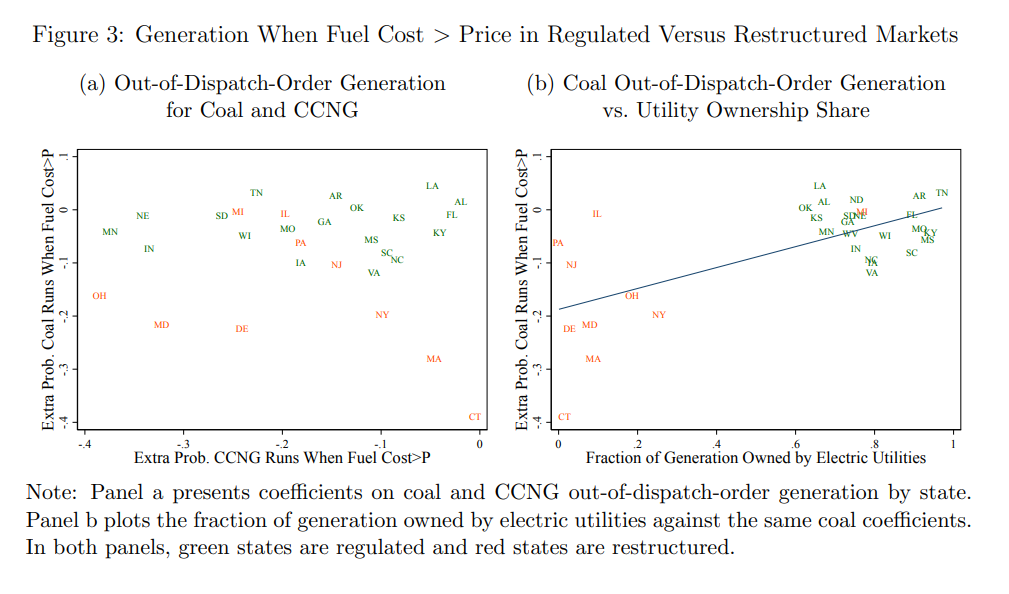
Figure 3 takes a little work to understand, but the pattern is clear. Each point represents a state. In panel A, the vertical axis shows how much less likely a coal plant is to run when the cost of coal exceeds the price of electricity. Obviously, a strongly negative coefficient is the economically sensible response: when burning coal is more expensive than buying electricity, the plant should burn less.
The red points represent restructured states and the green points regulated states. In restructured states coal burning falls when prices fall, just as expected. Coal burning in regulated states responds much less. (I.e., the red points generally lie below the green points.) Indeed, the six states with the largest reductions in coal operation are all restructured states.
One objection to this analysis might be that utilities in general are just slow to respond to prices, so on the horizontal axis the authors plot how well utilities respond to a higher price of gas. Note that these coefficients are all negative and there is no obvious difference between regulated and restructured states. In both types of states, utilities respond well to the price of gas, but only in restructured states do utilities respond strongly to the price of coal. (Why coal and not gas? Because the used-and-useful standard binds on capital whose usefulness is in doubt—which, once gas got cheap, meant coal. In other words, the utilities have to defend coal to the regulators, not gas.)
Panel B on the right shows a slightly different way of presenting the same data. The vertical axis is again how much less likely a coal plant is to run when its cost exceeds the electricity price. The horizontal axis is the fraction of generation owned by electric utilities. Regulated states tend to be vertically integrated, while restructured states opened electricity generation to competition, so utility ownership and regulatory status are closely correlated. Regulated states generally have utility ownership above 60%, while all the restructured states but one are below 30%. The best-fit line slopes upward: in other words, the more generation a state’s utilities own, the less coal dispatch responds to price. A different perspective on the same story.
That is the direct empirical evidence. The authors then construct a more ambitious structural model. In theory, regulation could produce either too much or too little investment in the new technology; their estimates imply too much. Much, too much. Not only do regulated utilities retain too much coal, they also build too much gas capacity. In short, they accumulate both too much old capital and too much new capital. Averch–Johnson on steroids.
The bottom line is that regulation under dynamic conditions is much more difficult than under static conditions. My view is that it may not even be worth the candle.
The post Regulated Markets Are Slow to Handle Change appeared first on Marginal REVOLUTION.


If a regulator struggles to decide whether a live transmission on YouTube should be considered “television,” the real problem may not be the platform, but the rules and the state’s insistence on continuing to apply them.
During the 2026 FIFA World Cup, the Brazilian company LiveMode broadcasted 34 matches for free on YouTube, including every game played by the Portuguese national team, using an advertising and sponsorship-funded model. The initiative drew strong audiences. Yet the company found itself caught in regulatory bureaucracy.
Portugal’s media regulator, the ERC, first classified it as a web TV service and later as an on-demand audiovisual service. The problem is that each classification determines the legal regime that applies and the obligations the company must meet.
This raises a broader issue: whether Europe’s audiovisual framework still reflects today’s digital media landscape, or whether regulators are trying to force new business models into legal categories designed for a completely different technological era.
For most of the 20th century, television regulation had a relatively solid justification. Radio spectrum was scarce. In a genuine context of scarcity, licensing and certain obligations could reasonably be defended as a way to manage a limited resource.
The Internet destroyed that premise. Content distribution no longer depended on scarce infrastructure, and the cost of reaching audiences collapsed. The original justification for state intervention largely disappeared. Instead of recognizing this change and reducing the scope of regulation, the European state did the opposite.
The Audiovisual Media Services Directive (AVMSD) and its national transpositions continue to operate with categories created for the age of scarcity. Whenever a new distribution model appears, the automatic response is to find which legal box it can be fitted into and which obligations can be attached to it.
The same impulse appears in the United Kingdom, where the government proposed requiring private platforms such as YouTube to give greater prominence to BBC content. This is a morally questionable measure: taxpayers are required to fund, through the television license fee, a public channel that the state, acting as both regulator and content producer, now seeks to impose by administrative means on private platforms.
In both cases, the state acts as though the original justification for its intervention (spectrum scarcity) has not disappeared, and its claim to continue organizing the content market remains necessary.
In a free society, state intervention in private economic activity should not be the rule, but the exception that must be justified. This does not mean that no regulation makes sense. Clear rules on the protection of minors, commercial transparency, or competition can remain legitimate.
The problem arises when the original market failure no longer exists and yet the scope of rules created for a different context is maintained or automatically expanded. These rules end up functioning as barriers to entry for new operators. They impose compliance costs such as registration, legal advice, and possible financial contributions that large platforms can absorb. For small companies starting out or experimenting with a new model, those costs weigh much more heavily.
The result is less competition and willingness to experiment with different formats. For consumers, this means fewer alternatives, especially free or lower-cost ones, and a market increasingly dominated by the same large players.
The frequent rhetoric of “public interest” and “pluralism” ends up, in practice, protecting those already established and reducing the options available to the public.
We see this in both the LiveMode case and the British proposals. In Portugal, the regulator focused on classifying and reclassifying a free transmission, creating a process that the company was forced to accept and did so under protest.
In the United Kingdom, the response to technological change was to propose requiring private platforms to prioritize content from a public channel. In neither case did the process begin with a clear demonstration that those specific obligations still address a concrete and proportionate problem for consumers.
Before applying rules created for 20th-century television to new distribution models, regulators should be required to show that those rules still serve a clear and justified public interest. If they cannot do so, the presumption should favor the freedom to experiment rather than the automatic expansion of regulatory power.
Next Page of Stories