71335 stories
·
2 followers

Regulated Markets Are Slow to Handle Change

1 Share

Gowrisankaran, Langer and Reguant have an excellent paper, Energy Transitions in Regulated Markets (WP), in the latest AER.

The basic idea is that regulation designed to prevent utilities from building useless power plants can induce them to keep obsolete power plants. Some background. We regulated electric utilities under the theory that they were natural monopolies and therefore we would do better by pushing their prices down. What’s a reasonable price? Hard to say, so regulated utilities were allowed to recoup their operating costs plus a fair return on their “rate base”—their capital stock. Makes sense, but once profits depended on the size of the capital stock, utilities had an incentive to build too much—the classic Averch–Johnson effect. Regulators responded with “prudence” requirements and the rule that capital must be “used and useful.” In a stable world, that rule is a check, albeit an imperfect check, on so-called gold-plating.

But now consider what happens in a time of technological change, such as a rapid decrease in the cost of generating electricity with natural gas (driven by fracking and improvements in combined-cycle natural-gas (CCNG) technology). In a free market, large decreases in costs would cause firms to abandon coal and move to natural gas—some would do this to make profits, others to avoid losses. In short, the market forces sunk investments to be abandoned when not profitable.

But there is another possibility under regulation. Tell the regulator that your plants are still viable. Well, telling is cheap talk so you keep burning coal to prove that the plant remains useful. If you can keep your base operating that’s better than abandoning it and to signal how valuable your coal plant still is, it may even be worth while to burn coal when the cost exceeds the price of electricity! The authors have some nice data on exactly this point.

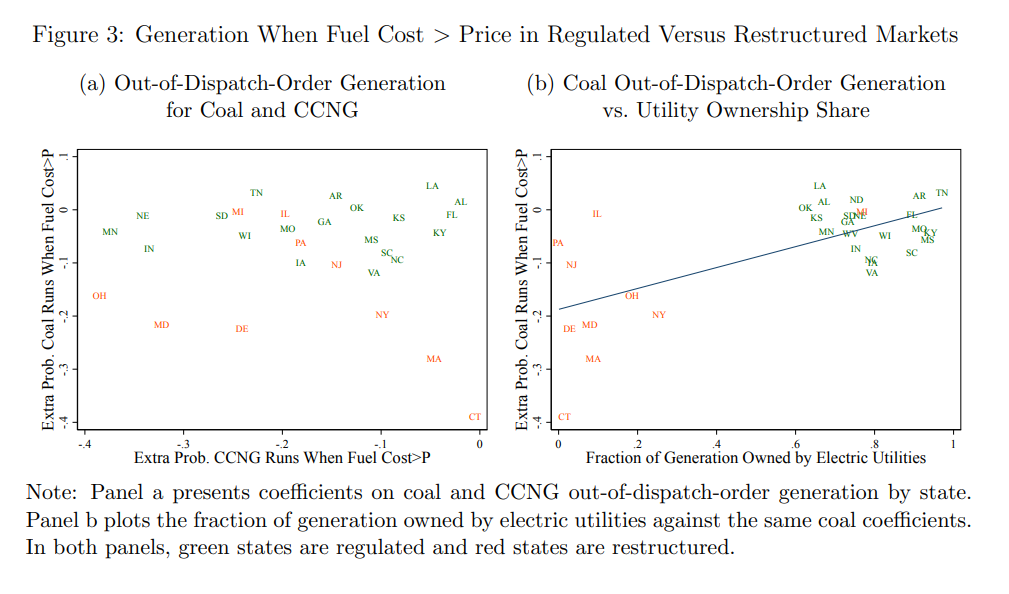
Figure 3 takes a little work to understand, but the pattern is clear. Each point represents a state. In panel A, the vertical axis shows how much less likely a coal plant is to run when the cost of coal exceeds the price of electricity. Obviously, a strongly negative coefficient is the economically sensible response: when burning coal is more expensive than buying electricity, the plant should burn less.

The red points represent restructured states and the green points regulated states. In restructured states coal burning falls when prices fall, just as expected. Coal burning in regulated states responds much less. (I.e., the red points generally lie below the green points.) Indeed, the six states with the largest reductions in coal operation are all restructured states.

One objection to this analysis might be that utilities in general are just slow to respond to prices, so on the horizontal axis the authors plot how well utilities respond to a higher price of gas. Note that these coefficients are all negative and there is no obvious difference between regulated and restructured states. In both types of states, utilities respond well to the price of gas, but only in restructured states do utilities respond strongly to the price of coal. (Why coal and not gas? Because the used-and-useful standard binds on capital whose usefulness is in doubt—which, once gas got cheap, meant coal. In other words, the utilities have to defend coal to the regulators, not gas.)

Panel B on the right shows a slightly different way of presenting the same data. The vertical axis is again how much less likely a coal plant is to run when its cost exceeds the electricity price. The horizontal axis is the fraction of generation owned by electric utilities. Regulated states tend to be vertically integrated, while restructured states opened electricity generation to competition, so utility ownership and regulatory status are closely correlated. Regulated states generally have utility ownership above 60%, while all the restructured states but one are below 30%. The best-fit line slopes upward: in other words, the more generation a state’s utilities own, the less coal dispatch responds to price. A different perspective on the same story.
That is the direct empirical evidence. The authors then construct a more ambitious structural model. In theory, regulation could produce either too much or too little investment in the new technology; their estimates imply too much. Much, too much. Not only do regulated utilities retain too much coal, they also build too much gas capacity. In short, they accumulate both too much old capital and too much new capital. Averch–Johnson on steroids.

The bottom line is that regulation under dynamic conditions is much more difficult than under static conditions. My view is that it may not even be worth the candle.

The post Regulated Markets Are Slow to Handle Change appeared first on Marginal REVOLUTION.

Read the whole story
gangsterofboats
10 minutes ago
reply
Share this story
Delete

When 20th-Century Regulations Meet 21st-Century Streaming

1 Share

If a regulator struggles to decide whether a live transmission on YouTube should be considered “television,” the real problem may not be the platform, but the rules and the state’s insistence on continuing to apply them.

During the 2026 FIFA World Cup, the Brazilian company LiveMode broadcasted 34 matches for free on YouTube, including every game played by the Portuguese national team, using an advertising and sponsorship-funded model. The initiative drew strong audiences. Yet the company found itself caught in regulatory bureaucracy.

Portugal’s media regulator, the ERC, first classified it as a web TV service and later as an on-demand audiovisual service. The problem is that each classification determines the legal regime that applies and the obligations the company must meet.

This raises a broader issue: whether Europe’s audiovisual framework still reflects today’s digital media landscape, or whether regulators are trying to force new business models into legal categories designed for a completely different technological era.

For most of the 20th century, television regulation had a relatively solid justification. Radio spectrum was scarce. In a genuine context of scarcity, licensing and certain obligations could reasonably be defended as a way to manage a limited resource.

The Internet destroyed that premise. Content distribution no longer depended on scarce infrastructure, and the cost of reaching audiences collapsed. The original justification for state intervention largely disappeared. Instead of recognizing this change and reducing the scope of regulation, the European state did the opposite.

The Audiovisual Media Services Directive (AVMSD) and its national transpositions continue to operate with categories created for the age of scarcity. Whenever a new distribution model appears, the automatic response is to find which legal box it can be fitted into and which obligations can be attached to it.

The same impulse appears in the United Kingdom, where the government proposed requiring private platforms such as YouTube to give greater prominence to BBC content. This is a morally questionable measure: taxpayers are required to fund, through the television license fee, a public channel that the state, acting as both regulator and content producer, now seeks to impose by administrative means on private platforms.

In both cases, the state acts as though the original justification for its intervention (spectrum scarcity) has not disappeared, and its claim to continue organizing the content market remains necessary.

In a free society, state intervention in private economic activity should not be the rule, but the exception that must be justified. This does not mean that no regulation makes sense. Clear rules on the protection of minors, commercial transparency, or competition can remain legitimate.

The problem arises when the original market failure no longer exists and yet the scope of rules created for a different context is maintained or automatically expanded. These rules end up functioning as barriers to entry for new operators. They impose compliance costs such as registration, legal advice, and possible financial contributions that large platforms can absorb. For small companies starting out or experimenting with a new model, those costs weigh much more heavily.

The result is less competition and willingness to experiment with different formats. For consumers, this means fewer alternatives, especially free or lower-cost ones, and a market increasingly dominated by the same large players.

The frequent rhetoric of “public interest” and “pluralism” ends up, in practice, protecting those already established and reducing the options available to the public.

We see this in both the LiveMode case and the British proposals. In Portugal, the regulator focused on classifying and reclassifying a free transmission, creating a process that the company was forced to accept and did so under protest.

In the United Kingdom, the response to technological change was to propose requiring private platforms to prioritize content from a public channel. In neither case did the process begin with a clear demonstration that those specific obligations still address a concrete and proportionate problem for consumers.

Before applying rules created for 20th-century television to new distribution models, regulators should be required to show that those rules still serve a clear and justified public interest. If they cannot do so, the presumption should favor the freedom to experiment rather than the automatic expansion of regulatory power.

Read the whole story
gangsterofboats
15 minutes ago
reply
Share this story
Delete

Can the WNBA Define a Woman?

1 Share
Two former NBA stars declare themselves eligible for the league’s draft, forcing a reckoning over gender identity in women’s basketball.

Read the whole story
gangsterofboats
25 minutes ago
reply
Share this story
Delete

Great Story—But Is It True?

1 Share
Journalists and academics are most vulnerable to being fooled when presented with narratives that confirm what they already believe.

Read the whole story
gangsterofboats
26 minutes ago
reply
Share this story
Delete

AI Can’t Replace Human Judgment

1 Share
A new book argues that the future of work belongs to judgment, accountability, and trust—not just intelligence.

Read the whole story
gangsterofboats
26 minutes ago
reply
Share this story
Delete

Quotation of the Day…

1 Share

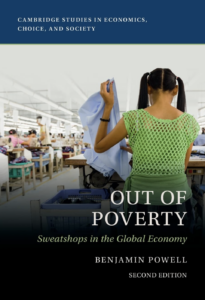
is from page xvi of the Second Edition (2025) of GMU alum Benjamin Powell’s excellent book Out of Poverty: Sweatshops in the Global Economy:

The laws of economics do not put “profits over people.” They dictate which policies will help poor workers and which policies will harm them.

DBx: Yes.

And pick any randomly chosen policy today peddled by either the progressive left or the MAGA right and you will likely pick a policy that, although marketed as helping the poor, actually hurts the poor.

The post Quotation of the Day… appeared first on Cafe Hayek.

Read the whole story
gangsterofboats
26 minutes ago
reply
Share this story
Delete
Next Page of Stories