Log in


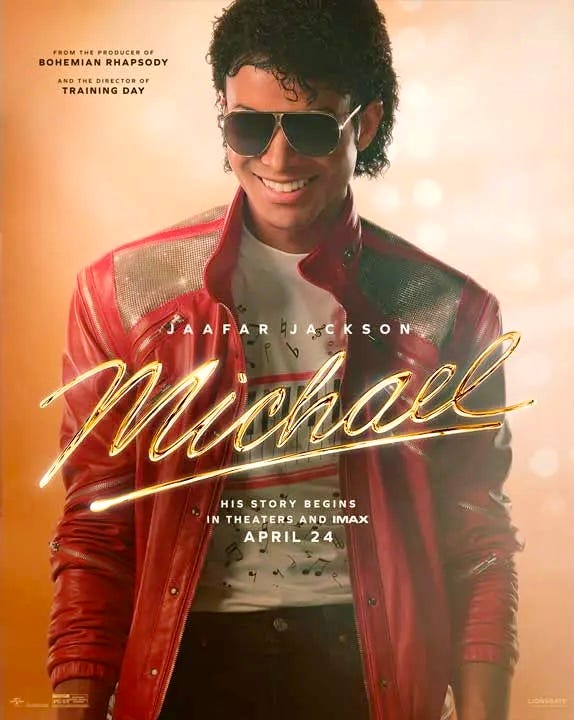
Michael is an intelligent film about an indelible pop singer, songwriter and dancer and it’s best thought of this way. It’s a simple, quiet, layered movie by director Antoine Fuqua written by John Logan (Hugo, The Aviator) that’s as softspoken as its subject.
Tightly focused on the essence of an artist, Michael examines as it asks the audience to contemplate one of the most influential artists of ability in the 20th century. His name is Michael Jackson. He died at the age of 50 on June 25th, 2009. His life was tragic, like the lives of many popular artists of ability, particularly Marilyn Monroe, Elvis Presley and Whitney Houston. Michael rightly and defiantly depicts Michael Jackson at his best—as America’s archetypical self-made man—not at his worst or most eccentric. Jackson was certainly flawed by all the evidence and you’re free to judge and come to your own conclusions based on facts in evidence. But you’re not free to be narrow-minded when watching Michael, which demands you take the whole man as he was, not as the disembodied freak Netflix or others would have you believe.
Michael begins in 1966 after a setup which will close the picture in 1988. In this remarkable 22-year period, Michael depicts the story of Jackson’s life. Gradually, it’s a coming-of-age altruistic climax to counter his sweetness and softness, which had by then begun to crystallize, harden and warp into a pre-courageous blend of delusion, isolation, pent-up anger, internalized shame, guilt, fear and doubt. Everything was about to explode.
Through it all, Michael’s soul remains the same. This is no easy accomplishment and it’s not to be taken lightly. The talented black boy from Gary, Indiana is exploited, shaped and controlled by his steelworker father in a large family of boys and girls tended to by their religious mother. Somehow, Michael crafts his own way of being in his own light during his dad’s boy band masterminding. He finds himself forging tenderness born of his unique ability to feel the music and express himself.
His mother (Nia Long) gives this space. His siblings—Janet has been erased, possibly for legal reasons—obey the patriarch (Colman Domingo) in the regimented Hoosier household. Later, after moving to the Jackson Five success-fed famous San Fernando Valley compound, one man—Motown businessman Berry Gordy, an underestimated American hero and Midwestern titan of industry—recognizes and affirms Michael’s wholesomeness as he seeks to protect and guide the boy based on reason—as against deforming the child with authority, cruelty and the rule of religious orthodoxy. Larenz Tate shines as Gordy. If Michael has flaws, one of them is downsizing Gordy’s role.
This comes after Motown’s beautiful, intelligent Suzanne De Passe (Laura Harrier) discovers the child star. Later, in another layer in this fascinating portrait, another man—Bill Bray (KeiLyn Durrel Jones in a subtle, excellent, Oscar-worthy performance)—both bears witness and watches over Michael in mind and body in a crucial part of writer John Logan’s and director Fuqua’s mosaic of men of ability rallying around the century’s most enigmatic pop star.
Michael’s strapped by his oppressor and limited by the tyranny of family, tradition and religion. In songs you’ll know and relish, amply and generously sampled, if not fully depicted, Michael foremost showcases the magic, worth and value of Michael Jackson and his remarkable career without delving into affiliations with Diana Ross, Elizabeth Taylor and the pivotal if underexplored role of the late Quincy Jones.
And others. This movie, Michael—a huge hit for Lionsgate in spite of critics’ diatribes—centers on Jackson’s vitality and self-realization in becoming his own man in his own way. Jaafar Jackson as Michael Jackson is good, performing with a general sensibility, recreating fabulous movements and moments in Jackson’s pre-abuse allegations career. With an arc of Off the Wall, Thriller and Bad, Jackson works through the plot’s conflict—overcoming his father’s radically Kantian ethics of altruism as moral duty—with tragic and, ultimately, deadly consequences. Personally, I wanted glimpses of “Rock With You,” “Heal the World,” “Billie Jean,” “Black or White” and “Smooth Criminal,” but Michael’s behind the scenes scenes of choreographing “Beat It” astonish in detail, entertainment and craftsmanship—Jackson’s intelligence as a songwriter, dancer and producer is on display and undeniable.
As a single-minded recording industrialist, Miles Teller (Whiplash) delivers the best dramatic scene in Michael. It’s a brilliant, almost spiritual, exchange between artist—singer, songwriter, dancer—and patron of the arts, a man named John Branca, who helps Michael Jackson break free from familial imprisonment. The scene’s a breakthrough for the pop star; a rare moment in his life, according to this version, in which the compliant and submissive star begins to assert himself and practice the virtue of selfishness.
Miles Teller’s performance in the scene is remarkable. Watch closely as he does something that’s virtually extinct in today’s Hollywood conferences: he looks like a laser at the only person in the room who truly, objectively matters—the individual whose life and work is at stake in the meeting—and he ruthlessly ignores everyone else to their instantaneous and unanimous disgust and consternation.
But, contrary to Hollywood’s stereotypical portrayal of the businessman as seedy, sleazy and salacious, Teller’s character looks upon the artist with warmth, kindness and deeply shared values—reflecting the very softness Michael Jackson feels inside—and, for the first time, the multimillionaire superstar feels mirrored, removing his mask (his sunglasses) and looking upon his new ally with a kind of hope, glow and wonder. It’s as if Michael Jackson discovers his ego for the first time. The rest of Michael, even with the tragic climax of what anyone who’s studied Michael Jackson’s tragic flaw knows is coming, affords a rich and unforgettable reward.
Michael depicts the Michael Jackson you know, watch, listen to and admire in awe; that fusion of pause, pride and passion for being alive within a childlike soul who knows—and performs—his own beauty, strength and restraint.