68222 stories
·
3 followers

Who owns you? Part II

1 Share

Who Owns You? Part II

Part I exposed the unnamed premise of laws against assisted suicide: the government owns you; no one can assist you in ending your life because that would be aiding the destruction of government property.

Harry’s Substack is a reader-supported publication. To receive new posts and support my work, consider becoming a free or paid subscriber.

But if your mind, body, and life are yours by right, then you do have the right to end your life. And, accordingly, you have the right to whatever help in ending your life that others are willing to give.

Part II extends the principle from getting help in dying to getting help in staying alive.

Just as the government cannot interfere with those who would help you end your life, so the government cannot interfere with those who would provide you with the means of continuing your life: the inventors of new medical devices and of new medicines.

Concretely, this means: the Food and Drug Administration (FDA) must be abolished.

It’s your life to end and your life to sustain. Why must you wait for the permission of the state before you can take a new drug?

You know the common answer:

“Oh, it’s not we sensible people who have to be stopped; it’s Loony Louie and Mindless Marvin---they would swallow snake oil and patronize quacks.”

And that’s the whole argument. For that, millions have died prematurely.

Note well: it is not ignorance but irrationality to which we are being sacrificed. Most of us are ignorant regarding the complexities of medical issues, but we proceed rationally: we get the advice of professionals.

The FDA exists to protect the irrational—those who would not seek professional advice and would not even bother to check online or with AI, but would just lurch blindly into self-destructive acts.

To stop these people from acting irrationally, the rest of us are forbidden to act rationally.

Here’s what the regulators might say to you if they gave voice to the agency’s actual roots and meaning:

“A new drug or new medical device could save your life? You’ve researched it, checked with your doctor, and want to try it? Too bad, you can’t. Maybe in 8 years we will give permission for its use. What’s that you say? ‘Then it will be too late?’ Not our problem.”

Let’s allow for the sake of argument that the current staff of the FDA does know better than the average doctor, better than WebMD, better than ChatGPT. Nothing stops the FDA from publishing its opinions and advice. But why is the majority opinion at the FDA something to be imposed on us by force?

That coercive element is the killer. Dissenters from the FDA opinion are not allowed to go their own way, and act against the FDA’s view.

Peter Schwartz gives this example of the situation:

. . . clinical data showed that Iressa, a drug for lung cancer, shrank tumors among certain people . . . Nonetheless, several years after approving it, the FDA banned its use for all new patients because, as noted in a news story, the drug “did not prolong lives in the lung cancer population as a whole.” . . .

Accordingly, even if you are among those who are helped by a drug---even if you are dying and the drug is your only hope---you will not be permitted to take any medicine deemed detrimental to the “population as a whole.”
[The Tyanny of Need, 160-161.]

There’s no difference in principle between the FDA ruling that a drug cannot be marketed and the 17th century Church ruling that Galileo could not publish his heliocentric theory of the solar system. Either there’s forced conformity to authority or there isn’t. It doesn’t matter whether it’s forced conformity to religion or to someone’s scientific views. It doesn’t matter whether the view is right or wrong, there’s no justification on earth for imposing it by force.

Others may inform you, advise you, warn you, but they have no right to issue you orders, backed up by a gun---which is exactly what the FDA does.

Since the law can’t read: “It shall be illegal to make foolish medical decisions,” the only way to save the irrational from the consequences of their irrationality is to coerce everyone. Some would act self-destructively, so all must surrender their freedom. Some would act self-destructively, so new, life-saving drugs and devices cannot be sold until and unless, many years after their development and testing on animals, a government-appointed board gives its permission.

This is preventive law: what is not expressly authorized is forbidden. Prove your innovation is not dangerous, despite your in-house test data, despite some people’s desperate need of it, despite totally informed consent.

Preventive law is utterly immoral. It holds the individual guilty until proven innocent. It subordinates doctors and scientists to political appointees. It expresses contempt for the doctor’s mind, for the scientist’s mind, and for your mind.
Next: The FDA vs. medical progress

Harry’s Substack is a reader-supported publication. To receive new posts and support my work, consider becoming a free or paid subscriber.


Read the whole story
gangsterofboats
1 hour ago
reply
Share this story
Delete

5 Things You Should Know About the Latest Bari Weiss 60 Minutes Controversy

1 Share
CBS News Editor in Chief Bari Weiss in front of an orange background with the 60 Minutes logo | Illustration: Eddie Marshall | Alberto E. Tamargo | Sipa USA | Newscom | Nano Banana

CBS News Editor in Chief Bari Weiss intervened to prevent 60 Minutes from airing a segment on the notorious CECOT prison in El Salvador, and her many critics elsewhere in the media are worried that there's one obvious reason for such a call: appeasing President Donald Trump. Defenders of Weiss, on the other hand, note that it's perfectly typical for an editor to offer feedback on a piece of journalism and demand changes—better sourcing, comments from government officials, etc.—before it's ready to run.

Who's right? This is one of those cases where people on both sides have made at least a few reasonable points—though there's no getting around the overarching concern that flattering Trump's ego is becoming all too powerful a motivating factor for media corporations. Here are five thoughts on the matter.

1. On the pro-Weiss side, it's true that her editorial notes are not particularly unreasonable.

Frustrating as it can be for a writer, reporter, or commentator to be forced by their boss to work harder to advance a story, demanding editors often require them to do just that. Anyone who has worked with Weiss in the past knows that she is an extremely demanding editor. She often has a strong view of what she expects from a piece and is perfectly comfortable asking for rewrite after rewrite until it's exactly what she wants. (And yes, I speak from personal experience.)

2. Weiss' main ask was that 60 Minutes work harder to get on-the-record comments from Trump administration officials. She also wanted the segment to advance the story in some way, given that the harsh conditions at CECOT have already been widely reported in mainstream media. Critics have said that the first demand is ridiculous, since a journalist obviously can't sit on a story forever if the relevant government officials are refusing to comment. Yet Axios reported that Trump officials did offer comment; 60 Minutes merely declined to include the comment in the segment. In his Reliable Sources newsletter, CNN's Brian Stelter reported that the comment was "a provocative jab at the media" and thus 60 Minutes' Sharyn Alfonsi decided not to use it. That strikes me as a mistake.

3. As for the idea that the segment didn't add much to the CECOT story, viewers can be the judge of that. The segment actually aired by mistake on a Canadian television app and can be watched here. Having seen it, my take is that the segment was perfectly OK as-is and wholly consistent with the usual 60 Minutes product—which is to say that it was hardly groundbreaking. Alfonsi could have certainly done more to make the segment more powerful, and Weiss' notes were inoffensive; the extremely last-minute decision to cancel an already approved piece and request significantly more reporting and comment, however, does seem a tad unreasonable.

4. It is nevertheless the case, as Washington Post columnist Megan McArdle points out, that many people who work at CBS News dislike Weiss both personally and ideologically, and have all sorts of frustrations that have nothing to do with the editorial output of 60 Minutes.

5. Trump's pathological fixation on 60 Minutes, and his insistence that CBS News' new bosses make the content friendlier to his administration, is relevant context that simply cannot be ignored. Trump balked at a 60 Minutes interview with Rep. Marjorie Taylor Greene (R–Ga.), a Trump friend turned critic, that was totally in bounds as a legitimate subject for the program: He stated plainly that the network's new owners, his "friends" the Ellisons, were worse than the old owners. The Ellisons would like to beat Netflix in the race to acquire Warner Bros., and the deal may very well hinge on which company is friendlier toward the president. These are disastrous incentives for a free media, but they are downstream of the federal government's power to thwart corporate mergers and acquisitions.

As I said previously, progressive fans of antitrust are getting precisely what they want: government oversight of large media organizations and close scrutiny of their editorial products. The idea that this oversight would necessarily be about what's good for consumers rather than what's good for government leaders is a false notion that Trump's very public corruption has laid bare.


This Week on Free Media

We're off this week, so instead I'd recommend you check out Freed Up, my new video podcast with Reason Reporter Christian Britschgi!


Worth Watching

I am closing out 2025, quite appropriately, with The Last Death of the Year, one of the new Hercule Poirot mysteries by Sophie Hannah, who has continued Agatha Christie's famous mystery series. Longtime readers know that I am a voracious consumer of all things Poirot and have eagerly awaited this title's release. Long live Poirot, and happy New Year to all!

The post 5 Things You Should Know About the Latest Bari Weiss <i>60 Minutes</i> Controversy appeared first on Reason.com.

Read the whole story
gangsterofboats
1 hour ago
reply
Share this story
Delete

Politicians Say AI Data Centers Are Driving Up Electricity Costs. That's Not How Energy Prices Work.

2 Shares
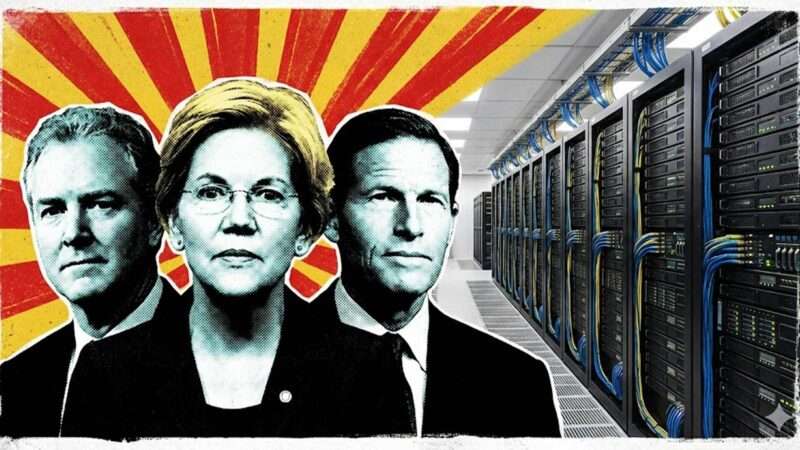
An illustration of politicians and a data center | Illustration: Eddie Marshall | Nano Banana

A simple story has taken hold in American politics: Big Tech is consuming vast amounts of electricity to power artificial intelligence, and ordinary households are paying the price.

It's a tidy narrative with a villain, a victim, and a moral. It also happens to be wrong.

The Conclusion Came First

In Washington, in statehouses, and increasingly in town halls, data-center projects are being stalled or blocked by communities convinced they're about to be priced out of their own electricity. Fear is outrunning evidence. Demand is cast as the problem and technology as the threat. Energy abundance is presented as something to fear rather than build.

That belief now has institutional backing.

Sen. Elizabeth Warren (D–Mass.) has opened a Senate investigation into whether AI data centers are driving up Americans' electricity bills—but the verdict is already baked in. In letters sent to utilities and hyperscalers, Warren and other Senate Democrats allege that rapid growth in data-center demand is forcing costly grid upgrades and shifting those costs onto households. One utility, Indiana Michigan Power, estimates it will spend $17 billion to meet projected data-center demand—costs Warren suggests will land on ratepayers. 

"Data centers' energy usage has caused residential electricity bills to skyrocket," the Senate Democrats said, adding that utilities are "passing the extra costs onto their customers." Demand, they argue, is pushing prices out of control.

Across the country, local governments are absorbing the same message and translating it into vetoes. Projects are delayed. Permits denied. A national policy failure is reframed as a local act of self-defense.

AI and energy have become the twin boogeymen of modern politics. AI is blamed for coming after jobs and truth. Energy is blamed for coming after the planet and household budgets. Combine the two in a single facility and you get the perfect villain, one that requires no examination of regulatory choices or supply-side constraints. Someone else can always be blamed.

But when you understand how electricity pricing actually works, the story collapses almost immediately.

Mistaking Use for Shortage

Blaming data centers for rising electricity prices is like blaming FedEx for the cost of gasoline. Demand didn't fail. Supply was boxed in.

Electricity is a capital-heavy business. Most of what consumers pay for isn't the power itself, but the infrastructure that produces and delivers it: generation, transmission, substations, and distribution. Once that infrastructure exists, the marginal cost of serving additional load is relatively low. What makes electricity expensive isn't use. It's underuse.

For this reason, steady demand has historically driven prices down, not up. When more electricity flows across the same wires, fixed costs are spread over more kilowatt-hours. Utilities recover investments more efficiently, and per-unit costs fall.

Recent research from Lawrence Berkeley National Laboratory examined state-level data from 2019 to 2024. The lab found that states with higher electricity demand growth generally experienced smaller increases in retail prices. In some cases, prices declined outright.

A separate 2025 analysis by Energy and Environmental Economics reached a similar conclusion. Large-load customers often pay more than the minimum cost required to serve them, generating surplus revenue that utilities can use for grid upgrades without raising residential rates. In California, PG&E has projected that incremental data-center growth could reduce average household bills by up to 2 percent.

Data centers fit this model unusually well. They draw power continuously, not in short, spiky bursts like air conditioning on a hot summer afternoon. A 100-megawatt facility runs like a small industrial city, but one with predictable demand and long planning horizons. Utilities can build around it.

And they do. In many regions, hyperscalers pay industrial rates and cover the full cost of the infrastructure built to serve them, including new substations, upgraded transformers, and transmission expansions that remain part of the grid long after a project is complete. In northern Virginia, large data center customers cover roughly 9 percent of transmission costs, helping keep residential transmission rates below the national average. In Mississippi, revenue from large data-center loads has funded grid modernization without raising household rates.

This is not theoretical. It's how grids stay solvent.

The investigation's central assumption—that more electricity use must mean higher bills—confuses consumption with scarcity. Prices rise only when supply can't respond.

How Politics Choked the Power Supply

If rising demand isn't the culprit, then why are electricity prices climbing? The answer isn't technological. It's political.

For decades, policymakers have systematically constrained the supply side of American energy. New power plants take years, sometimes decades, to permit. Transmission lines spend longer in court than they do under construction. Baseload generation, nuclear most of all, has been treated as a moral failure rather than an engineering necessity. Capacity is retired faster than it can be replaced.

Layer on an aging grid, wildfire liability, storm hardening, fuel volatility, and renewable mandates imposed without sufficient transmission, and the real drivers of higher bills come into focus. These are policy costs, not market ones.

Policymakers are scapegoating demand to avoid reckoning with the consequences of their own decisions. Not long ago, states competed to offer data centers sweetheart deals: tax breaks, land, discounted power. Now those same projects are treated as parasites, accused of inflating household bills and draining public resources. 

Local governments mistake obstruction for protection. Town councils believe they're defending residents from price spikes rather than blocking the very investments that would stabilize and modernize their grids. A national failure of energy policy becomes a culture of local veto.

Build, Baby, Build

When a data center comes to town and panic erupts, the answer isn't subsidies or scapegoats. The answer is to build.

Build power. Build transmission. Build enough capacity that demand stops being mistaken for a threat.

Electricity isn't a luxury good. It's the lifeblood of a modern economy. When you ration electrons, you don't just slow growth. You ration cancer care. You ration MRI time. You ration the computing power that lets doctors see earlier, diagnose faster, and treat more precisely.

When you throttle back power, you don't just protect scenery. You turn off the steam that lets a quadriplegic speak through a computer. You limit the systems that translate thought into movement, movement into independence.

More intelligence, more medicine, and more industry all require more energy. You don't get progress by pretending otherwise. You just decide who goes without it first. 

Energy abundance isn't something to tolerate. It's the fuel for every serious ambition we have.

If we don't build it here, someone else will. China already has.

The post The Data Center Price Myth appeared first on Reason.com.

Read the whole story
gangsterofboats
1 hour ago
reply
Share this story
Delete

Why the Economic Impact of Immigration Restrictions is Similar to that of Racial Discrimination and Apartheid

1 Share
South African apartheid sign. (NA)


In an insightful recent post, economist Tarnell Brown explains why the economic effects of immigration restrictions are similar to those of racial discrimination and segregation. He builds on Nobel Prize winner Gary Becker's famous theory of discrimination and South African economist W.H. Hutt's classic critique of apartheid, The Economics of the Colour Bar:

Racism and immigration restrictions are often sold as hard-headed realism: protecting "our" jobs, "our" communities, "our" way of life. The sales pitch leans on a simple story—exclude the "wrong" people and the "right" people will prosper. Gary Becker and William Hutt both spent careers dismantling that story, and the empirical record has been quietly backing them up ever since. Once you translate prejudice into costs, discrimination looks less like realism and more like an especially expensive luxury good.

As Brown explains, Becker and Hutt's insights explain that racial discrimination and segregation are economically harmful because they force employers to forego more productive workers from the disfavored group in favor of less productive ones from the dominant group. That obviously harms the excluded group. But it also lowers economic growth and innovation, ultimately harming even most members of the more privileged group. Immigration restrictions have much the same effects:

If Becker's discriminator is willing to pay more for the same output, and Hutt's white unionist is willing to shrink the industry to protect his wage, immigration restrictionists are willing to shrink the labor force itself. The logic is familiar: fewer immigrants mean less competition for "our" jobs and higher wages for native workers. The empirical record looks more like a modern color bar.

Contemporary studies highlight three mechanisms.

· Slower labor force growth. Immigrants have been the main driver of U.S. labor force expansion for decades. Tightening legal channels and ramping up enforcement reduces the number of working-age adults, especially in sectors with high demand and few native applicants, depressing potential GDP growth.

· Sectoral bottlenecks. When immigration restrictions bite hardest in agriculture, caregiving, hospitality, and construction, employers either cut back output, automate, or simply cannot meet demand. The result is higher prices, delayed projects, and foregone economic activity—not some clean transfer of "jobs from them to us."

· Innovation and entrepreneurship. Immigrants are disproportionately represented among patent holders, startup founders, and STEM workers. Curtailing inflows therefore clips not just current output but future growth, by lowering the rate at which new products, firms, and technologies appear.

The historical analogy to Hutt's South Africa is not rhetorical. The Chinese Exclusion Act of 1882, a classic piece of racially explicit labor protectionism, offers a clean test case. Recent research finds that areas that lost Chinese workers experienced dramatic declines in manufacturing—output down more than 60%, the number of establishments down 54–69%—as labor shortages rippled through the local economy. White workers were not "protected"; they were stranded in less dynamic labor markets with fewer opportunities and slower wage growth.

The modern U.S. has not reenacted Chinese Exclusion word-for-word, but the pattern is similar: a tightening of legal migration channels and aggressive enforcement campaigns in the name of "protecting" native workers. The Dallas Fed and others now warn that declining immigration will weigh on GDP growth for years, with little to show in terms of sustained wage gains for the least skilled natives. In Becker's terms, the country is paying more for the same work; in Hutt's terms, it is choosing a smaller pie so that a political coalition can claim symbolic victories.

I mad similar points - in a less sophisticated way - in a 2024 post on how mass deportations destroy more jobs for native-born Americans than they create:

The key theoretical point is that, while deporting immigrants often does create jobs for natives who directly compete with them, it destroys more elsewhere in the economy. For example, immigrant workers produce goods that are used by other enterprises, thereby creating jobs there. Immigrants start new businesses at higher rates than natives. That, in turn, creates new jobs for both natives and immigrants. And, of course, immigrant workers produce goods and services that greatly improve the options available to native-born consumers (thereby indirectly making them wealthier)….

One helpful way to think about the issue is to ask whether the twentieth-century expansion of job market opportunities for women and blacks helped white male workers, on net, or harmed them. Some white men likely were net losers. If you were a marginal white Major League Baseball player displaced by Jackie Robinson or other black baseball stars after MLB was integrated, it's possible that you would never find another job you liked as much as that one. But the vast majority of white men were almost certainly net beneficiaries by virtue of the fact that opening up opportunities for women and blacks greatly increased the overall wealth and productivity of society.

If, today, we barred women from the labor force, or restricted them to the kinds of jobs open to them a century ago, some male workers would benefit. For example, freed of competition from female academics, I might get a pay increase or become a professor at a higher-ranked school.

But, overall, men would be much poorer, by virtue of living in a far less productive and innovative society. And many men would lose jobs or suffer decreases in wages because their own productivity depends in part on goods and services produced by women. While I might have a more prestigious job, I would likely be poorer, overall, because I could no longer benefit from many of the goods, services, and innovations produced by female workers.

Similar consequences would occur if we were to reinstitute racial segregation, thereby severely restricting the job opportunities of black workers. While some whites would come out ahead, most would be net losers, as our economy becomes much less productive.

The key point to remember is that the economy - including the labor market - is not a zero-sum game. Men and women, blacks and whites - and immigrants and natives - can all prosper together, if only the government would let them.

Economic effects are not the only way in which immigration restrictions resemble racial segregation. The two policies are also both unjust by virtue of restricting freedom and opportunity based on morally arbitrary circumstances of ancestry and birth. I develop and defend that point in this article, and in Chapter 5 of my book Free to Move: Foot Voting, Migration, and Political Freedom.

The post Why the Economic Impact of Immigration Restrictions is Similar to that of Racial Discrimination and Apartheid appeared first on Reason.com.

Read the whole story
gangsterofboats
1 hour ago
reply
Share this story
Delete

Why College Students Prefer Socialism—and Why They're Wrong

1 Share
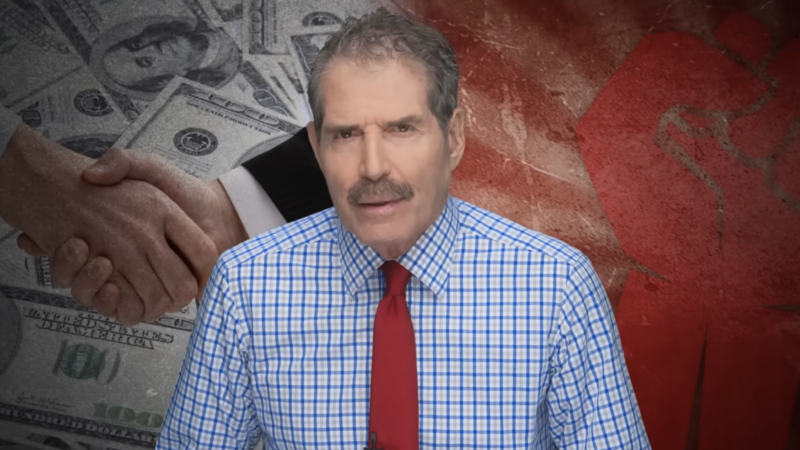
John Stossel stands in front of a handshake and a power sign | Stossel TV

People criticize capitalism. A recent Axios-Generation Lab poll says, "College students prefer socialism to capitalism."

Why?

Because they believe absurd myths. Like the claim that the Soviet Union "wasn't real socialism."

Socialism guru Noam Chomsky tells students that. He says the Soviet Union "was about as remote from socialism as you could imagine."

Give me a break.

The Soviets made private business illegal.

If that's not socialism, I'm not sure what is.

"Socialism means abolishing private property and…replacing it with some form of collective ownership," explains economist Ben Powell. "The Soviet Union had an abundance of that."

Socialism always fails. Look at Venezuela, the richest country in Latin America about 40 years ago. Now people there face food shortages, poverty, misery, and election outcomes the regime ignores.

But Al Jazeera claims Venezuela's failure has "little to do with socialism, and a lot to do with poor governance….Economic policies have failed to adjust to reality."

"That's the nature of socialism!" exclaims Powell. "Economic policies fail to adjust to reality. Economic reality evolves every day. Millions of decentralized entrepreneurs and consumers make fine tuning adjustments."

Political leaders can't keep up with that.

Still, pundits and politicians tell people, socialism does work—in Scandinavia.

Mad Money's Jim Cramer calls Norway "as socialist as they come!"

This too is nonsense.

"Sweden isn't socialist," says Powell. "Volvo is a private company. Restaurants, hotels, they're privately owned."

Norway, Denmark, and Sweden are all free market economies.

Denmark's former prime minister was so annoyed with economically ignorant Americans like Bernie Sanders calling Scandinavia "socialist," he came to America to tell Harvard students that his country "is far from a socialist planned economy. Denmark is a market economy."

Powell says young people "hear the preaching of socialism, about equality, but they don't look on what it actually delivers: poverty, starvation, early death."

For thousands of years, the world had almost no wealth creation. Then, some countries tried capitalism. That changed everything.

"In the last 20 years, we've seen more humans escape extreme poverty than any other time in human history, and that's because of markets," says Powell.

Capitalism makes poor people richer.

Former Rep. Jamaal Bowman (D–N.Y.) calls capitalism "slavery by another name."

Rep. Alexandria Ocasio-Cortez (D–N.Y.) claims, "No one ever makes a billion dollars. You take a billion dollars."

That's another myth.

People think there's a fixed amount of money. So when someone gets rich, others lose.

But it's not true. In a free market, the only way entrepreneurs can get rich is by creating new wealth.

Yes, Steve Jobs pocketed billions, but by creating Apple, he gave the rest of us even more. He invented technology that makes all of us better off.

"I hope that we get 100 new super billionaires," says economist Dan Mitchell, "because that means 100 new people figured out ways to make the rest of our lives better off."

Former Labor Secretary Robert Reich advocates the opposite: "Let's abolish billionaires," he says.

He misses the most important fact about capitalism: It's voluntary.

"I'm not giving Jeff Bezos any money unless he's selling me something that I value more than that money," says Mitchell.

It's why under capitalism, the poor and middle class get richer, too.

"The economic pie grows," says Mitchell. "We are much richer than our grandparents."

When the media say the "middle class is in decline," they're technically right, but they don't understand why it's shrinking.

"It's shrinking because more and more people are moving into upper income quintiles," says Mitchell. "The rich get richer in a capitalist society. But guess what? The rest of us get richer as well."

I cover more myths about socialism and capitalism in my new video.

COPYRIGHT 2025 BY JFS PRODUCTIONS INC.

The post Why College Students Prefer Socialism—and Why They're Wrong appeared first on Reason.com.

Read the whole story
gangsterofboats
1 hour ago
reply
Share this story
Delete

The Logical Consequence of Enforcing Indigenous Treaties

1 Share

A few weeks ago, the Free Press published a remarkable story about legal developments in Canada. In short, a judge ruled that the indigenous Cowichan Nation holds superior title over an 800 acre plot of land, based on claims from the 19th century. People who previously owned that land in fee simple now hold it subject to a servitude by the Nation.

After an 11-year legal battle and a 513-day trial that is the longest in Canadian history, a judge ruled in August that the indigenous Cowichan Nation holds "Aboriginal title" over 800 acres of land—including a swath along Road No. 6 that includes Batth's house and fields. The decision was a seismic shift in Canadian property law, declaring for the first time that indigenous land rights are greater than the rights held by private owners like Batth. It seemed unimaginable, but it was real.

Let me pause right there. How can a trial possibly last 513 days? Here, I will invoke Jeff Brown's Law.

The longer these trials go on, and the more evidence presented, the more the brain's ability to discern reality falters.

Does anyone think a single judge could possible keep nearly two years of evidence in mind? Such a proceeding, at a certain point, is no longer judicial, but instead becomes political. In related news, the NAACP has put on trial the question of whether naming a school after Robert E. Lee is inherently racist.

The trial, in the U.S. District Court for the Western District of Virginia, was ostensibly about whether a school board violated the rights of Black students when it reinstated the names of two schools that once honored the Confederate generals Robert E. Lee and Stonewall Jackson after they'd been replaced in of 2020.

But when arguments ended last week, it was clear that the case, Virginia State Conference N.A.A.C.P. et al. v. County School Board of Shenandoah County, represented something much larger. Hanging over five days of proceedings was the question of how the nation moved from the racial reckoning of 2020, when Confederate memorials were purged from the public square, to 2025, when President Trump led the Confederacy's historical retrenchment — and whether the fight over historical awareness still has life in it.

That's because part of the plaintiffs' strategy for assailing the renamed Stonewall Jackson High School and Ashby-Lee Elementary was to put the Confederacy itself on trial, not on the usual culture war battlefields of social media or television, but in a court of law. (Turner Ashby was also a Confederate commander.)

Does anyone think this case can be decided based on neutral principles of law?

Back to the Free Press Story:

According to the judge, land grants to British settlers by the government about 150 years ago never erased the previous indigenous ownership, and the sections of provincial law that bestow and protect land titles do not apply when Aboriginal title is in force. She ordered British Columbia to spend the next 18 months figuring out what to do about the ownership collision. . . .

The plaintiffs didn't ask the judge, Barbara Young of the Supreme Court of British Columbia, to seize anyone's house or land. But she wound up going far beyond what they did ask for. . . .

As a result, all of this property now has a servitude over it.

David Rosenberg, senior litigation counsel for the Cowichan Nation, tried to assure me that the current owners have nothing to worry about—as long as they don't try to build anything or get a renovation permit, or sell their land. If they do any of those things, Rosenberg said, then the government might have to consult with or even secure consent from the Cowichan Nation, because Aboriginal title now gives the Cowichan a constitutional say over what happens on that land.

Professor Dwight Newman explains:

Dwight Newman, a law professor at the University of Saskatchewan who studies indigenous rights, said the idea that Aboriginal title and private property can "coexist," as the judge put it in her ruling, doesn't really make sense, because both are supposed to be "exclusive" forms of ownership. Each one claims the full right to control the land.

"If you have two owners with exclusive rights, one of them will always have to give way. In practice, that means private homeowners will end up having to defer, at least in part, to Aboriginal title," Newman told me. While the appeals drag on, "uncertainty around mortgage financing, land titles, and investment is likely to grow."

Another expert explains that the judge used 19th century Indian law to rewrite modern property law:

Tom Isaac, a well-known expert in indigenous law who advises businesses and governments, said that the judge's ruling "erased 99 percent of the words" on property titles held by the current owners in the black zone. "It makes us the only jurisdiction in the Western Hemisphere where a supposedly guaranteed and indefeasible land title is defeasible." . . .

"By reaching back to what the Cowichan were doing on the land in 1846, the judge essentially used a 19th-century snapshot to rewrite 21st-century property rights," said Isaac, the lawyer. The ruling triggered the most "profound political and legal reckoning" of his career, he added. Many of the people he speaks to are wondering if Canada's approach to land rights and reconciliation is sustainable at all. . . .

The Free Press article highlights the danger of vapid land acknowledgments. They are not so harmless when activist judges take them to their logical conclusion.

Nothing like this has ever happened in Canada. Because of the judge's ruling, all those land acknowledgments that are only half-listened-to at school assemblies and hockey games actually have extremely complicated consequences, at least in British Columbia—and perhaps all across the country someday.

"I never really gave land acknowledgments much thought, but now I do," Batth told me.

… Many Canadians sleepwalked through every step, never imagining that they could lead to a court ruling that literally shifts the legal ground beneath them. Now, land acknowledgments and broader settler-colonist narratives are starting to encounter more skepticism, at least on the political right. Last month, Dallas Brodie, the leader of breakaway conservative party OneBC, introduced a bill in the Legislative Assembly of British Columbia to eliminate Truth and Reconciliation Day as a provincial holiday.

The logical consequence of enforcing Indigenous treaties is restoring land claims.

I have several responses to this claim. First, the doctrine of adverse possession exists to settle property conflicts. I don't know all of the specifics of adverse possession in Canada, but these sorts of stale claims should be discarded. Property law demands stability in title and ownership. People need to know what their rights are. Even if these claims are meritorious, the costs of unsettling property rights after 150 years, for people who have no connection to Canadian settlers, is untenable. I would apply this doctrine to the concept of appropriated artifacts. Can it really be that the modern governments in Egypt or Greece can assert any actual claim over artifacts moved to museums centuries ago? Adverse possession should kick in. Likewise, I think the passage of time makes the case for reparations for descendants of slaves impossible.

Second, these treaties and agreements should be unenforceable under the doctrine of desuetude. This story made me think of Arizona v. Navajo Nation. Could it really be that agreements reached in the 19th century, that have not been enforced in more than a century, suddenly override property rights?

Justice Kavanaugh made this point in Navajo Nation:

Of course, it is not surprising that a treaty ratified in 1868 did not envision and provide for all of the Navajos' current water needs 155 years later, in 2023. Under the Constitution's separation of powers, Congress and the President may update the law to meet modern policy priorities and needs.

Third, I would propose something like the Rule Against Perpetuities for treaties: A treaty only remains valid for the duration of a measuring life. That is, so long as some beneficiary of the treaty who was alive when the treaty was signed is still alive, the treaty can be enforced. But when all of the beneficiaries who were in existence when the treaty was signed die, the treaty is no longer effective. Of course, if there is a successful treaty that is mutually beneficial to both parties, the treaty can be extended and re-negotiated. But with the indigenous tribe treaties, the benefits only go in one direction. When Manhattan is called Turtle Island, it is not idle chatter.

Johnson v. McIntosh is a very unpopular ruling. Way back in 2016, I mused that this decision would be enough to get Marshall cancelled. But it is useful thought experiment to consider what a contrary decision would have done. What would a map of the United States look like if agreements with native tribes were fairly enforced? What would Tulsa look like today if McGirt is taken to its logical consequences? And if the United States did not extend from sea to shining sea, but instead was made up of a patchwork of different territories, what would world history look like?

Were there injustices in the past? Of course. Lots of things were unfair in world history. But societies need to move on, and not cling to legal rights that noone in living memory benefited from.

The post The Logical Consequence of Enforcing Indigenous Treaties appeared first on Reason.com.

Read the whole story
gangsterofboats
1 hour ago
reply
Share this story
Delete
Next Page of Stories