71775 stories
·
2 followers

The Lost Round Trip

1 Share

Originally published at The Rude Awakening.
The Lost Round Trip

The Rude Awakening (Sept. 25, 2026)

By Sean Ring

Sean Ring

The Lost Round Trip

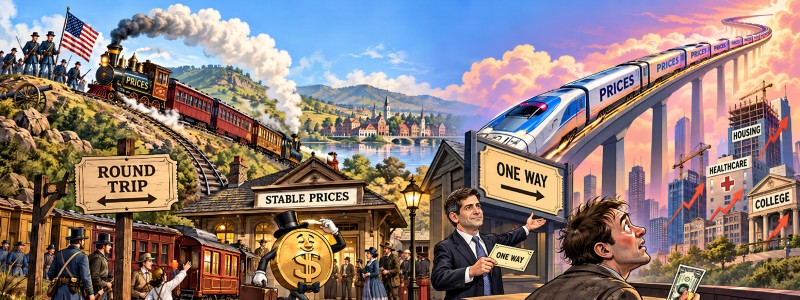
In 1884, a dollar bought roughly what it had bought before the Civil War.

America had fought its bloodiest war, printed greenbacks by the wagonload, and endured a roughly 75% surge in prices. And then the inflation went away. Twenty years later, prices had made the round trip.

The dollar went to war and, after a decent interval, came back home.

For most of American history, prices ebbed and flowed normally. But today, it seems that once something gets expensive, it stays expensive. Think of housing, healthcare, and college tuition. Anything the USG gets its grubby, greedy hands on, really.

But since it wasn’t always that way, I thought I’d show you why.

When Prices Fell

Peter Bernstein wrote about inflation his famous 1996 book, Against the Gods. He claimed that from 1800 to 1940, U.S. prices rose only about 0.2% a year and ended just 28% higher.

I love that stat, but then I went and checked it.

The Minneapolis Fed keeps a price index that reaches back to 1800. On that series, prices in 1940 weren’t 28% higher than in 1800. They were about 17% lower.

Neither number is the gospel truth, because there wasn’t a national CPI in 1800. (And if the BLS is inaccurate today with all its computing power, just imagine how ridiculously wrong the numbers would’ve been back then.)

Those early figures come from Vermont farm records and older academic studies. The Fed itself calls anything before 1913, the infamous year of its founding, an estimate. So treat those numbers as a sketch.

But every version of the sketch shows the same outline.

Up the Mountain and Back Down

Let’s start with the wars.

The War of 1812 pushed prices up about 24% in 2 years. By 1824, they sat 35% below where the war began.

The Civil War lifted prices by 75%. They were back to prewar levels 20 years later.

World War I doubled prices between 1915 and 1920. By 1932, they had given back nearly 67% of that rise.

Prices had climbed in wars (always an expensive proposition) and booms (thanks to the credit expansion). Then they came back to earth. Between 1800 and 1940, the price index actually fell in more than 50 separate years.

Now, let’s cross over to the other side of 1940.

Prices rose an eye-watering 71% from 1940 to 1948. They never came back down. Since 1948, the index has posted a yearly decline just 3 times: in 1949, 1955, and 2009. Each drop was only 1% or less.

The round trip became a one-way ticket.

Remember, Congress created the diabolical Fed in 1913. In the 113 years before that, prices fell about 42%. In the 113 years since, they’ve risen more than 30x(!). What cost $1 in 1913 costs about $34 today.

Falling Prices Aren’t Always Bad News

Of course, Keynesian economists think that deflation means depression, and falling prices translate to breadlines.

To be fair, sometimes they do. The early 1930s were brutal. When money and credit collapse, prices fall because the money supply collapses.

But the late 1800s show a different outcome. Prices meandered lower for decades as America built railroads, steel mills, and modern factories. As a result, output soared. Goods and services got cheaper because Americans got better at making them. That’s “economies of scale” at work for you.

We call that “good” deflation. It’s the reward for progress, handed straight to the customer. The dollar bought more each year because the country grew more productive.

Of course, debtors hated it. Farmers who borrowed in cheap dollars had to repay in expensive ones. At the Democratic National Convention in Chicago in 1896, William Jennings Bryan told a roaring crowd that the country shouldn’t crucify mankind on a cross of gold. He spoke for the borrowers. A rising dollar made every debt heavier. Telling the crowd what they wanted to hear got him the nomination. Same as it ever was.

Keep that in mind, as it explains everything that came next.

Why the Ticket Only Goes One Way

Today, the biggest debtor on earth is Uncle Sam. As you know well by now, US federal debt tops $40 trillion.

So it’s little wonder why The Donald, his administration, and Congress want lower rates and a softer dollar. A dollar that gains value makes that debt heavier every year. A dollar that loses value melts it away. Any leader who wants to keep his job picks the melt.

But more importantly, the borrowers, the banks, and the spenders who keep them in office all want a softer dollar. Paradoxically, nobody in that coalition gains when the common voter’s savings grows on its own.

So the Fed made it official. In 2012, it named 2% inflation as its target. In Fedspeak, “price stability” now means prices that rise forever.

It sounds small, doesn’t it? Except it isn’t.

Using the Rule of 72, at a rate of 2% a year, prices double every 36 years. A dollar you save at 30 buys half as much when you’re retired at 66. That’s how cheap money punishes the saver. The Fed’s stated goal actually hurts the citizenry.

Economist Charles Goodhart warned that when a measure becomes a target, it stops being a good measure. The CPI became the target. But now the target is a price level that only climbs… and it’s not even an accurate measure.

Where the Round Trip Still Runs

The round trip still runs wherever markets work freely. That is, when government regulations can’t keep up with innovation. Televisions, phones, and computing power get cheaper year after year. High productivity still drags prices down. Every time you buy electronics, you get more bang for your buck.

Of course, prices only increase when the government intervenes: college, health care, and housing. Stacking interventions on top of each other is an expensive habit indeed.

Gold tells the same tale. From 1834 to 1933, the government fixed an ounce at $20.67. For a century, the price barely needed to move, because the dollar held still. As of writing, gold trades at $4,275. Gold didn’t get more valuable. What you buy the gold with got less valuable.

Wrap Up

My grandfather used to tell me his popcorn costs 5 cents a bag. Since my popcorn cost $5 a tub, I thought my popcorn must’ve been better.

But popcorn is just popcorn. The truth is his dollar was far better than mine.

For most of America’s history, a saver could expect his money to hold its value. Sometimes it grew just by sitting still.

The people who understand the one-way ticket stop mistaking it for prosperity. Now you’re one of them.

Have a great weekend.

Read the whole story
gangsterofboats
43 minutes ago
reply
Share this story
Delete

‘When Did Google Get So F-Ing Weird?’

1 Share

Sancho Panza:

I recently had an experience while doing a simple Google search that was so profoundly weird that it stopped me in my tracks.

Kagi, the search engine I’ve been using for a few years now, gave me the exact sort of results to Panza’s query that he was looking for.

Read the whole story
gangsterofboats
16 hours ago
reply
Share this story
Delete

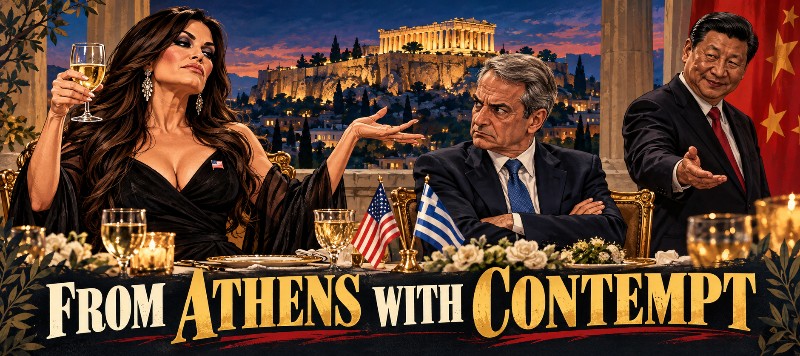
From Athens with Contempt

1 Share

Originally published at The Rude Awakening.

From Athens with Contempt

The Rude Awakening (Sept. 25, 2026)

By Sean Ring

Sean Ring

The Straits Strangle

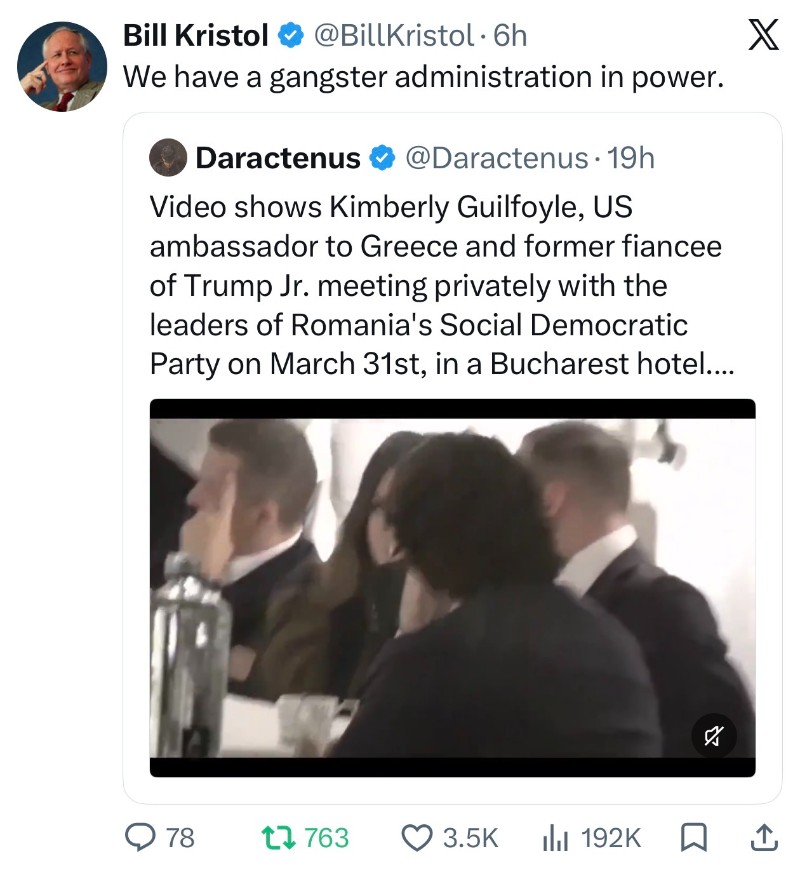
Do you have any idea what a foul mood it puts me in to agree with that neocon chickenhawk Bill Kristol first thing on a Monday morning?

Bill Kristol Tweet

Still, a broken clock is right twice a day.

So what was old Bill moaning about?

Dinner in Athens

Last Friday, The Wall Street Journal reported a story from a private dinner in Athens back in March.

Greek and American officials sat at the table. America’s ambassador to Greece, Kimberly Guilfoyle, was there, as was Stavros Papastavrou, Greece’s energy minister.

Talk turned to Romania, where Prime Minister Ilie Bolojan’s government was wobbling. According to one guest and others briefed on the exchange, Guilfoyle said, “We can do that to any country we want. We can do that here.”

“Here,” of course, meant Greece.

Red hot at the implied threat, Papastavrou shot back that America can’t replace a government the Greek people elected.

In May, Bolojan’s government fell. The no-confidence vote drew 281 lawmakers.

Now, let’s first be fair. Guilfoyle’s lawyer disputed the account. The quote had rested on one guest and some secondhand retellings. Of course, Romania’s government had plenty of homegrown enemies. Bolojan pushed hard austerity, and the Social Democrats had allegedly walked out of his coalition over it.

Nobody has shown that DC pulled the trigger, though no one ever can.

But a boast like that does its damage whether it’s true or not. What matters is who heard it.

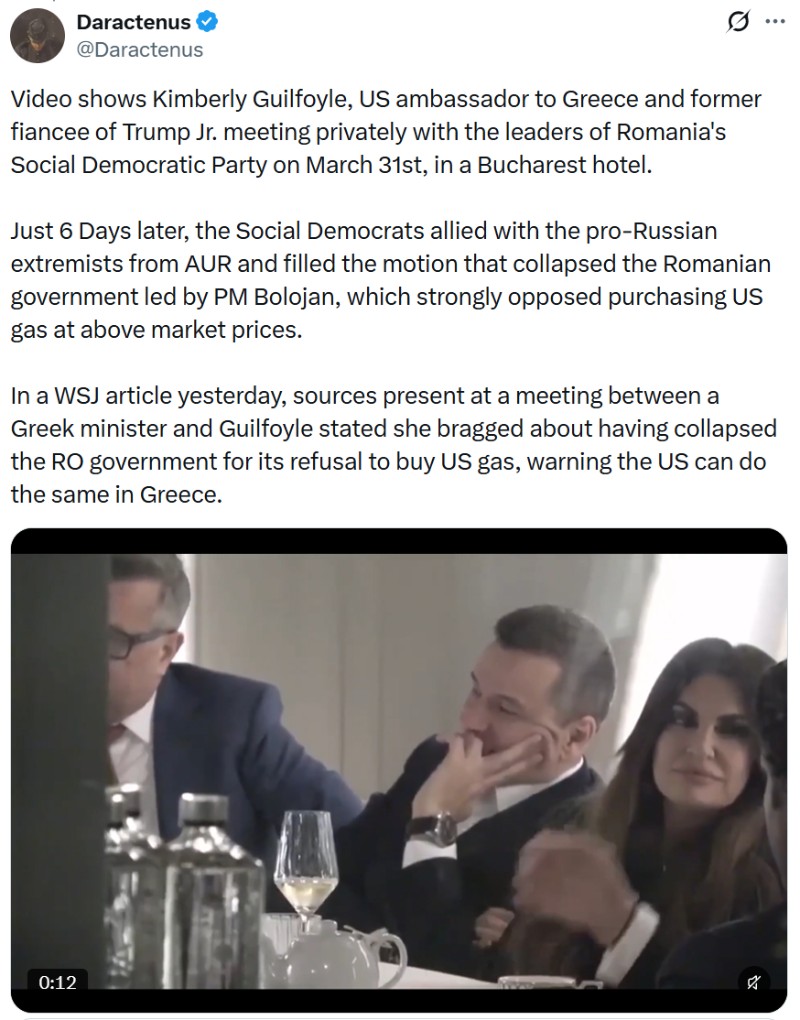
Except, it seems that it’s true. Because this morning on X, someone posted a video showing Guilfoyle meeting with Romania’s Social Democratic Party in a Bucharest hotel on March 31, 2026. (Why a US ambassador to Greece meeting with Romanian politicians in Bucharest is another question… or is it?)

Daractenus TweetCredit: @Daractenus

So the meeting was about forcing a European country to buy overpriced American energy, economic coercion at its finest.

But since Europe can’t admit it was plain wrong about Russia (yet), and it can’t say no to a dying superpower chucking haymakers, some of those countries, like Italy, have seen France’s relative energy independence and smartly decided to restart their nuclear programs.

But that’s a column for another day.

This one is about why it’s not at all surprising the Global South is actively cheering for China to take over the world’s hegemony reins.

Ancient History, Modern Application

The Greeks have heard this speech before.

Last time, the speaker was an Athenian, in 416 BC. Athens had the strongest navy on earth, and it wanted the small island of Melos to join its empire. The Melians wanted to stay neutral.

The Athenian envoys didn’t bother with diplomatic niceties. Thucydides records their answer, and it’s the most accurate assessment of power ever written.

The strong do what they can, and the weak suffer what they must.

Melos refused. Then Athens took the island, killed all the men, and sold all the women and children into slavery.

The next year, Athens sailed for Sicily. Two years later, nearly that entire expeditionary force lay dead or was captured. The war turned, and the empire never recovered.

The Greeks have a word for the swagger that comes before that kind of fall: hubris.

The Melian Mistake

When a great power says out loud what everyone already suspects, the mask of beneficence slips. Lack of subtlety isn’t merely a diplomatic faux pas. Hubris invites enmity, jealousy, and an eagerness to find alternatives. That’s why we cheer for underdogs in sports matches.

The Athenians didn’t lose because of their behavior towards Melos. God knows empires are cruel all the time. Athens lost because they sent every neutral city in the Greek world a message about the worth of Athenian friendship. When the Sicily expedition came, too few of those cities wanted Athens to win.

Guilfoyle, who only has an ambassadorship because she’s Don Junior’s ex-squeeze, didn’t just talk to one Greek minister at dinner. She spoke to every government official worldwide.

Those folks have much longer memories and historical understanding than the average American doomscroller.

They remember Iran in 1953, when the CIA toppled an elected prime minister. They remember Guatemala in 1954. The Greeks remember 1967, when the colonels seized power, and DC looked the other way. President Clinton admitted as much in Athens in 1999, when he said America had put its Cold War interests ahead of its duty to support Greek freedom.

Clinton’s admission had earned goodwill because it told the Greeks that Americans had learned something.

A threat delivered at a dinner table from an unqualified diplomat to a proud Greek pisses that goodwill up a wall.

Why the World Roots for China

The 2026 Democracy Perception Index surveyed over 94,000 people in 98 countries. America’s net rating fell to -16. Two years ago, it was +22. China sits at +7. Russia sits at -11. For the first time in the survey’s history, the world views America more darkly than Russia.

Don’t blame that on marketing or bots.

But why China?

Beijing isn’t kind. Just ask Hong Kong, the Tibetans, or the Sri Lankans who handed over a port when their loans went bad. I suspect we’ll be adding Taiwan to the list soon.

It’s because Beijing sells one product the Global South craves: the CCP says it won’t touch their governments. Non-interference has been China’s pitch since 1954. It’s a sales slogan more than a moral principle, but it works.

Remember how a ruler of a poor country stays in power. He keeps a small circle of generals, bankers, and party bosses happy. That circle is his whole world.

Now picture two suitors at his door. One brings loans and asks no questions. The other brings loans and hints he could replace you.

I ask you: Who is that ruler incentivized to deal with?

Soft Power Seed Corn

Trust is soft capital.

Like hard capital, it takes decades to build and moments to ruin.

America built its trust the hard way. The Truman Doctrine of 1947 kept Greece free when communists came for it. The Marshall Plan rebuilt a continent that had tried to kill itself. Nations followed America because they wanted what it had. Or, more importantly, they wanted to be like America.

That’s real power.

Pope Gregory the Great called pride “the queen of all vices.” Every other sin grows from it. Nations aren’t exempt. Unfortunately, pride feels more like brute strength than one of the seven deadly sins.

So how much does the rest of the world trust the USG right now?

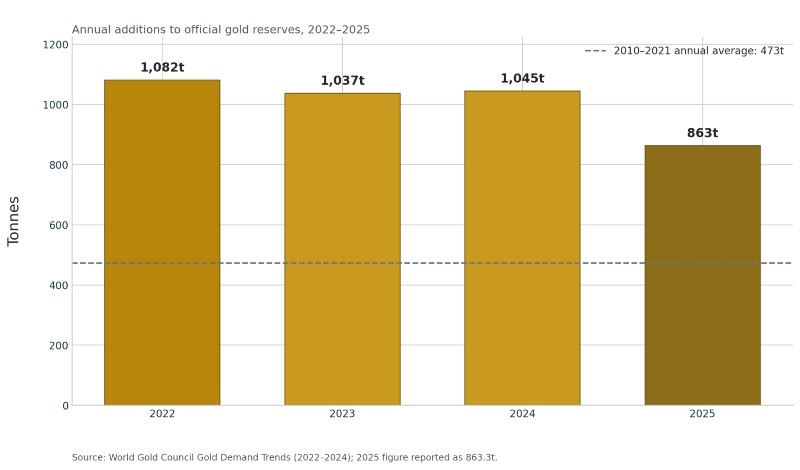
The world’s central banks have bought more than 1,000 tons of gold in each of 2022, 2023, and 2024, a record run. The World Gold Council (WGC) forecasts total central bank purchases for 2026 to fall between 650 tons to 850 tons.

pub

Considering the annual average purchase from 2010 to 2021 was only 473 tons, I’d say trust has dropped considerably.

Fearing the long arm of The Swamp, governments want the one asset no US politician could freeze.

Wrap Up

Ambassadors come and go. Most of them are forgotten, like Guilfoyle will surely be. Athens outlived Melos, and Greece outlived the colonels.

America will outlive one careless remark at a private dinner. It still has the deepest markets and the best companies. America can rebuild trust faster than anyone, but only once it stops spending it on mic drops.

The Greeks at that table weren’t impressed, because they’ve read Thucydides. They knew how the story ends.

Real strength never has to announce itself. It’s humble.

Have a great week.

Read the whole story
gangsterofboats
16 hours ago
reply
Share this story
Delete

BBC Suddenly Discovers That It Has Been Pushing Hamas Propaganda and Is 'Shocked'

1 Share


Read the whole story
gangsterofboats
1 day ago
reply
Share this story
Delete

"This is what America should have been teaching the world."

1 Share
"It took centuries of intellectual, philosophical development to achieve political freedom. It was a long struggle, stretching from Aristotle to John Locke to [America's] Founding Fathers. The system they established was not based on unlimited majority rule, but on its opposite: on individual rights, which were not to be alienated by majority vote or minority plotting. The individual was not left at the mercy of his neighbours or his leaders: the Constitutional system of checks and balances was scientifically devised to protect him from both. This was the great American achievement — and if concern for the actual welfare of other nations were our present leaders’ motive, this is what [they] should have been teaching the world."
~ Ayn Rand from her article 'Theory and Practice,' collected in her 1966 book Capitalism: The Unknown Ideal
Read the whole story
gangsterofboats
1 day ago
reply
Share this story
Delete

ALSO, SHE LOOKS LIKE SHE’S HAVING FUN. MOST FAMOUS WOMEN TODAY SEEM LIKE JOYLESS SCOLDS. https:/

1 Share

ALSO, SHE LOOKS LIKE SHE’S HAVING FUN. MOST FAMOUS WOMEN TODAY SEEM LIKE JOYLESS SCOLDS.

Read the whole story
gangsterofboats
2 days ago
reply
Share this story
Delete
Next Page of Stories