72186 stories
·
2 followers

Opinion: My economically illiterate milk carton doesn’t get trade

1 Share

I was sitting peacefully at my kitchen table in Vancouver, happily eating breakfast, when I was intellectually assaulted by the milk container sitting there on the table. It stated as follows: “By Choosing an Agropur Product, you are Choosing to Contribute to the Canadian Economy.” I was affronted.

To be sure, this is correct insofar as it goes. By purch…

Read more

Read the whole story
gangsterofboats
8 minutes ago
reply
Share this story
Delete

Philosophical Notes, No. 2: The Three-Plate Method or Popper Falsified Again

1 Share

Here is the second of my occasional philosophical notes. Like the first, it presents a counterexample to Karl Popper’s falsificationism drawn from the work of the late German philosopher Peter Janich, and then considers its bearing on Ludwig von Mises’ account of the method of the natural sciences.

2. Popper Falsified Again: The Three-Plate Method and Ampliative Induction

Peter Janich further offers a second instructive counterexample to Popper’s falsificationist thesis.1 Planes as forms of surface pieces of objects (such as drawing planes) have the property that all planes (pair-wise) fit on each other, and can be rotated and moved at will. Here Popper’s condition for theories is fulfilled such that some All-statement is given, which refers to real objects.2 And yet, no one will release this theorem for falsification. Rather, if two objects that are considered plane do not fit together, at least one of these objects will be considered not a plane or flat one. The proposition in question, then, is true a priori.

And importantly: its status as an a priori, non-hypothetical true All-statement is not owed to induction (which Popper rightly regards as an invalid method of logical inference),3 but rather to the fact that the same-ness of all plane or flat surfaces is assured by the same-ness of their constructive realization, according to the “three-plate method” described by Hugo Dingler.4 Accordingly, any seeming falsification, then, of two plane or flat surfaces not fitting, would find its explanation in a faulty method of construction of at least one of the two surfaces.

Incidentally, the “constructivist” solution provided here by Janich concerning the possibility of non-hypothetically true empirical or realistic All-statements — and the generalized insight of his school of rationalist philosophy, then, regarding the methodic and methodological priority or “a priori” of technics and technology, i.e., the purposeful setup and construction of measurement procedures and instruments (in the widest sense of the term) according to some common, general, uniform and standardized construction norms, prior to and preceding any “a posteriori” empirical natural science5 — can also shed some light and help lend further support to Ludwig von Mises’ reference to and use of what he termed “ampliative induction” as the appropriate method of the natural sciences.6

Ampliative induction, according to Mises, requires the assumption that nature does not change but stays constant and the same, such that we can generalize from the outcome of one experiment or measurement to the outcome of all future experiments or measurements of the same kind without having to repeat them over and over again. Nor, for that matter, can Popper’s falsificationism do without this assumption. Only if it is assumed — in accordance with what I have elsewhere called the “constancy principle” — that causes operate in a time-invariant way can a failure to reproduce some experimental result count as a falsification of a hypothesis, rather than as merely one more, different experience.7

“Constructivism” makes us recognize that the same-ness condition required for all All-statements is not just a logically necessary assumption, but a condition that can be actually realized and practically assured, owing to the same-ness of the design of our various measuring procedures and instruments according to a set of common, general, uniform and standardized construction norms. The same-ness condition is not merely a formal-logical requirement; it is a real condition, intentionally brought about or constructed by everyone prior to and before even beginning with any empirical natural science.8

Related

  1. Peter Janich, Kultur und Methode: Philosophie in einer wissenschaftlich geprägten Welt (Frankfurt am Main: Suhrkamp, 2006), pp. 38f., 439f. For the first counterexample, see Hans-Hermann Hoppe, “Philosophical Notes, No. 1: The Alibi Principle or Popper’s Falsificationism Falsified,” PFS Blog (Nov. 3, 2026).
  2. “All-statement” renders Popper’s Allsatz, which the English edition of his work calls a “strictly universal statement”: a statement about all things of a kind which, according to Popper, can never be verified by any finite number of observations but can be falsified by a single counter-instance, and which therefore qualifies as an empirical-scientific theory. See Karl Popper, The Logic of Scientific Discovery (London: Hutchinson, 1959), §§ 6, 15.
  3. Ibid., § 1, “The Problem of Induction.”
  4. Hugo Dingler (1881–1954), German mathematician and philosopher, was the forerunner of the “methodical constructivism” of Paul Lorenzen’s Erlangen School, to which Janich belonged. See Hugo Dingler, Die Grundlagen der Geometrie (Stuttgart: Enke, 1933); and, on Dingler, Lorenzen, and the Erlangen School regarding the a priori character of geometry, Hans-Hermann Hoppe, “On Praxeology and the Praxeological Foundation of Epistemology,” in Economic Science and the Austrian Method (Auburn, Ala.: Mises Institute, 1995), n.62. The procedure itself is old workshop practice, popularized in the 1830s by the British engineer Joseph Whitworth as a way to make true surface plates without relying on any prior reference standard: three plates are lapped or scraped against one another in rotating pairs. Two plates alone can come to fit each other perfectly while one is convex and the other concave; but if each of three plates fits both of the others, all three must be flat. See “Flatness (manufacturing),” Wikipedia; Joseph Whitworth, “A Paper on Plane Metallic Surfaces or True Planes,” in Miscellaneous Papers on Mechanical Subjects (London: Longman, Brown, Green, Longmans, and Roberts, 1858), pp. 1–20.
  5. Hans-Hermann Hoppe, “The Libertarian Quest for a Grand Historical Narrative,” in The Great Fiction: Property, Economy, Society, and the Politics of Decline, 2d expanded ed. (Auburn, Ala.: Mises Institute, 2021), ch. 25, p. 476. The chapter argues, following Janich, that “Handwerk” precedes and provides the foundation of “Mundwerk,” and that “it is engineering and advances in engineering that make science and scientific progress possible.” See also Peter Janich, Handwerk und Mundwerk: Über das Herstellen von Wissen (Munich: C.H. Beck, 2015); idem, Euclid’s Heritage: Is Space Three-Dimensional? (Dordrecht: Kluwer, 1992); and Hoppe, “Austrian Rationalism in the Age of the Decline of Positivism,” in The Economics and Ethics of Private Property: Studies in Political Economy and Philosophy, 2d ed. (Auburn, Ala.: Mises Institute, 2006), ch. 14, on logic, arithmetic, Euclidean geometry, and chronometry as a priori “protophysics.”
  6. Ludwig von Mises, The Ultimate Foundation of Economic Science: An Essay on Method (Princeton, N.J.: D. Van Nostrand, 1962), ch. 1, § 5, “Induction,” pp. 21–24. Mises there writes that the conclusions of the experimental sciences rest on “the assumption that what happened in one case must necessarily also happen in all other cases of the same type,” and that “the natural sciences are possible only because there prevails regularity in the succession of external events.”
  7. Hans-Hermann Hoppe, Critique of Causal Scientific Social Research, trans. Andreas Tank (2025; PDF), ch. 1, § III (“What is the condition of the possibility that one can say ‘falsified’? Such a statement necessarily presupposes the intellectual principle of ‘equal cause, equal effect’ …”), and ch. 2, § III (“In its shortest version, it states that causes have a time-invariant form of effectiveness. It represents the logical basis for the known rule ‘equal effect = equal cause’ or ‘unequal effect = unequal cause’, according to which we interpret repetitions as confirmations and non-repetitions as falsifications”) [translating Kritik der kausalwissenschaftlichen Sozialforschung (Opladen: Westdeutscher Verlag, 1983), pp. 11–12, 21–23; Google Doc version]. See also idem, “Is Research Based on Causal Scientific Principles Possible in the Social Sciences?,” in The Economics and Ethics of Private Property, ch. 10, p. 298, and ch. 14, pp. 364–66; idem, A Theory of Socialism and Capitalism (Auburn, Ala.: Mises Institute, 2010), ch. 6, pp. 129–30; idem, Economic Science and the Austrian Method, p. 36 and n.27; and, applying the point expressly to Popper, idem, “In Defense of Extreme Rationalism,” in The Great Fiction, ch. 18, pp. 324–26 and n.50: Popper’s claim to have solved the problem of induction is “simply an illusion,” for experiences cannot be related “as falsifying (or confirming) each other … unless one presupposed the existence of time-invariantly operating causes.”
  8. Cf. Hans-Hermann Hoppe, “My Discovery of Human Action and of Mises as a Philosopher,” HansHoppe.com (June 6, 2024): “as in particular the mentioned constructivist philosophers from Hugo Dingler to Paul Lorenzen to Peter Janich have demonstrated, the natural sciences all rest on some ‘technological apriori,’ in the form of purposefully constructed measuring instruments.” See also Stephan Kinsella, “Hoppe on Falsificationism, Empiricism, and Apriorism and Protophysics,” StephanKinsella.com (June 9, 2011), which collects Hoppe’s earlier remarks on protophysics and Janich’s English-language works.
Read the whole story
gangsterofboats
8 minutes ago
reply
Share this story
Delete

British History Needs Celebrating Not Rewriting

1 Share
Read the whole story
gangsterofboats
9 minutes ago
reply
Share this story
Delete

Thankfully, Child Transgenderism Lost on Election Day

1 Share
Read the whole story
gangsterofboats
6 hours ago
reply
Share this story
Delete

What Is Space Made Of?

1 Share

Here, I discuss unconventional views about space, what it’s made of and its dimensionality.*

1. Is Space Made of Points?

1.1. The Standard View

According to standard geometry, space is made of “points.” Geometrical objects such as circles and squares are commonly defined as sets of points satisfying a particular description (e.g., “the set of all points in…

Read more

Read the whole story
gangsterofboats
6 hours ago
reply
Share this story
Delete

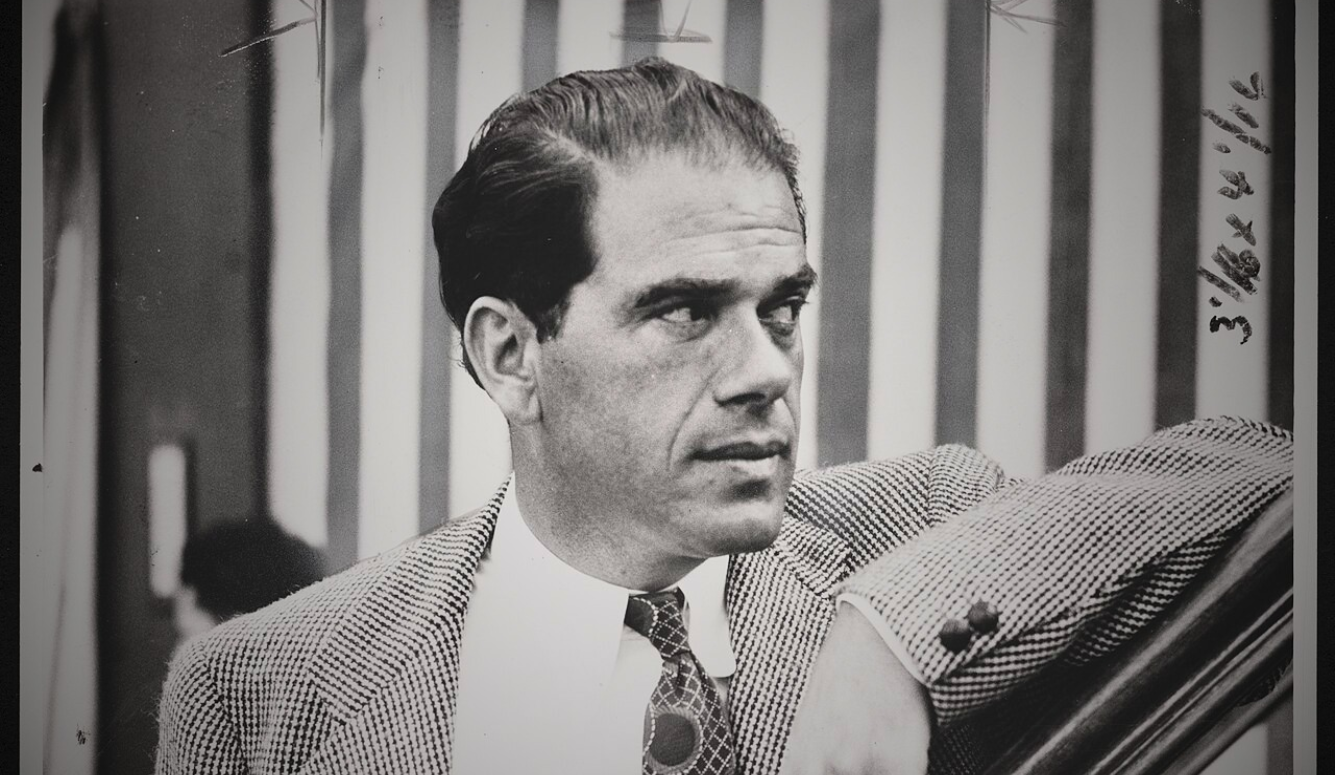
Man of the People

1 Share
Man of the People

A review of Frank Capra: A Life by Sam Wasson; 736 pages; HarperCollins, New York (October 2026)

Near the start of his massive new biography of Frank Capra, film historian Sam Wasson describes his subject as “the greatest American director who ever lived.” In the FDR era, that would have been an uncontroversial opinion. Between 1935 and 1939, Capra received the Oscar for Best Director three times. He was on the cover of Time magazine. He was the president of both the Screen Directors Guild and the Academy of Motion Picture Arts and Sciences. “Capra,” the novelist (and Spectator film critic) Graham Greene wrote in 1936, “has what Lubitsch, the witty playboy, has not: a sense of responsibility, and what Clair, whimsical, poetic, a little precious and à la mode, has not, a kinship with his audience, a sense of common life, a morality: he has what even Chaplin has not, complete mastery of his medium.”

Capra’s career foundered in the Fifties, but he was held in high regard for the rest of his life, collecting awards, continuing to play an important role in guild politics, and sitting for countless interviews. Then, in 1992, a year after Capra’s death, Joseph McBride published his long-awaited, meticulously researched biography of the director, Frank Capra: The Catastrophe of Success, and readers recoiled. McBride revealed that Capra was not a sweet everyman like the heroes of his films but an absolute bastard—a liar, a credit-thief, an antisemite, a political reactionary who kept a portrait of Mussolini on his bedroom wall, and “a gut-punching little man.” McBride acknowledged that Capra had made some excellent films, but he pointed out that much of what we call Capra-esque was, in fact, the invention of screenwriter Robert Riskin:

What Capra called his “formula” did not emerge until he began working with Riskin material in the early 1930s. His career before that point was scattershot and uncertain, that of a director in search of something to say. But once the formula had been established, Capra was content to repeat it, with minor embellishments, for the rest of his career, eventually to diminishing effect. ... Without Riskin, the formula became a straitjacket for Capra, one in which he struggled uncomfortably for years but could never manage to escape.

Though Wasson never says so explicitly, it’s clear that his biography of Capra is meant to correct the record. “By his own example, Capra led,” Wasson writes. “Working late into the night, he was the filmmaker his colleagues wanted to be, the winning embodiment of industry, kindness, patience, integrity, and—when he was called upon to exceed his managerial duties—talent.” That’s laying it on a bit thick, I think. Still, Capra could use a boost because he was, in his prime, an incredibly gifted filmmaker, directing some of the most luminous films to come out of Hollywood during the Great Depression, including Lady for a Day (1933), It Happened One Night (1934), and Mr. Smith Goes to Washington (1939).

Read the whole story
gangsterofboats
13 hours ago
reply
Share this story
Delete
Next Page of Stories