72243 stories
·
2 followers

My 1994 Dream: A Regularly Updated Libertarianism Treatise

1 Share

[StephanKinsella.com cross-post]

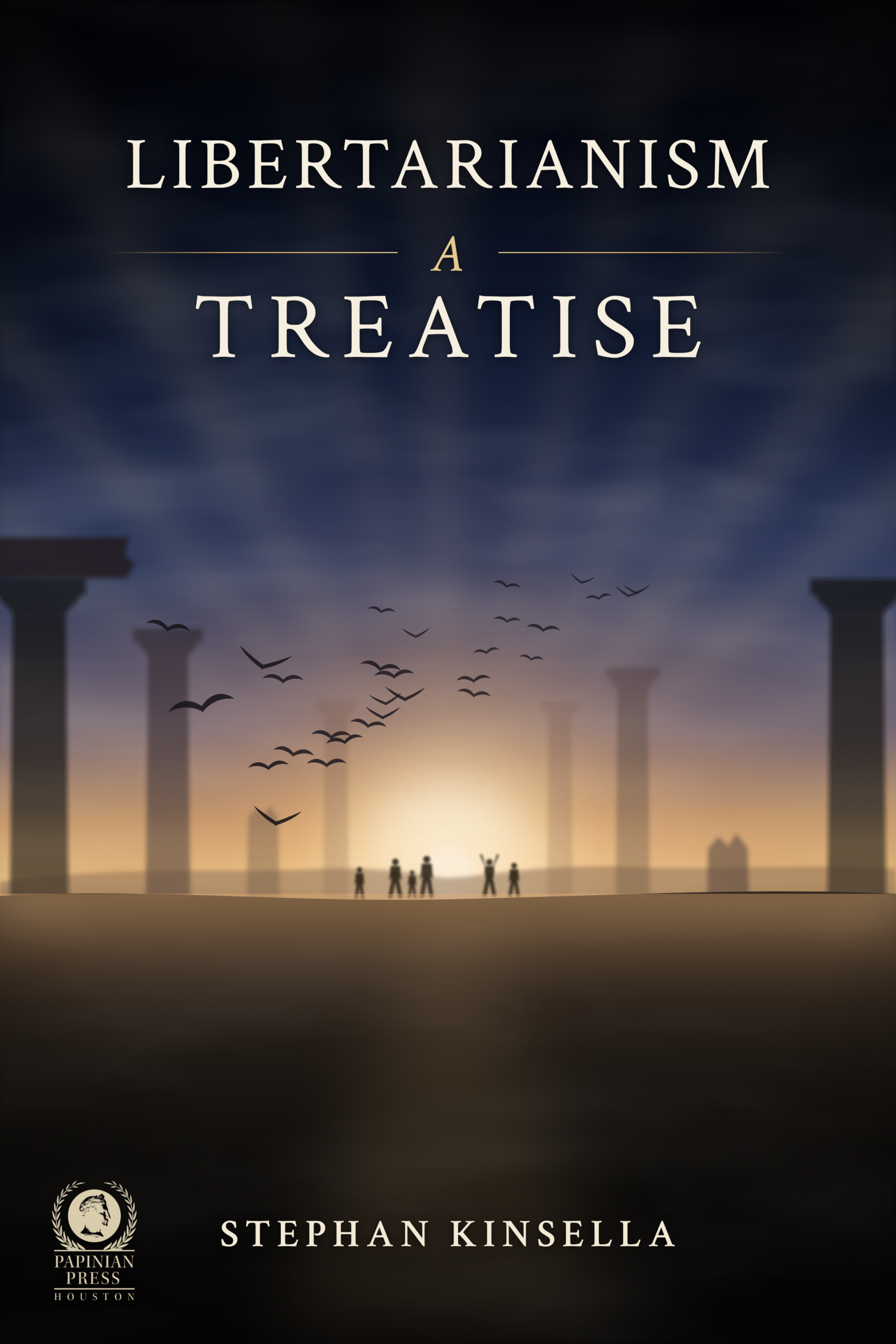
Mockup cover of Libertarianism: A Treatise, by Stephan Kinsella (Papinian Press)The other day I was telling a friend what I would do if I didn’t have so many other projects to get to first: take on a project I toyed with about twenty years ago. Libertarianism: An Encyclopedia, or Libertarianism: A Treatise: a systematic, regularly updated guide to all things libertarian. A multivolume work. Not “Kinsella’s libertarianism,” but all of it: the arguments for rights, the rival foundations, the disputes, the applications, who said what and where.

Then I went digging through my old files and found that my memory was off by a decade. I first sketched the idea in June 1994, when I was a young patent associate at a Philadelphia law firm, just beginning to write on libertarian theory, and floated it by email to Tibor Machan and Jan Narveson that July.1 So this is a thirty-two-year-old dream, not a twenty-year-old one.

I suppose I sensed even then that I would keep writing and developing my own theories. I had already started, with the estoppel theory of rights I first laid out in a 1992 article,2 and I kept at it over the next three decades, culminating in my 2023 book Legal Foundations of a Free Society [LFFS].3 But stating my own views is one thing; objectively stating others’ views, and the general state of libertarian thought, is another, and different. LFFS is the former, and doesn’t pretend to be anything else. The Universal Principles of Liberty, which I published in 2025 with input from several like-minded colleagues, was an attempt at the latter: a concise statement of core libertarian principles rather than only my own approach to libertarian theory. Of course, the Principles are phrased in my own way and rest on my own views. But they try to state objectively the principles implicit in most libertarian thinking, even where others use different concepts or terminology. That’s why the Principles avoid areas “where there is still significant disagreement among libertarians,” such as abortion, as well as more detailed applications, and why they contemplate supplemental principles and scholarly commentary. I’m now working on both: my own annotated commentary on the Principles, and proposed supplemental principles—both clearly in my own name, not presented as speaking for libertarianism as a whole.4

What I envisioned in 1994 was that second kind of work on a much grander scale: a comprehensive, regularly updated treatise or guide to libertarianism, covering all the significant literature—treatises, theories, approaches, books, and articles—modeled on the commercial legal treatises I used in practice, such as Harmon’s Patents and the Federal Circuit, Texas Jurisprudence, and the Louisiana Civil Law Treatise series (and later the Digest of Commercial Laws of the World, which I would go on to edit; more on all of these below). There was already a sizable libertarian literature then, larger than it had been even in the late 1980s, so the task would be daunting, perhaps one reason I didn’t attempt it seriously. But modern libertarianism was only a few decades old, and the corpus was far smaller than it is today.5 There be far more material to include now.

I was also inspired by earlier efforts to survey that literature, such as Literature of Liberty, with its bibliographical essays and short reviews of books and journal articles.6 Those kind of efforts inspired me, a couple of years later, to start a short-lived “Libertarian Literature Review” section in the Journal of Libertarian Studies, which Hans-Hermann Hoppe had recently taken over as editor. It gave short descriptions of recent scholarly articles of libertarian interest, drawn from non-libertarian journals.7 Today the field of libertarian scholarship is vastly larger, and the ways of publishing it have changed completely.

Below is the story: the original idea, what the treatise would look like, why I think it may finally be feasible, and why I’m still not going to start it any time soon (if ever).

Read more>>

  1. My first scholarly article appeared in Reason Papers in 1992. See Kinsella, “Estoppel: A New Justification for Individual Rights,” Reason Papers No. 17 (Fall 1992): 61–74. See also Kinsella, “Preface and Acknowledgments to Legal Foundations of a Free Society,” StephanKinsella.com (Sept. 11, 2024) (“I first wrote on rights and punishment theory in the early 1990s”).
  2. Kinsella, “Estoppel: A New Justification for Individual Rights,” supra; see also idem, “Punishment and Proportionality: The Estoppel Approach,” Journal of Libertarian Studies 12, no. 1 (Spring 1996): 51–73; and see LFFS, chs. 5, “A Libertarian Theory of Punishment and Rights” [originally in Loyola of Los Angeles Law Review 30, no. 2 (Jan. 1997): 607–45], and 6, “Dialogical Arguments for Libertarian Rights” [originally in The Dialectics of Liberty: Exploring the Context of Human Freedom, Roger E. Bissell, Chris Matthew Sciabarra, and Edward W. Younkins, eds. (Lanham, Md.: Lexington Books, 2019)]. On how the estoppel idea came about, see Kinsella, “The Genesis of Estoppel: My Libertarian Rights Theory,” StephanKinsella.com (March 22, 2016).
  3. Kinsella, Legal Foundations of a Free Society (Houston: Papinian Press, 2023).
  4. Kinsella et al., The Universal Principles of Liberty (Aug. 14, 2025); Kinsella, “Announcing The Universal Principles of Liberty,” StephanKinsella.com (Aug. 18, 2025); “Supplemental Principles to The Universal Principles of Liberty.”
  5. As I noted in a 2014 talk, “the modern libertarian movement is only about five or six decades old”; or, as I put it in 2011, modern libertarianism “really did not originate until the 1950s.” Kinsella, “Libertarianism After Fifty Years: What Have We Learned?,” StephanKinsella.com (Oct. 21, 2014), revised as LFFS, ch. 25; idem, “Libertarian Controversies,” Mises Daily (Aug. 26, 2011).
  6. Literature of Liberty: A Review of Contemporary Liberal Thought, Leonard P. Liggio, ed., was published by the Cato Institute (1978–1979) and then the Institute for Humane Studies (1980–1982); it is available at the Online Library of Liberty.
  7. The JLS sections are N. Stephan Kinsella, comp. and ed., “Literature Review,” Journal of Libertarian Studies 12, no. 2 (Fall 1996): 367–87, and idem, “Libertarian Literature Review,” Journal of Libertarian Studies 13, no. 1 (Summer 1997): 121–33. Hoppe became JLS editor after Rothbard’s death in 1995, and later made me the JLS book review editor (2000–2004). See Kinsella, “My Years with the Mises Institute,” Property and Freedom Journal (May 2, 2026), section “First Contact”; idem, “My Failed Libertarian Speaking Hiatus; Memories of Mises Institute and Other Events, 1988–2026,” StephanKinsella.com (Feb. 29, 2016). The 1996 Literature Review also pointed readers to the Federalist Society’s Conservative & Libertarian Legal Scholarship: An Annotated Bibliography, another useful survey, which later moved online and is updated periodically; see Kinsella, “Anti-IP Material Needed in the IP Section of the Federalist Society’s ‘Conservative & Libertarian Legal Scholarship: Annotated Bibliography’,” C4SIF.org (Oct. 29, 2012). See also Kinsella, “The Greatest Libertarian Books,” StephanKinsella.com (Aug. 7, 2006); Hans-Hermann Hoppe, “Anarcho-Capitalism: An Annotated Bibliography,” LewRockwell.com (Dec. 31, 2001).
Read the whole story
gangsterofboats
29 minutes ago
reply
Share this story
Delete

Samizdata quote of the day – There is a progression when Muslims take over a country

1 Share

Reasonable people go elsewhere if a restaurant doesn’t serve what they want. We are not dealing with reasonable people; we are dealing with Islamists, and they are flexing their muscles. But, yeah, those of us who point it out are the problem.

– Longrider

Read the whole story
gangsterofboats
20 hours ago
reply
Share this story
Delete

An article claiming to explain Stephen Miller’s motivations that does not mention the Duke Lacrosse team

1 Share

Stephen Miller has recently been appointed as Donald Trump’s new White House Chief of Staff. In an article for the Guardian called “How the rightwing operative David Horowitz shaped Stephen Miller”, Sidney Blumenthal, a former senior adviser to President Clinton and later to Hillary Clinton, writes,

Miller’s superiority complex neatly complements Trump’s malignant narcissism. Trump is Miller’s calling; Trumpism is his profession. His life has led to this consummation. Miller feels most superior, most himself, servicing Trump’s megalomania.

Miller is far more than a yes-man extraordinaire. Miles Taylor, the chief of staff at the Department of Homeland Security in the first Trump term, recalls being present when, after a lower federal court decision went against the administration, Trump banged his desk. “We need to get rid of the judges,” he reportedly said. In Taylor’s account, Miller piped up: “Yes sir, a country without judges would help.”

Miller projects his superiority complex as more than the lament of the lonely truth-teller. He debases opponents as “dumb”, “stupid”, “ignorant” and “foolish”.

Blumenthal has obviously delved deeply into Miller’s life. He talks about Miller’s father, his school and his relationship with Horowitz. Then he writes,

After Miller graduated from Duke, where he used the Horowitz front group, Students for Academic Freedom, to attack multiculturalism and liberalism as the campus crank

Blumenthal knows. It would be impossible for him – it would be impossible for anyone – to have researched Stephen Miller’s life in enough detail to be able to quote the exact words of Miller’s pitch when running for the student council of Santa Monica High School and not to have come across any mention of the experience that brought Miller to national prominence, and which Miller described as his greatest achievement while at college.

Blumenthal knows, but he doesn’t want to tell his readers that the blindingly obvious reason why Miller thinks of himself as a lonely truth-teller against the delusions of the leftist establishment is that he remembers being a lonely truth teller against the delusions of the leftist establishment. He remembers standing up – as a twenty year-old undergraduate – for the right to a fair trial of three fellow-students at Duke University accused of rape who were subjected to a worldwide media frenzy of denunciation, led by 88 members of Duke’s own faculty.

As it turned out, the three members of the Duke University Lacrosse team were innocent:

The Duke lacrosse rape hoax was a widely reported 2006 criminal case and racial scam in Durham, North Carolina, United States, in which three members of the Duke University men’s lacrosse team were falsely accused of rape. The three students were David Evans, Collin Finnerty, and Reade Seligmann. The accuser, Crystal Mangum, a student at North Carolina Central University] and part-time striptease dancer, alleged that the rape occurred at the Durham residence of two of the team’s captains, where she had worked on March 13, 2006. Investigation and resolution of the case sparked public discussion of racism, sexual violence, media bias, and due process on campuses. The former lead prosecutor, Durham County district attorney Mike Nifong, ultimately resigned in disgrace and was disbarred and briefly imprisoned for violating ethics standards. It was not until December 2024, 18 years after the events that Mangum admitted she had lied.

Miller did not know that they were innocent at the time, of course. What he was defending was their right to the presumption of innocence. He was right to do so.

I knew who Stephen Miller was in 2006. I rather think that Sidney Blumenthal did too.

Read the whole story
gangsterofboats
20 hours ago
reply
Share this story
Delete

A crime against science

1 Share

Matt Ridley writes, “The plot to discredit the Covid lab leak theory was a crime against science”

Jay Bhattacharya, head of the National Institutes of Health, has written to Nature Medicine journal demanding a “formal, independent investigation” into why a key scientific paper misled the world about the virus causing Covid, and concealed the contributions made by three senior scientists to commissioning, reviewing and editing the paper.

In a career as a science writer that spans more than four decades, I have never seen an alleged case of scientific malpractice as influential. Like many others I have called for the paper to be retracted. Twice, the editor of the journal, Joao Monteiro, has been sent letters from numerous leading scientists demanding an investigation or retraction of the misleading paper. He has ignored us.

I know the paper entitled “Proximal Origin of SARS-CoV-2” was misleading because I was among those misled. At the time I sat on the science and technology select committee of the House of Lords and we were conducting an inquiry to try to understand this new virus threatening all our lives. The possibility that it had been accidentally released from a laboratory, if true, would have significant implications for the public-health response: a virus marinaded in human tissues in a laboratory for weeks would be far more infectious than one newly arrived from bats.

Parliamentary colleagues were asking me what I thought. To my shame, I told them a lab leak could be ruled out. I did so based almost entirely on the authority of this one paper. That very phrase “ruled out” appeared in the press announcement of the paper from the institution where the lead author, Kristian Andersen, worked. The article itself left no room for doubt: “we do not believe that any type of laboratory based scenario is plausible… our analyses clearly show that SARS-CoV-2 is not a laboratory construct.”

That these words appeared in Nature Medicine gave them a stamp of authority, or so I believed. The paper was subsequently viewed millions of times and cited in thousands of academic papers. The journal and the authors of the paper therefore had a special responsibility not to allow themselves to be misled. Yet we now know that Proximal Origin’s arguments were flawed and released Slack messages and emails show several of its authors were expressing exactly the opposite opinion in private both before, during and after publication. They still thought a lab leak was “friggin likely”, in the words of Andersen.

Worse than all that, congressional investigations have uncovered records strongly indicating that three of the most senior medical scientists in the world, Francis Collins (Bhattacharya’s predecessor as head of the National Institutes of Health), Anthony Fauci (head of National Institute for Allergy and Infectious Diseases) and Jeremy Farrar (head of the Wellcome Trust) had not only seen the paper before publication, but – according to a House Select Subcommittee report – had prompted its authors to write it in the first place, had reviewed it and even suggested alterations in wording. Fauci referred to the paper from the White House podium, giving no hint of his own role in it.

Science requires honest admission of error. Ridley’s done his. Now the authors and undisclosed funders of this paper need to step up, alongside the editor of Nature Medicine, Joao Monteiro. If they do not, we are entitled to conclude that they were deliberately lying.

Read the whole story
gangsterofboats
20 hours ago
reply
Share this story
Delete

Samizdata quote of the day – The danger of forbidden knowledge

1 Share

If academics and students think that someone holding Cofnas’s views is wrong, then they should be able to refute his claims. But that is not what they tried to do. They tried to prevent him from speaking to a small number of students in their spare time and then tried to stop students from getting into the lecture hall to hear him. This is not evidence of intellectual strength. It is evidence of intellectual failure. And that encourages interest in the forbidden subject.

– Douglas Murray

Read the whole story
gangsterofboats
20 hours ago
reply
Share this story
Delete

Samizdata quote of the day – A bizarre interlude on the BBC

1 Share

Ms Spurrell had already told Campbell’s listeners the opposite. The anti-racism guidelines, she said, were perfectly good.

It got stranger. Among her ideas for winning public respect was police officers dancing with drag queens.

Ask the pensioner whose shed has been emptied twice since Easter what she wants from her local force. I promise you it isn’t a constable who can twerk.

– Gawain Towler

Read the whole story
gangsterofboats
20 hours ago
reply
Share this story
Delete
Next Page of Stories