70572 stories
·
2 followers

Journalists Ditch Colbert, Mourn Scott Pelley’s ’60 Minutes’ Exit

1 Share

Some examples of media bias are so blatant they practically scream their intentions.

Take the year-long mourning over Stephen Colbert’s “Late Show” cancellation. Week after week, saw news articles bemoaning his late-night fate. Most journalists ignored the fact that the show cost CBS $40 million a year.

Oops! Did we leave that out?

Had Colbert spent the last decade skewering President Joe Biden, Senatorial hopeful Graham Platner and other progressives, the same journalists would have pinned a “Kick Me” sign to Colbert’s back on the way out the door.

Instead, they collectively recoiled at his dismissal, dubbing him an “avenger” and a “minister” to a troubled nation.

Really.

Now? It’s Stephen Colbert who? 

Why? CBS News head honcho Bari Weiss is cleaning house at another hard-Left institution – “60 Minutes.” Yes, the same program that got pummeled by President Donald Trump’s lawyers for selectively editing Kamala Harris to make her sound smart in the final days of the 2024 presidential campaign.

The same “60 Minutes” that tried to fix the 2004 election with a “fake but accurate” story smearing President George W. Bush.

The same “60 Minutes” that fought with President Trump over the Hunter Biden laptop, insisting it lacked the resources to see if it was the real deal.

It was … and they were terrified to learn the truth.

That “60 Minutes.”

Now, with center-Left Weiss attempting to bring the show to the journalistic center, the same Colbert defenders are rallying behind the just-fired Scott Pelley.

He’s been a part of the far-Left show for years, and he epitomized the modern journalist – arrogant, biased and willing to publicly trash his bosses, assuming said bosses wouldn’t fire employees for insubordination.

Wrong.

He’s out of a job, and the media is in full meltdown mode. Here’s a Google News snapshot.
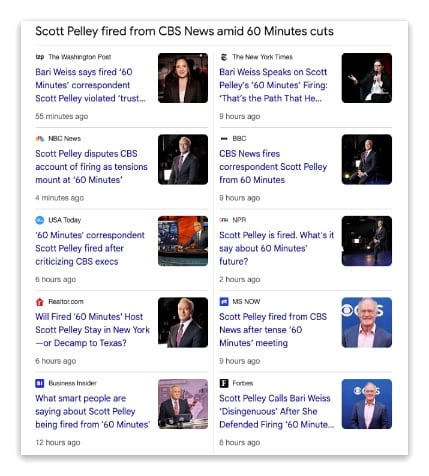
Google News screenshot Scott Pelley firingThat’s a small sample of the media coverage.

Wait … who is Scott Pelley? Newsbusters offers a crash course on his chronic liberal bias.

Consider this softball he lobbed to President Joe Biden:

“Joe Biden is among the longest-serving politicians in Washington. If there is less bounce in the step than there once was, if the words don’t flow like they used to, maybe there’s something to be said for knowhow, five decades on the Hill and in the Oval…You have lived a long life of triumph and tragedy. In November, you’ll be 80. And I wonder what it is that keeps you in the arena.”

Or this commencement address during the second President Trump administration, which doubled as an MS NOW audition tape:

“Our sacred rule of law is under attack. Journalism is under attack, universities are under attack, freedom of speech is under attack. An insidious fear is reaching through our schools, our businesses, our homes and into our private thoughts. The fear to speak in America….In a moment like this, when our country is in peril, don’t ask the meaning of life. Life is asking, what’s the meaning of you?”

Is it any wonder journalists forgot Colbert’s cancellation to mourn yet another far-Left figure?

And, for added context, consider how little attention these same journalists paid to a former president suffering from obvious cognitive decline?
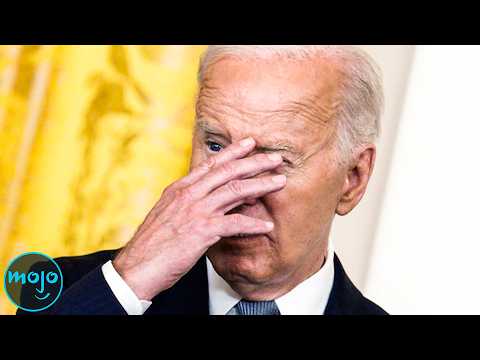
YouTube Video

What’s the worst example of Pelley’s liberal bias that you remember?

The post Journalists Ditch Colbert, Mourn Scott Pelley’s ’60 Minutes’ Exit appeared first on Hollywood in Toto.

Read the whole story
gangsterofboats
1 minute ago
reply
Share this story
Delete

"The principal view of human laws is, or ought always to be, to explain, protect, and enforce such rights as are absolute, which in themselves are few and simple."

1 Share
"[T]he principal aim of society is to protect individuals in the enjoyment of those absolute rights, which were vested in them by the immutable laws of nature ...[namely] ... the right of personal security, the right of personal liberty, and the right of private property ...

“[T]he principal view of human laws is, or ought always to be, to explain, protect, and enforce such rights as are absolute, which in themselves are few and simple. ...

“The absolute rights of man, considered as a free agent, endowed with discernment to know good from evil, and with power of choosing those measures which appear to him to be most desirable, are usually summed up in one general appellation, and denominated the natural liberty of mankind. This natural liberty consists properly in a power of acting as one thinks fit, without any restraint or control, unless by the law of nature: being a right inherent in us by birth.”

~ William Blackstone (1723–1780) from his landmark Commentaries on the Laws of England (Book 1, 1765), discussed here
Read the whole story
gangsterofboats
34 minutes ago
reply
Share this story
Delete

Robert Nozick’s Political Philosophy

1 Share
[Revised entry by Eric Mack on June 3, 2026. Changes to: Main text, Bibliography, notes.html] Robert Nozick (1938 - 2002) was a renowned American philosopher who first came to be widely known through his 1974 book, Anarchy, State, and Utopia (1974),[1] which won the National Book Award for Philosophy and Religion in 1975. Pressing further the anti-consequentialist aspects of John Rawls' A Theory of Justice, Nozick argued that respect for individual rights is the key standard for assessing state action...
Read the whole story
gangsterofboats
1 hour ago
reply
Share this story
Delete

Make Britain Great Again

1 Share
To reclaim an upward trajectory, the U.K. must relearn the habit of national agency.

Read the whole story
gangsterofboats
1 hour ago
reply
Share this story
Delete

The Supreme Court For The First Time Refers To Our "Colorblind Constitution"

1 Share

As big as Callais was, I think Allen v. Milligan may prove to be more significant. The Court smacked down the notion that the government "defies" court order when it takes actions designed to be tested before the Supreme Court. The Court also signaled that the presumption of good faith for purposes of Section 2 should apply to other Fourteenth Amendment contexts. (Indeed, I wonder why prosecutors should not get the same presumption of good faith under Batson; this is a topic I am developing.) But the very first sentence of Allen dropped a bomb that most people may have missed:

In Louisiana v. Callais, 608 U. S. ___ (2026), to resolvethe tension between vote-dilution claims under §2 of the Voting Rights Act of 1965 and our colorblind Constitution, we updated the standards for §2 liability established by Thornburg v. Gingles, 478 U. S. 30 (1986).

Did you see it? The Court referred to "our colorblind Constitution." Of course, Justice Alito was channelling Justice John Marshall Harlan's dissent in Plessy v. Ferguson (1896).

But in view of the constitution, in the eye of the law, there is in this country no superior, dominant, ruling class of citizens. There is no caste here. Our constitution is color-blind, and neither knows nor tolerates classes among citizens. In respect of civil rights, all citizens are equal before the law. The humblest is the peer of the most powerful.

These powerful words were read and re-read during the worst days of Jim Crow. Yet, the Supreme Court has never actually embraced Justice Harlan's conception of a color-blind constitution, not even in Brown. To the contrary, the Court has often found the Constitution prohibits a color-blind approach to equal protection.

Justice O'Connor made this point expressly in Shaw v. Reno:

Despite their invocation of the ideal of a "color-blind" Constitution, see Plessy v. Ferguson, 163 U.S. 537, 559, 16 S.Ct. 1138, 1146, 41 L.Ed. 256 (1896) (Harlan, J., dissenting), appellants appear to concede that race-conscious redistricting is not always unconstitutional. See Tr. of Oral Arg. 16–19. That concession is wise: This Court never has held that race-conscious state decisionmaking is impermissible in all circumstances.

Shaw v. Reno, 509 U.S. 630, 642, 113 S. Ct. 2816, 2824, 125 L. Ed. 2d 511 (1993).

Query if Callais and now Allen have abrogated Shaw.

Justice Thomas, for his part, routinely cites Harlan's dissent, but always in separate writings, including Adarand ConstructorsHolder v. Hall, and other cases. Justice Thomas addressed the issue squarely in Parents Involved:

Most of the dissent's criticisms of today's result can be traced to its rejection of the colorblind Constitution. The dissent attempts to marginalize the notion of a colorblind Constitution by consigning it to me and Members of today's plurality.[F19] But I am quite comfortable in the company I keep. My view of the Constitution is Justice Harlan's view in Plessy: "Our Constitution is color-blind, and neither knows nor tolerates classes among citizens." Plessy v. Ferguson, 163 U.S. 537, 559, 16 S.Ct. 1138, 41 L.Ed. 256 (1896) (dissenting opinion). And my view was the rallying cry for the lawyers who litigated Brown. See, e.g., Brief for Appellants in Nos. 1, 2, and 4, and for Respondents in No. 10 on Reargument in Brown v. Board of Education, O.T.1953, p. 65 ("That the Constitution is color blind is our dedicated belief"); Brief for Appellants in Brown v. Board of Education, O.T.1952, No. 8, p. 5 ("The Fourteenth Amendment precludes a state from imposing distinctions or classifications based upon race and color alone");20 see also In Memoriam: Honorable Thurgood Marshall, Proceedings of the Bar and Officers of the Supreme Court of the United States, p. X (1993) (remarks of Judge Motley) ("Marshall had a 'Bible' to which he turned during his most depressed moments. The 'Bible' would be known in the legal community as the first Mr. Justice Harlan's dissent in Plessy v. Ferguson, 163 U.S. 537, 552, 16 S.Ct. 1138, 41 L.Ed. 256 (1896). I do not know of any opinion which buoyed Marshall more in his pre-Brown days …").

[FN19] The dissent halfheartedly attacks the historical underpinnings of the colorblind Constitution. Post, at 2815 – 2816. I have no quarrel with the proposition that the Fourteenth Amendment sought to bring former slaves into American society as full members. Post, at 2815 (citing Slaughter–House Cases, 16 Wall. 36, 71–72, 21 L.Ed. 394 (1873)). What the dissent fails to understand, however, is that the colorblind Constitution does not bar the government from taking measures to remedy past state-sponsored discrimination—indeed, it requires that such measures be taken in certain circumstances. See, e.g., Part I–B, supra. Race-based government measures during the 1860's and 1870's to remedy state-enforced slavery were therefore not inconsistent with the colorblind Constitution.

Parents Involved in Cmty. Schs. v. Seattle Sch. Dist. No. 1, 551 U.S. 701, 772–73, 127 S. Ct. 2738, 2782–83, 168 L. Ed. 2d 508 (2007).

Does the Supreme Court now agree with Justice Thomas's invocation of Parents Involved? Did the other Justices, rushed on the emergency docket, miss this line? Who knows? 130 years later, Justice Harlan's Plessy dissent is now the "supreme law of the land."

The post The Supreme Court For The First Time Refers To Our "Colorblind Constitution" appeared first on Reason.com.

Read the whole story
gangsterofboats
1 hour ago
reply
Share this story
Delete

Pride Parade Forces To Change Direction After Route Takes It Within 200 Yards Of School

1 Share

SAN FRANCISCO, CA — A parade celebrating Pride Month was forced to suddenly change course after participants informed organizers that none of them were allowed within 200 yards of a local elementary school.

Read the whole story
gangsterofboats
1 hour ago
reply
Share this story
Delete
Next Page of Stories