70376 stories
·
2 followers

What's in a name? Are we really a "capitalist command economy"?

1 Share

WHAT'S IN A NAME?

What do you call an economic system that's neither a free-market economy with a small state and light-handed regulation, nor a state-owned economy run by bureaucratic, politically-driven trading departments -- it's neither, sometimes both, but mostly a mongrel grab-bag of bits from small govt and large. They're wrestling with that question in the UK at the minute -- and we could just as easily ask the same question here:

The left call it neoliberal but neoliberals have had no meaningful influence on British governments for thirty years. The right call it socialist but neither the Tories nor Labour have shown much [recent] interest in seizing the means of production. 
Liberty Scott puts the question:
Of course the Greens, TPM and parts of Labour will say t[that New Zealand] is under the oppressive yoke of neo-liberalism, and their latest scapegoat "billionaires" and "foreign capital"; and, of course, people like me will rail against the "commie kids" on the left in Parliament and in local government, but [in truth] there's little real evidence of NZ embarking on [either] Douglas/Richardson Mk. 2 or becoming the DDR ....
It's not to say the Douglas/Richardson ... reforms have been unwound. New Zealand isn't returning to rampant protectionism, nor has Labour embarked on vast re-nationalisation ... ["but hold my beer!" says Winston], but what has happened is an accretion of central command and control.
This is one reason some pundits are beginning to realise that, beyond the usual vitriol, there's so little separating the two tired main parties that a Grand Coalition would at least be more honest than continuing their pretence of difference. They've both kept the institutional structure established by Douglas/Richardson, while quietly growing an activist state to increasingly dictate how (and by whom) it will be run -- "regulatory control of the private sector remain[ing] at the heart of what the Wellington bureaucracy advances to meet [their] social goals."

Some might call this Fascism, i.e., the pretence of private property with an activist state dictating terms. But we're not there yet.

Ludwig Von Mises, who'd seen and escaped from the Nazi's fascism, would probably have simply called it a Hampered Market:
The system of interventionism or of the hampered market economy differs from the German [i.e., the Nazi] pattern of socialism by the very fact that it is still a market economy. The authority interferes with the operation of the market economy, but does not want to eliminate the market altogether. It wants production and consumption to develop along lines different from those prescribed by an unhampered market, and it wants to achieve its aim by injecting into the working of the market orders, commands, and prohibitions.

BOTH MISES AND HIS student Ayn Rand were quick to point out that the Hampered Market, or what Rand was happy to dub the Mixed Economy, was of course a mongrel mixture on the way to something else -- that no matter how tired the state's representative might seem, it is still their coercion that is pulling the strings. Any analyis of the Mixed Economy must logically, she said, begin by identifying the two elements that are being mixed: A mixed economy, she identified "is an explosive, untenable mixture of two opposite elements,” freedom and statism, “which cannot remain stable, but must ultimately go one way or the other.”

A mixed economy is a mixture of freedom and controls—with no principles, rules, or theories to define either. Since the introduction of controls necessitates and leads to further controls, it is an unstable, explosive mixture which, ultimately, has to repeal the controls or collapse into dictatorship. A mixed economy has no principles to define its policies, its goals, its laws—no principles to limit the power of its government. The only principle of a mixed economy—which, necessarily, has to remain unnamed and unacknowledged—is that no one's interests are safe, everyone's interests are on a public auction block, and anything goes for anyone who can get away with it. ...

A mixed economy is rule by pressure groups. It is an amoral, institutionalised civil war of special interests and lobbies, all fighting to seize a momentary control of the legislative machinery, to extort some special privilege at one another's expense by an act of government—i.e., by force. In the absence of individual rights, in the absence of any moral or legal principles, a mixed economy's only hope to preserve its precarious semblance of order, to restrain the savage, desperately rapacious groups it itself has created, and to prevent the legalised plunder from running over into plain, unlegalised looting of all by all—is compromise; compromise on everything and in every realm—material, spiritual, intellectual—so that no group would step over the line by demanding too much and topple the whole rotted structure. ...

The only danger, to a mixed economy, is any not-to-be-compromised value, virtue, or idea. The only threat is any uncompromising person, group, or movement. The only enemy is integrity.

If there's one thing New Zealand's so-called opposing parties do agree on, beyond their love for the activist state, it's their hatred of the groups their erstwhile opponents appear to favour., their cronies or voting fodder But as Rand points out, 

If parasitism, favouritism, corruption, and greed for the unearned did not exist, a mixed economy would bring them into existence.

ECONOMICALLY, WE LIVE IN a Hampered Market. Politically, we live in a Mixed Economy. Realistically, we should be aware that neither can exist indefinitely. Things "must ultimately go one way or the other."

Read the whole story
gangsterofboats
7 minutes ago
reply
Share this story
Delete

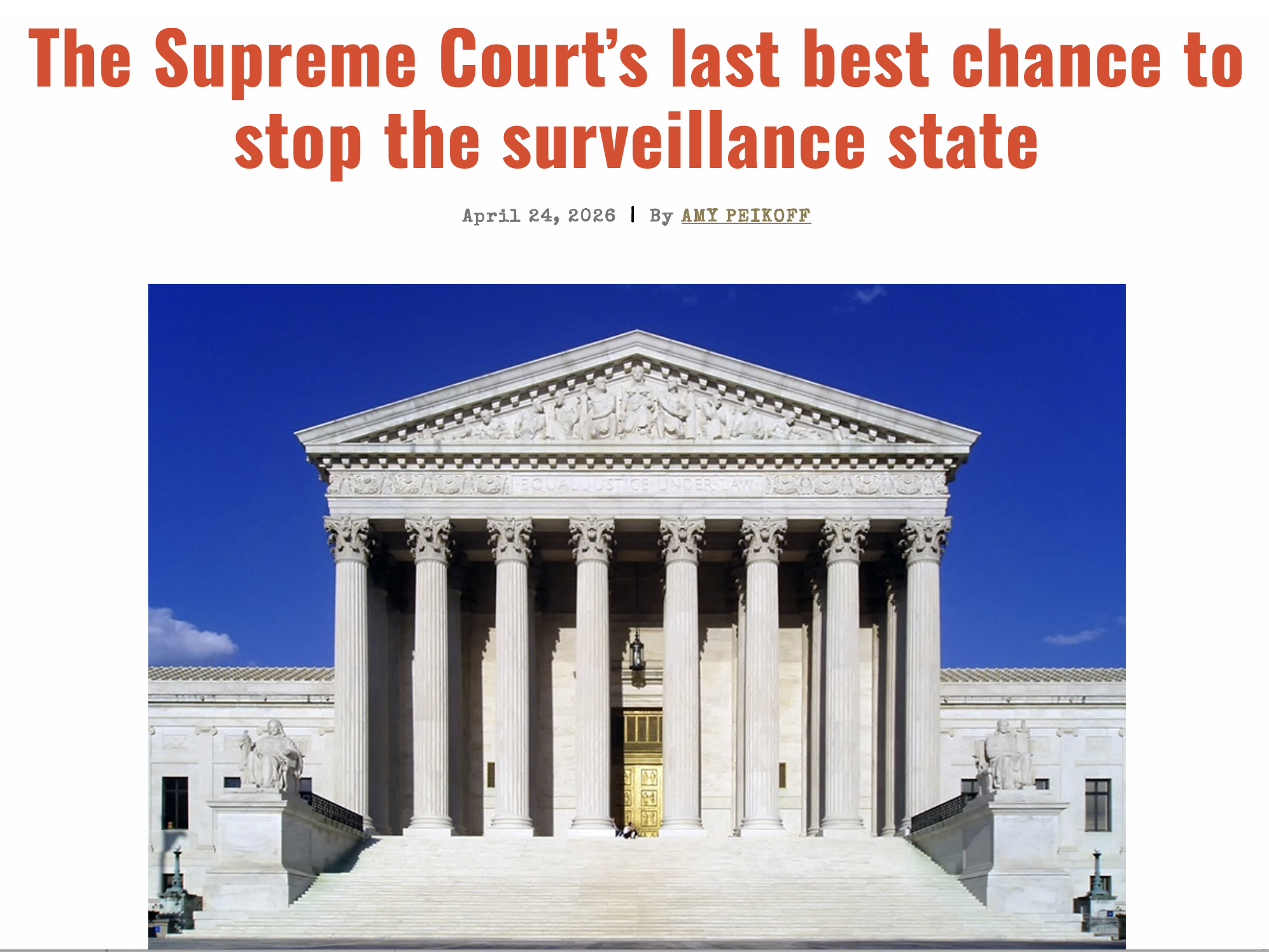
My latest at the PLF Blog: The Supreme Court’s last best chance to stop the surveillance state

1 Share

When you text your doctor, share your location with a rideshare app, or use your credit card at checkout, you aren’t broadcasting your private life to the world. You’re sharing specific information, for a specific purpose, with a specific party you’ve chosen to trust—usually under terms of service that promise to keep it confidential. You know this. Your service provider knows this. The only institution in America that pretends not to know this is the federal government, armed with a legal doctrine the Supreme Court erroneously expanded almost fifty years ago.

That doctrine is the third-party doctrine. The Court now has a chance to return it to its original and proper scope in the case Chatrie v. United States, which it is currently considering after oral argument last month. It should seize that chance.

Dragnet searches and Supreme Court precedent

In 2019, the government obtained a “geofence warrant”—a demand that Google hand over location data on every user whose phone happened to be near the scene of a bank robbery.

Not a suspect. Not a person connected to the crime by evidence. Every person in the area.

Google searched its entire Sensorvault database—hundreds of millions of accounts—and produced the results. Okello Chatrie was among them.

The government relied on the third-party doctrine to justify this dragnet search. The doctrine was dramatically expanded without justification in two 1970s cases, United States v. Miller and Smith v. Maryland. Their holding was disarming in its simplicity and devastating in its consequences: if you share information with a third party, you forfeit any “reasonable expectation of privacy” in that information. It doesn’t matter that you shared it for a limited purpose or that your service provider contractually promised to protect it. In the eyes of the law, you might as well have shouted it through a megaphone, from the highest mountaintop, on worldwide livestream.

This was always a dubious proposition, but in the digital age, it’s absurd. Your phone continuously communicates with cell towers. Your search queries exist in databases. Your emails and messages pass through servers. To claim that all of this information is fair game for warrantless government access simply because a service provider processes or stores it is to say that the Fourth Amendment has nothing to offer the twenty-first century.

Read the rest at the PLF blog.


Read the whole story
gangsterofboats
7 minutes ago
reply
Share this story
Delete

Goodbye, Stephen Colbert: Bringing ‘Very Fine People’ Hoax Back

1 Share

It’s easy to spot liberal media bias in 2026. Heck, we’re soaking in it.

Most headlines all but scream it, skewering Republicans and giving Democrats a pass.

There’s even a popular meme on the subject. When progressives behave badly, the media will frame the story as “Republicans pounce/and or seize.”

You can set your clock to it.

Perhaps the biggest example of extreme media bias came all the way back in 2017.

RELATED:

GOODBYE STEPHEN COLBERT: LET THEM EAT CAKE

GOODBYE STEPHEN COLBERT: A RARE MOMENT OF COMEDY

GOODBYE STEPHEN COLBERT: THE C*** HOLSTER CRACK

GOODBYE STEPHEN COLBERT: THE VAX SCENE CRINGE FEST 

The Unite the Right rally in Charlottesville, Va. featured a group of tiki torch bearing bigots screaming, “they will not replace us.” The gathering also involved a controversial statue of Robert E. Lee that some wanted to pull down for good.

It was ugly, full stop. And, as we recently learned, it may have been partially fueled by the Southern Poverty Law Center.

Either way, President Donald Trump spoke about the event after a protester hit and killed a woman with his car.

YouTube Video

Trump said there were “very fine people on both sides” of the debate. That meant  those who gathered to remove a controversial statue or to keep it standing for historical reasons.

He didn’t mean the neo Nazis who slithered around the protests, spreading hate in their wake. How do we know that? Because he literally said so.

“And I’m not talking about the neo-Nazis and the White Supremacists, who should be condemned totally.”

Yet the media and many Democrats (but we repeat ourselves) insisted Trump meant the neo Nazis were “very fine people.”

A media hoax unlike any other was born. And boy, did it have legs. Future President Joe Biden used the lie to launch his 2020 campaign.

It took the progressive Snopes seven years to set the record straight on the matter. Seven. Years.

Better insanely late than never. Gee, why would Snopes drag its feet on this particular fact check?

Either way, anyone with a healthy news diet knows it’s a lie, and a despicable one at that.

Does that explain why Colbert repeated it … LAST YEAR?

“For the record, Trump did not come up with ‘America first.’ ‘America first’ was the motto of Nazi-friendly Americans in the 1930s … Trump wasn’t Nazi-friendly until 2017,” Colbert said, before mimicking the president’s voice saying, you guessed it, “very fine people.”

No lie is too big, apparently, for the far-Left host. It’s one more reason Colbert won’t be missed on late-night TV.

The post Goodbye, Stephen Colbert: Bringing ‘Very Fine People’ Hoax Back appeared first on Hollywood in Toto.

Read the whole story
gangsterofboats
8 minutes ago
reply
Share this story
Delete

Comey Now Using Non-Subtle Tricksy Lingo on FBI Employees

1 Share


Read the whole story
gangsterofboats
9 minutes ago
reply
Share this story
Delete

Luigi's Lawyers Get a Mixed Result in Effort to Suppress Evidence

1 Share


Read the whole story
gangsterofboats
9 minutes ago
reply
Share this story
Delete

Boom: Texas, DoJ Force Houston Hospital to Open First 'Detransition' Clinic In Landmark Settlement

1 Share


Read the whole story
gangsterofboats
10 minutes ago
reply
Share this story
Delete
Next Page of Stories