 Log in


Back in July, Veronique de Rugy of the Cato Institute considered the costs of Trump's anti-immigration agenda, and finds them exorbitant.
The gist of this well-argued and alarming piece:
The gist of this well-argued and alarming piece:
...STEM students who stay in the U.S. after graduation "patent new inventions at four times the rate of typical college graduates and are responsible for around 10 percent of all new inventions patented in the United States. They found high-growth startup companies at six times the rate of US-born graduates."Economists have managed to put the cost in dollar terms:
That means we can dispense with the idea that if a foreign engineer gets a job, an American engineer must have lost one. Protectionism applied to human capital relies on the same economic fallacy that underlies other forms of protectionism: the belief that the economy is like one pie, and hence, allowing foreign interests to take a seat hurts those already at the table.
Economies don't work that way. Talented people don't merely fill existing jobs. They create them by inventing products, starting companies, conducting research, and making the people around them more productive. In the process, they create opportunities for other people that otherwise wouldn't exist.
Giving a cold shoulder to foreign students is particularly absurd when you consider Washington's obsession with competing against China. Politicians insist that America is engaged in an existential technological race. They spend billions of dollars subsidizing semiconductors and other favored industries. They develop elaborate industrial policies intended to make America dominant in artificial intelligence, quantum computing, and advanced manufacturing.
Then, when a potentially brilliant young scientist from India, China, or anywhere else earns an advanced degree at an American university and wants to stay and contribute to the American economy, our government says perhaps they should leave.
You can throw billions of taxpayer dollars at a semiconductor factory in Arizona. You cannot manufacture genius through an appropriations bill. [bold added]
[D]iscouraging just one-third of international STEM graduates could leave the American economy 0.7 percent to 1.3 percent smaller, or roughly $200 billion to $400 billion in GDP over a decade -- equivalent to losing the entire economy of Utah or South Carolina.
This is bad enough, but de Rugy correctly warns of higher, intangible costs that American patriots should appreciate.
I think the piece does a good job of both demolishing the ludicrous "fixed pie" view of the economy protectionism is based on and offering positive arguments in favor of making immigration safer, legal, and more common.
I would recommend it to anyone genuinely curious about whether immigration is a good thing -- a question many people can be forgiven for asking these days, thanks to the full-court press of nativists of late.
-- CAV



When Justice Neil Gorsuch recently described America as a “creedal nation”—one defined by ideas rather than bloodlines—it sparked a debate. But Gorsuch is right about this: America is based on the ideas of the Declaration of Independence, not heritage.
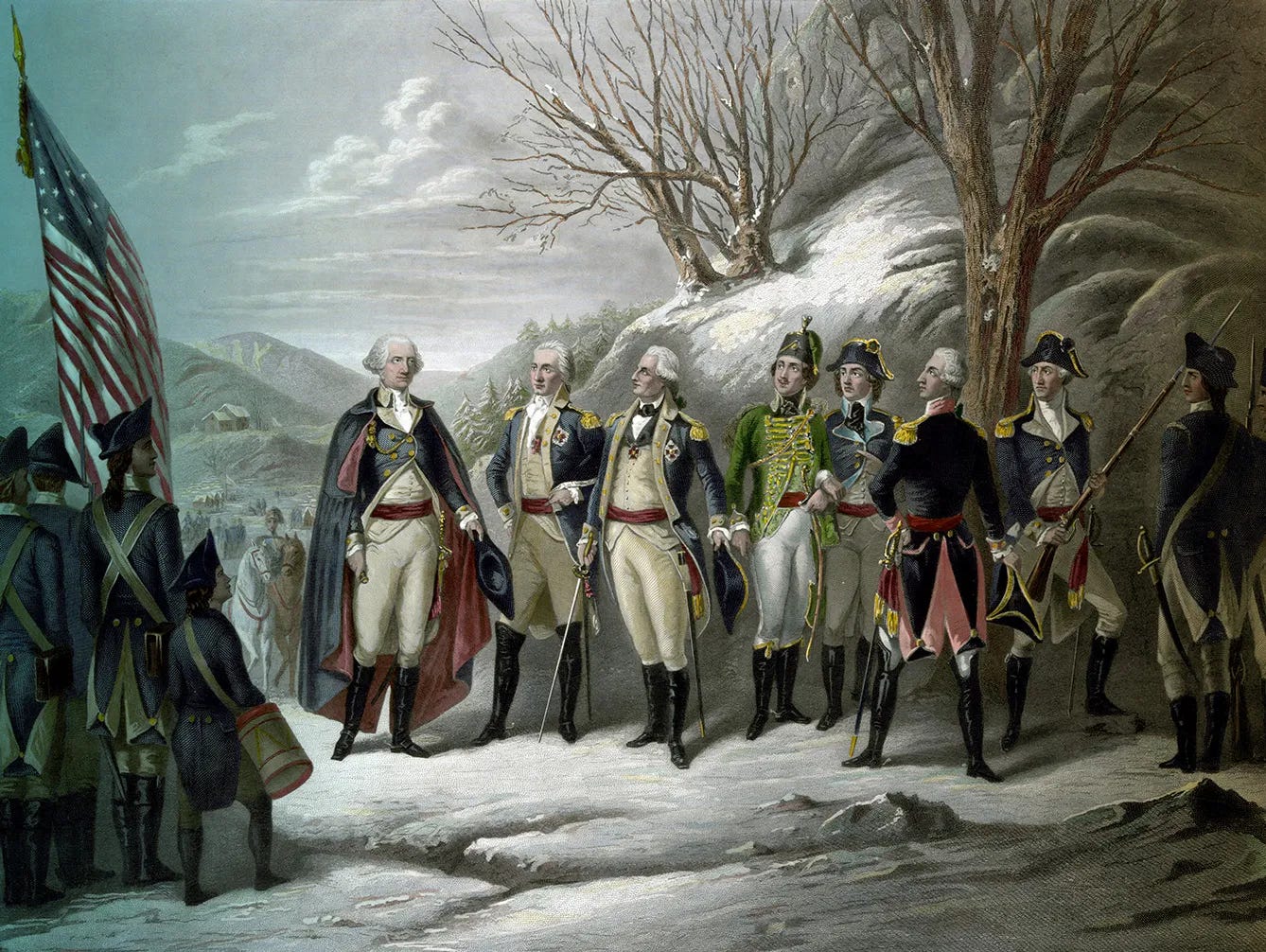
America’s unique capacity to attract and assimilate people from around the world has proven this thesis since its founding. From the American Revolution to today, foreign-born individuals have fought for America—not because they shared a lineage with native-born Americans, but because they believed in America’s principle of individual rights and chose to defend it.
Perhaps the most famous example of a foreign-born revolutionary is that of the Marquis de Lafayette. In his memoirs, he recalls hearing King George III’s brother mock the ideals of the American Revolution at a 1775 dinner—and immediately resolving to learn more and join the cause. “My heart was enlisted and I thought only of joining my colors to those of the revolutionaries,” he later wrote. The Marquis sailed to these shores at age 19 and fought in many battles, including Yorktown in 1781, where he played a crucial role.
Lafayette chose to fight for America after he became enamored with the cause for independence. In 1778, he wrote: “The moment I heard of America I loved her; the moment I knew she was fighting for freedom I burnt with a desire of bleeding for her; and the moment I shall be able to serve her, at any time, or in any part of the world, will be the happiest of my life.”
He wasn’t the only foreigner who felt this profound reverence for this country, even though he didn’t have any prior connection to it.
Prussian-born military officer Baron von Steuben is regarded as one of the fathers of the United States military. Recruited by Benjamin Franklin, the veteran officer joined the Continental Army to professionalize its ranks. Appointed temporary inspector general and dismayed at the state of the Army, von Steuben developed a training program that radically improved the Americans’ abilities to fight the war. His role was instrumental in the American victory, and the military regulations he developed continued assisting military efforts until 1814.
Though he did not share a language with the Americans, von Steuben shared their devotion to freedom. “The honor of serving a respectable Nation, engaged in the noble enterprise of defending its rights and Liberty, is the only motive that brought me over to this Continent,” he wrote to Congress in 1777. To George Washington, he wrote: “The object of my greatest ambition is to render your Country all the Services in my Power, and to deserve the title of a Citizen of America by fighting for the Cause of your Liberty.” An American in every respect except on paper when he fought, von Steuben became a naturalized U.S. citizen in 1784.
Polish-born soldier Casimir Pulaski didn’t get such an honor, as he died during the Siege of Savannah at 34. Pulaski’s own words reveal his motivation to join the Revolutionary cause: “I came here, where freedom is being defended, to serve it, and to live or die for it,” he wrote to George Washington.
Recruited for his military expertise and commitment to freedom, Pulaski eventually took command of the Pulaski Legion, a cavalry unit composed of American and foreign recruits. Like von Steuben, Pulaski didn’t speak English, yet earned the titles of “Father of the American Cavalry” and “Soldier of Liberty” for his commitment to this country.
The pattern of foreigners defending America didn’t stop after the Revolutionary War. Immigrants have fought in every war since then, and do so to this day (even in conflicts that often have little to do with the ideals they enlisted to defend, and even as the government moves to deport some of them). Per a recent congressional report, an estimated 50,000 non-U.S. citizens were serving in the Armed Forces as of February of 2026, and there are approximately 125,000 non-citizen veterans who previously served in active duty living in the U.S. (This figure doesn’t count foreign-born veterans who have become citizens.)
Among those who served is Alfredo Rascon Velasquez, a Mexican-born veteran who originally entered the country illegally and won the Medal of Honor during the Vietnam War. He eventually became a U.S. citizen. “I was always an American in my heart,” he said when asked why he had volunteered to join and go to Vietnam before he was even a citizen. He describes himself as “Mexican by birth, American by choice.”
A key thread in all these cases is that they reflect a first-hand, purposeful admiration for American values, not sacrifice or blind devotion for an inherited cause imposed on them. These individuals likely understood that they had something to gain: They fought for the country they wanted to live in, knowing that America’s revolutionary principle of individual rights enabled the freedoms they wanted to enjoy. Their Americanism and commitment come from understanding these principles, not from “ethnicity” or tribal duty.
America is, as Gorsuch said, a nation based on the ideas of the Declaration of Independence, and these ideas have persuaded millions across the world for 250 years. The foreign-born men and women who step on the battlefield made a version of a choice millions of immigrants make every day: to embrace a country defined by individual rights, not bloodlines.
This article was first published in the Orange County Register.


Here’s a letter to the Washington Post.
Editor:
Kudos to Dominic Pino for the reminder that those of us living in today’s industrialized, commercial economies enjoy nature only because nature for us has largely been tamed and sanitized by industrialization and commerce (“A hike through the woods feels natural. It’s anything but.” September 13). As Aldous Huxley wrote in 1928, reacting to William Wordsworth’s romantic attraction to nature,
The Wordsworthian adoration of Nature has two principal defects. The first … is that it is only possible in a country where Nature has been nearly or quite enslaved to man. The second is that it is only possible for those who are prepared to falsify their immediate intuitions of Nature. For Nature, even in the temperate zone, is always alien and inhuman, and occasionally diabolic…. Nature-worship is a modern, artificial, and somewhat precarious invention of refined minds. Admirable, but somehow, in too many instances, rather ridiculous in being so refined, so rootlessly high-class.*
More succinct, but no less accurate, were Will and Ariel Durant:
Word peddlers tend to idealize the countryside if they are exempt from its harassments, boredom, insects, and toil.**
Sincerely,
Donald J. Boudreaux
Professor of Economics
and
Martha and Nelson Getchell Chair for the Study of Free Market Capitalism at the Mercatus Center
George Mason University
Fairfax, VA 22030* Aldous Huxley, “Wordsworth in the Tropics” (available here).
** Will and Ariel Durant, The Age of Voltaire (1965), p. 45.
The post We Enjoy Nature Because of Free Markets, Commerce, and Industry appeared first on Cafe Hayek.


NEW YORK, NY — Twenty-five years after Americans from all walks of life had pledged to "Never Forget" the horrific terrorist attacks of September 11, 2001, sources confirmed that the nation had, indeed, forgotten.
Next Page of Stories