71593 stories
·
2 followers

★ And It’s True That I Stole Your Lighter, and It’s Also True That I Lost the Map

1 Share

Last week both Google and Apple updated their maps to accommodate Trump changing the United States Geological Survey’s recognized name for Lake Ontario to “Lake America”. Just as with Trump’s fiat renaming of the Gulf of Mexico back in the first days of his 2.0 administration, Google and Apple are showing the same names to the same people, by region. Here are the names you now see for Lake Ontario, based on what region your device is set to:

  • United States: “Lake America”
  • Canada: “Lake Ontario”
  • Everywhere else in the world: “Lake Ontario (Lake America)”

This is exactly the same as their joint solution to the Gulf of Mexico renaming — the U.S. sees “Gulf of America”, Mexico sees “Gulf of Mexico”, and the rest of the world sees “Gulf of Mexico (Gulf of America)”.

Here is the solution I strongly believe Google and Apple should follow:

  • United States: “Lake America (Lake Ontario)” and “Gulf of America (Gulf of Mexico)”
  • Everywhere else in the world: “Lake Ontario” and “Gulf of Mexico”

There is no reason to show these new Trump-dictated names anywhere outside the U.S., even putting them in parentheses. There is no reason to show only the actual traditional names exclusively for users in Canada (for Lake Ontario) and Mexico (for the Gulf). Treating Canada and Mexico as special cases only makes sense if they’re part of some sort of dispute over the names. They’re not. The names of these two bodies of water are not contentious. There is no long-simmering debate about them, like there is with Denali/Mount McKinley in Alaska. The one and only country on the planet with a crackpot kook-ridden government that claims these bodies of water have new names is the United States; the only country that should see the new names is the United States.1

So, I disagree with how Google and Apple have chosen to handle these re-namings. But it is correct that users in the United States do see the new names.

Here’s Andy Ihnatko, at his eponymous website:

We all have every right to be upset. Google’s receiving plenty of flak over this move (as is Apple; Apple Maps now shows “Lake America,” reportedly after being pressured directly by Trump). I dislike Google’s and Apple’s choices, but I can’t personally fault them.

That said, Trump’s move is clearly meant to antagonize Canada during a volatile period in our relations. He’s throwing gasoline on a tariff fight that’s already creating uncertainty and suffering among vulnerable businesses and consumers on both sides of what was once an impeccably peaceful border. Google and Apple didn’t need to move so damned quickly. I wish they’d deferred the name change long enough for things to cool down a little. Doing so would have avoided creating the perception of handing one side a swift, validating victory.

I doubt a cooling-off period would help. Wounds don’t feel better when they’re reopened after healing. It’s best to get it over with. Applying the change to Google and Apple Maps while the GNIS database ink is still wet at least serves to remind who made this change and why. And whose change it rightfully is to make.

This is a bitter pill for some to swallow. What a lot of people want is for Google and Apple to just ignore the U.S. government’s official new names. E.g., to pick just one high-profile pundit, here’s Kara Swisher regarding Google (“quislings”) and Apple (“craven”, “pathetic”). But I suspect, quite strongly, that the people who profess to be the most angry at Apple and Google for going along with this change are the same people who would argue most strongly that Goliath tech companies and mega-billionaires wield too much anti-democratic power and influence.

It’s not coherent to argue that Google and Apple should decide which names to put on their maps only when you want them to ignore the names from the official government database. Neither Google nor Apple are going to sell their maps apps, but it’s not outlandish to think that in some alternative universe, one or more of the leading maps app might be owned by, say, Elon Musk or Larry Ellison. Would the people who want Apple and Google to ignore the official names from the GNIS support the same stance if the two leading maps apps were owned by SpaceX and Oracle instead? Obviously they would not.

What we want is a system where geographic names are determined democratically, by voting. And that is the system we in fact have. Trump won. The Department of the Interior has the power to change these names. If you’re angry that their official names in the United States are now Lake America and Gulf of America, stay angry that Trump won the 2024 election. Stay angry that our president continues to debase his office and embarrass our nation. Directing your anger at Google and Apple for reflecting that change is shooting the messengers.

But this is why I find it embarrassing that both Google and Apple are foisting these absurd names on the rest of the world, even if only between parentheses. These names are nonsense, and they are Americans’ nonsense to deal with.

China is another country with ridiculous geographic dogma. China demands that Taiwan, which is an independent free nation, be falsely labelled as a province of China. Apple Maps reflects that policy — within China. It doesn’t label Taiwan as “(Province of China)” on maps outside China. Bullshit inside parentheses is still bullshit. Less seriously but more preposterously, the Chinese government also insists that the obscure Diaoyu Islands, subject of a long-running territorial dispute with Japan, be drawn larger than they actually are on maps. Apple Maps dutifully renders those inflated false island sizes to users in China. It doesn’t show them to users anywhere else in the world — not even as dotted outlines. Chinese users see Chinese government dogmatic nonsense; no one else does.

So too it should be for U.S. government dogmatic nonsense. Spreading the nonsense to the rest of the world only makes it more embarrassing.

Neither Google nor Apple claim to be cartographic editorial authorities. I do not think we should want them to be. Other non-governmental institutions do claim to be independent authorities. The Associated Press has stuck to their guns even in the face of losing its White House press pool seat over their refusal to adopt the “Gulf of America” name. And then there’s Wikipedia, whose reputation, integrity, popularity, and independence haunt the right wing. From Politico, last week:

Other platforms will soon follow, a senior administration official told Politico on Tuesday. “We got Lake America changed on Google Maps, and many other maps are changing in a couple days. And Wikipedia is going to change as well,” said the official, who was granted anonymity to speak frankly.

As of Wednesday, Wikipedia was still using the original names of both the Gulf of Mexico and Lake Ontario, while noting that Trump had signed orders to rename them.

Regarding this, Molly White noted:

A Wikipedia editor put it well: “You almost want to pat them on the head and say ‘Yes, of course it will’ in the same way you’d tell a small child that Santa Claus will be delivering their presents.”


  1. And, I feel strongly, the traditional names should remain visible, in parentheses, even for users in the U.S. for a period of, say, five years. What is someone who doesn’t follow current events — god bless them — to think if they go looking for Lake Ontario on Google Maps or Apple Maps and don’t see it? ↩︎

Read the whole story
gangsterofboats
1 hour ago
reply
Share this story
Delete

The myth of the cession of Māori sovereignty [sic]

1 Share
A piece from a Dr Luke Fitzmaurice-Brown is doing the rounds again. It's called 'The Myth of the Cession of Māori Sovereignty' -- and argues (unsurprisingly) that "to accept that Māori surrendered sovereignty when they signed Te Tiriti o Waitangi in 1840 requires 'a profound suspension of disbelief'."

So I figured I'd fisk the Fitzmaurice-Brown fiction.

Mr Fitzmaurice-Brown [whose opinion piece excerpts appear in blue] is a law lecturer at the university formerly known as Victoria University of Wellington. Unlike him, I'll begin by defining my terms -- or at least the most important one: "Sovereignty":
Sovereignty is the supreme authority of a state or governing body to rule itself without interference from outside powers. It typically includes a few core elements:
  • Political authority – the recognised right to make and enforce laws within a territory
  • Independence – freedom from control or dictation by other states or entities
  • Territorial integrity – authority over a defined geographic area
  • Self-determination – the capacity of a people or government to decide their own political status and course
So this is what's contested. And the opinion piece by Fitzmaurice-Brown begins with some of those basic assumption, especially those last four:

Moana Jackson once said that to accept that Māori surrendered sovereignty when they signed Te Tiriti o Waitangi in 1840 required “a profound suspension of disbelief.” As he put it, no country anywhere in the world has ever guarded its independence for hundreds of years only to then relinquish it. He argued that “to assume that is what our people did flies in the face of human history, let alone Māori history, where the notion of giving away the authority to make independent decisions is not just culturally inconceivable, it is politically impossible.”

But there's an immediate problem. He talks about a "country" that "guarded its independence." A country? What country? There was no "country" here to claim independence, let alone to guard it. For hundreds of years -- those years that Jackson claims was spent "guarding" independence -- Māori was set against Māori as each tribe, iwi and hapu struggled, not for independence but for safety. For survival. If anything were guarded here it was tribal claims -- and, more accurately, they were not guarded but contested -- heavily contested. Tell the Te Rauparaha of 1820, for example, that he was guarding the independence of these islands and he would have laughed; he was not trying to guard the "country" as he warred his way from Kawhai to Kaiapoi, but to exterminate his enemies. 

In a series of islands with no visible outsiders, even the idea of a "country" would have been absurd -- you might even say it would require “a profound suspension of disbelief.”

There is no historical disgrace in societies contesting territory over each other-- but for the sake of peace and prosperity and everything that's wroth living for, they do need to get over it. For centuries, Europe endured that struggle. The idea of "sovereignty," which Mr Fitzmaurice-Brown leaps over so quickly, came from the Peace of Westphalia (1648) which ended the massively destructive Thirty Years' War in Europe. The idea came from it that religious authority behind a throne, which created these endless wars, must be replaced with something "better": an idea of nationhood in which each state held supreme authority within its own territory — with no higher power (pope, emperor, or otherwise) entitled to override it.

In this idea, sovereignty was not contested, it was recognised -- even in its breach. Inter-tribal or inter-religious battles were replaced with a recognition of some kind of right. And some kind of peace flowed therefrom.

If we drill down a level, that right to rule within a given territorial area came from the idea that the people within that territory were not subjects, but citizens, each of them holding some kind of rights. As this idea became better understood, it was realised that sovereignty is not a primary, freestanding right of "the state" or "the nation" as an entity in itself — it is a derivative right. It exists only because, and only to the extent that it does. protect the individual rights of the people living under that government. In other words: Sovereignty is downstream of individual rights, not the other way around.

This has a sharp corollary that we should spell out explicitly: sovereignty is conditional on being a rights-respecting government.

We are already several miles from Moana Jackson's historical assumptions. Territorial authority for him comes not from the consent of the ruled, but from the point of a taiha. 

But even if we've disproved the idea that there was one "country" here to cede authority, we're still left with his claim that those several tribal leaders who did control territory here -- not by right, but by military power -- would not have given away that gradually crumbling authority. Whay would they when they were (apparently) all-powerful within their fiefdoms. Fitzmaurice-Brown cites Margaret Mutu in support of this idea:
Professor Margaret Mutu [he says] has pointed out the huge amount of evidence that casts further doubt on the myth of the cession of sovereignty. She states, for example, that in 1840 the Māori population numbered about 80,000, while the settler population numbered about 2,000. That the former would give up their sovereignty to the latter seems overwhelmingly unlikely. In some parts of the country, there were single-figure numbers of settlers when Te Tiriti o Waitangi was signed.
And this is true, of course. And unanswerable ... unless you go back to that realisation that the territorial authority of each tribe and tribal leader was continually contested. Signing Te Tiriti was not simply handing over the sovereignty of 80,000 Māori to 2,00 settlers for unfathomable reasons. It was an exchange: giving up the notion of continuing and ongoing territorial struggle (highlighted by the horrific self-inflicted Butchers' Bill experienced under the Musket Wars) for this new idea promulgated mostly by missionaries (however imperfectly) of peace within a given territorial area.

The rangatira who signed Te Tiriti were the modernisers of their day. As Lyndsay Head explains, their signatures ceding sovereignty were entirely rational:
"In the 1830s northern Māori sought meaning in their post-contact experience through understanding how the foreigners ordered their world. This was a period of rational and intellectual response to European culture in which Christian teaching became a political primer for change. Consciously replaying the conversion of the barbarians, the missionaries taught that peace was the condition of political and social modernity — that is, of a European-style society.
    "This impacted heavily on culture, because tribal histories were almost exclusively histories of war. Fighting was central to the social identity of Māori. [It set] up peace as the condition of modernity ...
    "Their attention to the missionaries, and subsequent support for a treaty with the British, was not without history, but a response to lived change. By this reading, then, a possible basis of Māori citizenship was rational choice.
    "The rationality of the chiefs has been obscured by the rationality of the British side of the Treaty, which entirely dominates the literature."
It would be nice if that rationality were respected rather than brushed over by the likes of Mutu and Fitzmaurice-Brown.

He continues however:

Nevertheless, the idea that Māori ceded sovereignty in 1840 has been unquestioned by many New Zealanders for much of our country’s history. In large part this has been because of the appearance of the term in the English text of the Treaty of Waitangi. Article 1 of the Treaty states that Māori signatories ceded “all the rights and powers of sovereignty” to the ‘Queen of England’. Case closed, right?

Well, no. The English text of the Treaty of Waitangi was never actually signed on February 6 at Waitangi, with every signatory on that day signing their name to Te Tiriti o Waitangi, the text in te reo Māori. Subsequently around the country, about 500 Māori leaders added their name to Te Tiriti, but about 92 percent of those leaders signed the Māori text. ...

So, what does the text in te reo actually say?

Instead of mentioning ‘sovereignty’ (as the English text does), article 1 of the Māori text gives the Queen of England the power of “kāwanatanga”, a transliteration of the English term ‘government’ or ‘governance’. Kāwanatanga was likely intended as a far more limited form of authority, primarily aimed at enabling the Crown to control and discipline its own settlers (who were largely beyond the control of the English legal system in Aotearoa).

Mr FB is right, of course. Rangatira signed the te reo text, after they heard an explanation of it by the translator Henry Williams. Several of those rangatira were readers, but even those wholly reliant on Williams would have heard him say, in describing the Treaty's Article 1, that "the chiefs shall surrender to the Queen for ever the Government of the country, for the preservation of order and peace." That was from the description of his translated speech which Henry Williams wrote about to Bishop Selwyn, 12 July 1847 [reproduced in Hugh Carleton's The Life of Henry Williams]. 
Of course, they would have heard it in te reo, in which Williams translated the word "Government" as "kawanatanga katoa."  That little word katoa is rarely mentioned by today's revisionists. And with good reason. Because, as Ewen McQueen observes, "it means complete, all-encompassing, totally, without exception." 
It’s no wonder [that in 1840] it focussed the minds of the chiefs on the issue of Crown authority. ...  
    Nowhere in the historical records do we find any indication that either the chiefs or the Pākehā protagonists understood anything other than that Kāwanatanga katoa meant the Crown was being established as the pre-eminent governing authority in the land. ...
    Te Kawenata Hou' (the 'Māori New Testament') ... would have had significant influence on how the chiefs understood the Treaty. ... In 'Te Kawenata Hou' the term rangatira is a general term for leadership. In contrast kawana is a very specific term used to denote governors who represent the authority of kings.   To use [the] example of Pilate – as the kawana (governor) he represented the sovereignty of the Roman empire in Jerusalem. He had the authority to tax and to execute judgement. The local Jewish leaders who wanted Jesus crucified had to get his permission. Those leaders are described in Te Kawenata Hou as rangatira. From this the chiefs at Waitangi would have quickly understood what was being proposed in the Treaty. And it certainly did not involve them retaining 'absolute sovereignty'."
But, as everyone from Hugh Kawaharu to Matthew Hooton to Margarat Mutu to Mr Fitzmaurice-Brown would counter, what about "Article 2 of the te reo text [which] guaranteed that Māori would continue to be able to exercise 'tino rangatiratanga' over their whenua, kainga, and taonga katoa – translated by Sir Hugh Kawharu as their lands, their villages, and all their treasures. 
This is the closest the te reo text gets to mentioning sovereignty [says Mr Fitzmaurice-Brown], but in the te reo text it is a power reserved for Māori, not for the Crown.
Mr Fitzmaurice-Brown lectures in law, but appears ignorant of even the first principles of the subject. In law, an earlier Article (which often sets the fuller context) generally takes precedence over later articles. And if Mr Fitzmaurice-Brown were to read that earlier Article, he would see those words "kawanatanga katoa," i.e., complete Government, which the te reo text (as translated by Te Tiriti's first translator) says "the chiefs shall surrender to the Queen for ever." 

Why would they do that? As answer, the Article continues: "For the preservation of order and peace."

If you don't have Hugh Carleton's Life of Henry Williams (and why would you, it's poor reading even for historians) you can read Williams's transliteration of the te reo text on page 481 of Ned Fletcher's tome. Perhaps Mr Fitzmaurice-Brown could read (or re-read) it? Because it contains in only a few words the counter to the first two of his opinion piece's main points.

He continues however. 

The evidence against the cession myth is further bolstered by another document, signed in 1835 – He Whakaputanga o te Rangatiratanga o Nu Tirene: the Declaration of Independence of the United Tribes of New Zealand. Generally referred to just as He Whakaputanga, it is an assertion of Māori mana, sovereignty, and independence, addressed primarily to an international audience ...

This is a pathetic claim, evidence only of the ability to grasp at straws. The Declaration was the idea of James Busby, the British Resident here desperate for something to do. Written by him, signed by thirty-four northern chiefs, it was formally acknowledged by the Crown in May 1836.  

What did it say? 
It asserted that sovereign power and authority in the land (‘Ko te Kingitanga ko te mana i te w[h]enua’) resided with Te Whakaminenga, the Confederation of United Tribes, and that no foreigners could make laws. Te Whakaminenga was to meet at Waitangi each autumn to frame laws ....
Te Whakaminenga, the Confederation of United Tribes, in which sovereignty was supposed to reside, never met to "frame laws" -- in fact it never met again. As the NZ History site acknowledges, For many,  the Declaration was primarily a matter for Ngāpuhi, who were ninety percent of the signatories. For any other rangatira to travel to Ngāpuhi territory for any reason in 1835 was still to take your life in your hands, so it's not surprising no more came of it. Historian Paul Moon sees it as a ‘regional goodwill agreement rather than a national document of truly constitutional significance.'" 

It's only significance, having been recognised by the British Crown, was to ensure that any lingering claim to sovereignty derived from the Declaration was firmly expunged by Te Tiriti -- which is precisely the opposite of Mr Fitzmaurice-Brown's argument.

Persistent as ever, however, he continues:

More recent scholarship suggests the cession of sovereignty (in the sense of all-encompassing power, including over Māori) may not have even been intended in the English text. That is a debate for another day ...

Indeed, that alleged "recent scholarship" by Ned Fletcher is when I entered that debate in two opinion pieces at Newsroom not so long ago.

... but in the meantime, the myth of the cession of sovereignty persists. ... To return to Moana Jackson’s words about the suspension of disbelief, I would add that believing Māori ceded sovereignty in 1840 also requires a suspension of humanity. Put yourself in the shoes of the actual rangatira who signed Te Tiriti. If you assume the humanity of those leaders, if you assume they were intelligent, competent, and humane, you can’t possibly reach the conclusion that they just gave away everything that mattered to them and their people. It’s hard to think otherwise unless you believe Māori were unintelligent, incompetent, and inhumane.

Mr Fitzmaurice-Brown began his opinion piece essentially suggesting that to see Māori ceding sovereignty made you dumb. To that he now adds that it makes you racist. What a vile person he must be.
If you assume the humanity of those leaders, if you assume they were intelligent, competent, and humane [he says, to repeat], you can’t possibly reach the conclusion that they just gave away everything that mattered to them and their people.
And of you think otherwise, he implies, you're a racist. Is this the lowest of the low? Of course an honest person can reach that conclusion. To cite just Lyndsay Head above, she argues it was precisely the intelligence, competence, and humanity of these modernising rangatira that recognised Māori citizenship within a British legal paradigm was, in 1840, a completely rational choice. 

Does Mr Fitzmaurice-Brown answer that? Of course not.

Lyndsay Head's argument is only reinforced by what the signatories themselves were reported to have said in that first signing (as we can read in Colenso's account), and what they said about their signing two decades later in Kohimarama -- what Claudia Orange once called the renewal of a Covenant.

The Kohimarama Conference began with then Governor Gore Browne recalling to those assembled (including more than 100 rangatira from Ngāpuhi in the north to Ngai Tahu in the south, who by then were mostly competent in English, and who could also enjoy translations into to reo):
On assuming the Sovereignty of New Zealand Her Majesty extended to her Maori subjects her Royal protection, engaging to defend New Zealand and the Maori people from all aggressions by any foreign power, and imparting to them all the rights and privileges of British subjects; and she confirmed and guaranteed to the Chiefs and Tribes of New Zealand, and to the respective families and individuals thereof, the full, exclusive and undisturbed possession of their lands and estates, forests, fisheries, and other properties which they may collectively or individually possess, so long as it is their wish to retain the same in their possession.
    In return for these advantages the Chiefs who signed the Treaty of Waitangi ceded for themselves and their people to Her Majesty the Queen of England absolutely and without reservation all the rights and powers of Sovereignty which they collectively or individually possessed or might be supposed to exercise or possess.
The astute reader will notice that these are almost exactly the words to which Mr Fitzmurice-Brown objects -- that is to say, almost a recapitulation of the Treaty terms. No one rose to object.

The Conference itself concluded on 10 August 1860 with rangatira gathered there giving unanimous agreement that:
the several Chiefs, members thereof, are pledged to each other to do nothing inconsistent with their declared recognition of the Queen's sovereignty and of the union of the two races ... [16] 
It was Apirana Ngata six decades later who reminded Māori that
The Government placed in the hands of the Queen of England, the sovereignty [mana] and the authority to make laws. ... it made the one law for the Maori and the Pakeha. If you think these things are wrong and bad then blame our ancestors who gave away their rights in the days when they were powerful.
    Those ancestors were not stupid. They knew what they were about, and and had a pretty fair idea of what they were promised.
But perhaps they knew less about what they were agreeing to and signing than geniuses like Mr Fitzmaurice-Brown, and the intellectual giants who are sharing his work on social media.

Read the whole story
gangsterofboats
1 hour ago
reply
Share this story
Delete

The Monkeyfisher: an Award for the Year’s Worst Journalism

1 Share


Read the whole story
gangsterofboats
1 hour ago
reply
Share this story
Delete

AI keeps stubbornly refusing to take our jobs

1 Share

It’s Labor Day, so here’s a post about how human labor is alive and well in the age of AI.

I live in San Francisco and hang out with a lot of tech people, both in the AI industry and outside of it. And one thing that almost everyone I know here believes is that AI’s main economic effect is to displace humans from their jobs. Most people don’t have concrete arguments for why this should be true; it’s just an article of faith. The conventional wisdom is pretty well summed up by the first line of this tweet:

In fact, AI companies themselves have spent years talking about how their inventions are going to render large swathes of humanity economically obsolete — an odd marketing pitch, perhaps, but one that seemed to reflect their honest expectations.

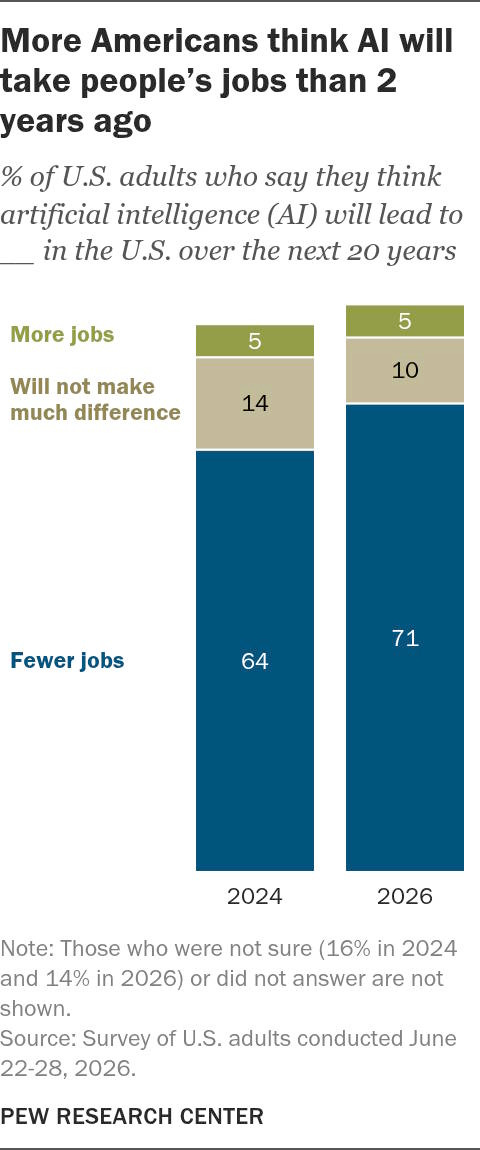
A lot of times, San Francisco tech people are out of step with the general public. This time, though, the public seems to agree. A recent Ipsos poll found that most Americans expect AI to compete with human workers more than it complements them. And Pew finds that this belief has even strengthened in recent years:

Source: Pew

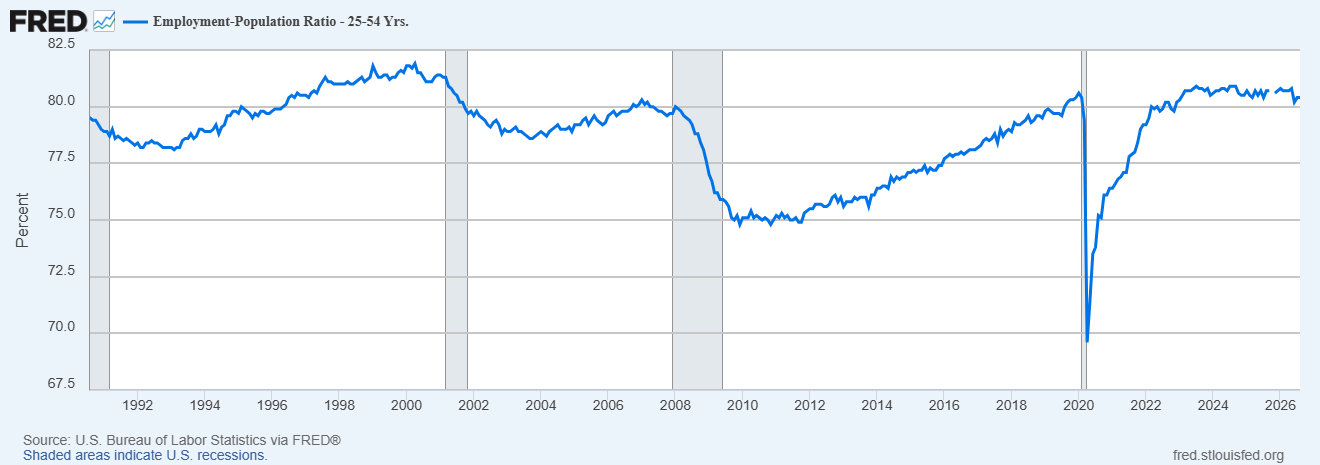
So basically, most people think AI is a job-killer. And yet somehow, this job-killer keeps stubbornly refusing to kill jobs. In the aggregate, the labor market is about as healthy as it’s ever been. The prime-age employment rate — the single best indicator of how many Americans have jobs — continues to hover near all-time highs:

Of course, there are lots of other things going on in the labor market right now besides AI. But most of those things — tariffs, the Iran war, etc. — are bad for employment. It’s not easy to identify some sort of positive shock that is canceling out the job-killing effects of AI.

Or maybe it is, if the shock is AI itself. Theoretically speaking, automation can create jobs just as easily as it can destroy them. Here are Acemoglu and Restrepo (2019), explaining the various ways that technology can affect the demand for labor:

Automation [can be bad] for labor because of a displacement effect—as capital takes over tasks previously performed by labor…

[A]utomation technology also increases productivity, and via this channel, which we call the productivity effect, it contributes to the demand for labor in non-automated tasks

[T]he displacement effect of automation has [historically] been counterbalanced by technologies that create new tasks in which labor has a comparative advantage. Such new tasks generate not only a positive productivity effect, but also a reinstatement effect—they reinstate labor into a broader range of tasks and thus change the task content of production in favor of labor. The reinstatement effect is the polar opposite of the displacement effect and directly increases the labor share as well as labor demand. [emphasis mine]

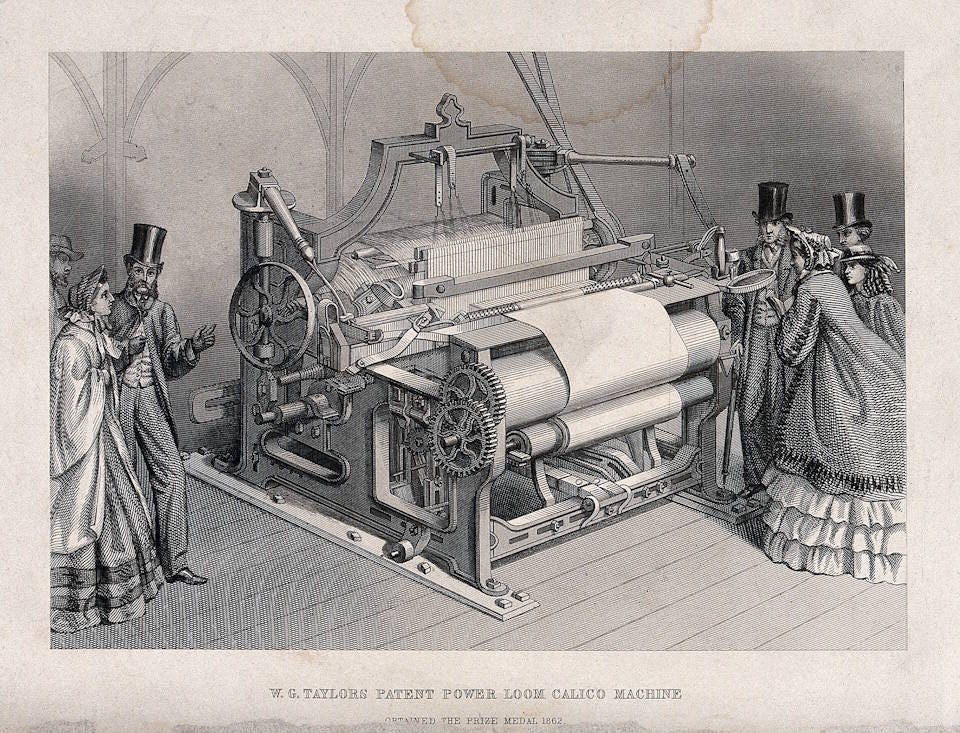
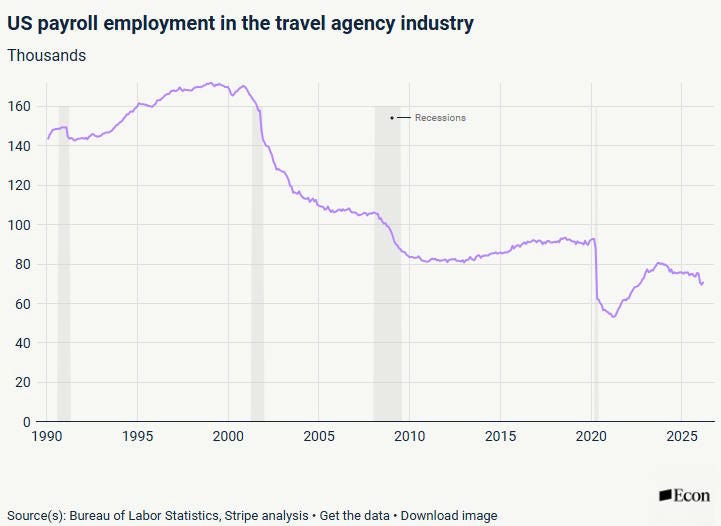
In other words, automation can do three basic things. Yes, it can replace people and take their jobs. It can also make them more productive, which can both create jobs and destroy them.1 And, crucially, automation can create new jobs for people to do. Power looms replaced master weavers, but they created jobs for technicians and engineers to make the power looms work. The internet automated much of the work of travel agents, but created jobs for web designers. And so on.

People who think of AI as a job-killer might not have thought of the second and third of these. Or they may have thought of them, but simply assumed they’re not a big deal. Anecdotally, a lot of tech people think that AI will keep substituting for more and more tasks until A) productivity increases just increase the demand for AI, and B) there are no new tasks left for humans to do. AI detractors, meanwhile — like Daron Acemoglu himself — often simply assume that new tasks created by AI will be “bad tasks” like misinformation and cybercrime that hurt the economy instead of helping it.

But these assumptions simply might not be correct. AI might be creating lots of new tasks for humans to do. For example, software engineers are writing less and less code themselves. Instead, they’re spending more and more time telling AI to write code — that represents a productivity improvement. But they’re also trying to figure out what code to tell AI to write, making sure AI is writing the kind of code they want, integrating that code into products, and so on. Those are all new tasks. There are also a lot of software engineers working on improving AI itself, and on discovering new applications for AI. Those are new tasks as well.

This helps explain why in the age of Codex and Claude Code, software developer jobs have been increasing as a percentage of total employment:

Anecdotally, organizations that thought they could replace lots of their software engineers with AI ended up having to hire many of them back — sometimes at a premium.

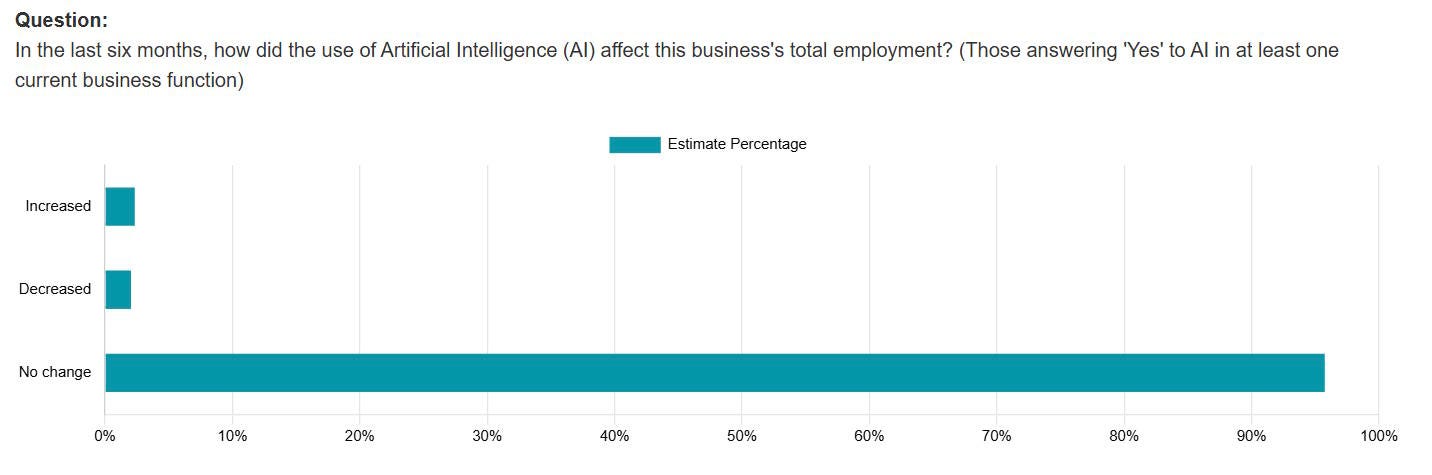
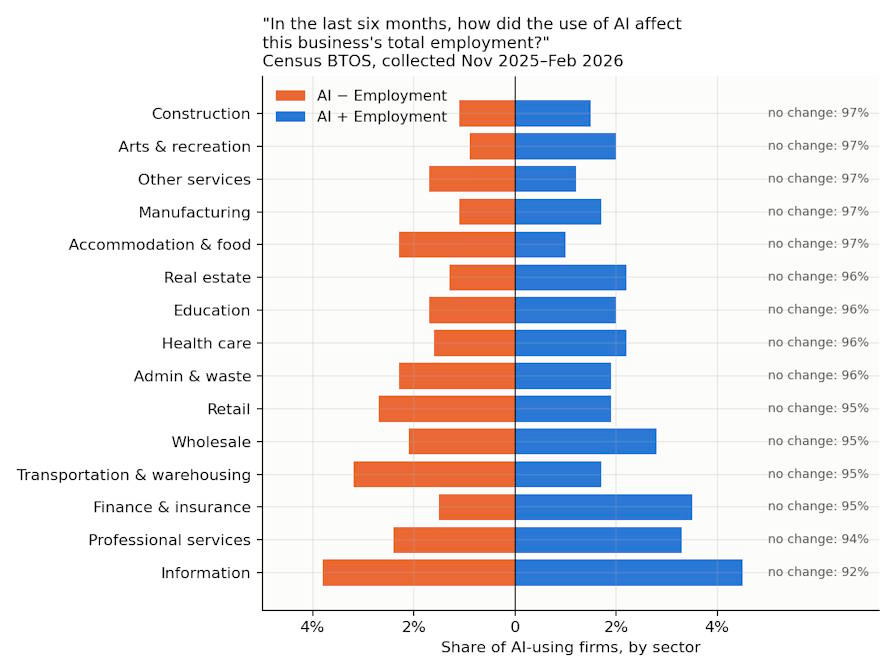
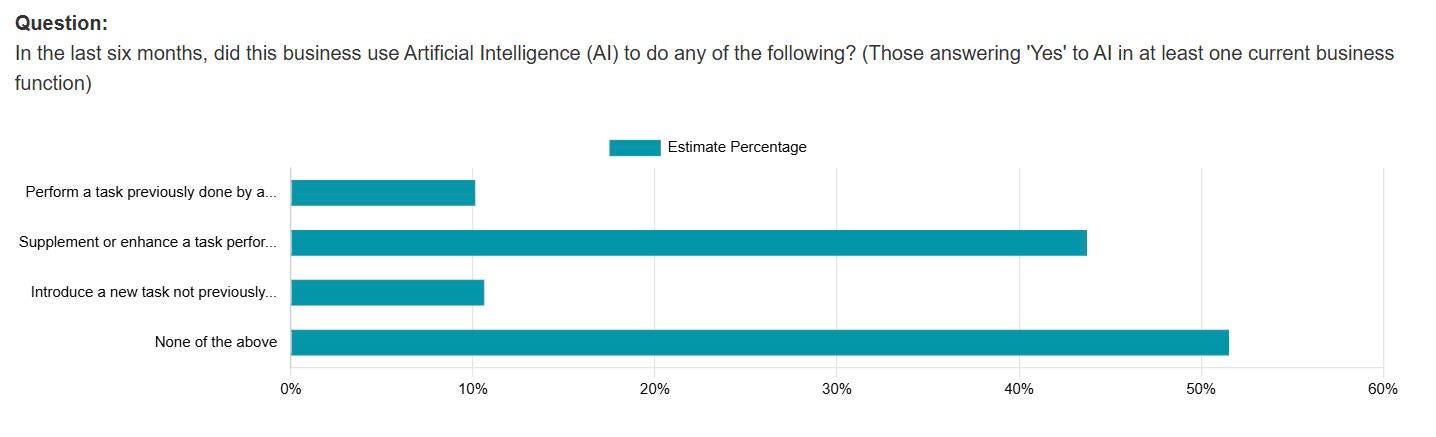
In fact, this is a story we see throughout the economy. Alex Tabarrok recently reported on a Census Bureau survey about AI that’s been running since 2023. The Census Bureau calls companies up and asks them A) how AI affected their total employment, and B) how AI affects the tasks that workers do.

Most companies reported no change in overall employment, which could just be due to inertia. But of companies that did report a change, more reported an increase than a decrease!

And here’s the breakdown by sector:

Source: Census Bureau via Alex Tabarrok

The story was similar for tasks. Tabarrok writes:

Among firms using AI, 44% say it supplemented or enhanced work an employee already does. Ten percent say it performed a task an employee used to do. Eleven percent say it introduced a task no one had been doing.

Here’s the chart:

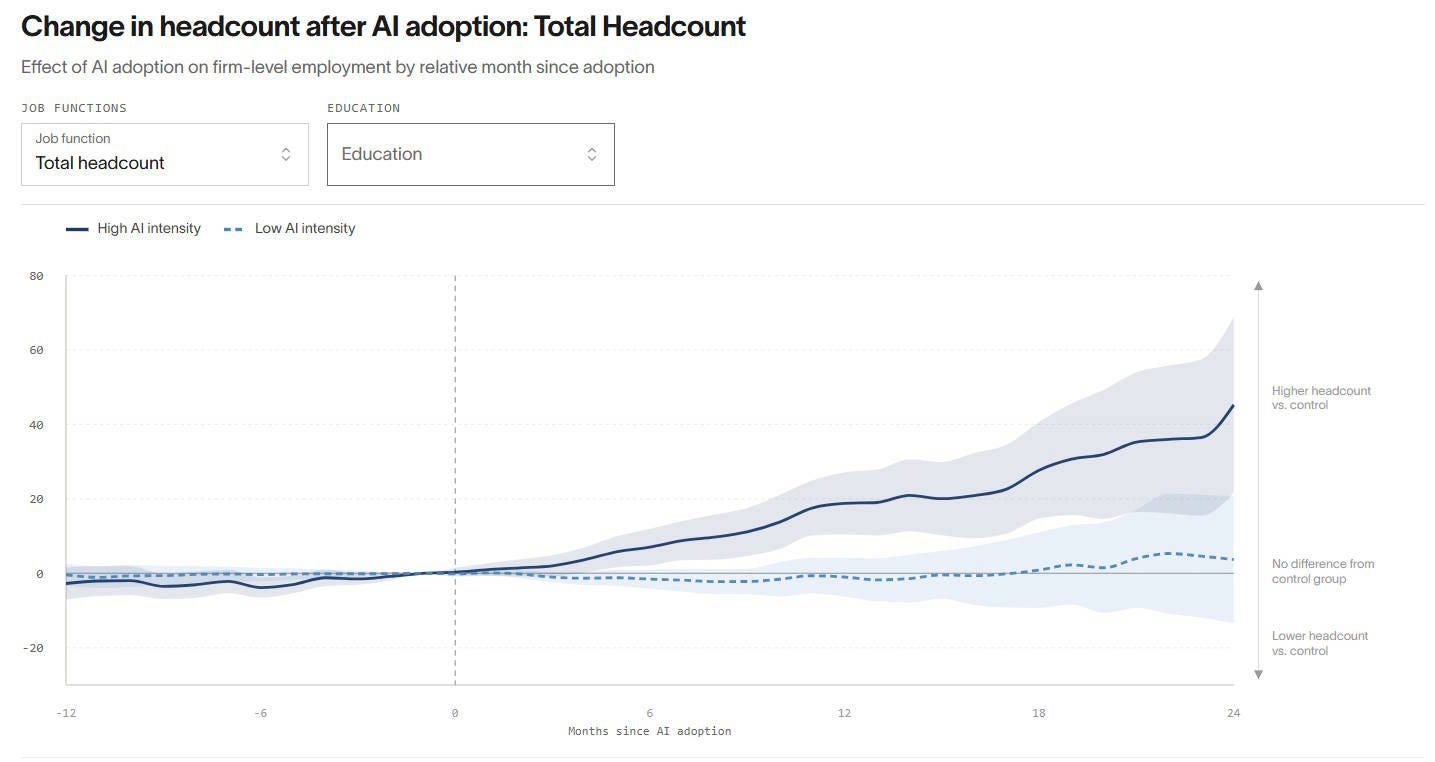
Rigorous research, meanwhile, sometimes finds negative effects of AI on labor demand at the industry level, and sometimes not. But at the company level, the evidence is clearer — Kharazian, Simon, and Stevens (2026) find that when companies adopt more AI, they tend to hire humans rather than replacing them. Here’s a blog writeup of their findings:

Ramp Economics Lab
We can finally say AI isn’t killing jobs
Dear Colleagues: The most important economic question of this decade asks how AI will affect jobs. Everyone wants to write that paper. Until now, no one has had the right dataset, so existing research has relied on a combination of guesses, surveys, AI exposure scores, and self-interested punditry. In fact, a recent paper from Stanford said the ideal da…
Read more

And here’s a chart:

Interestingly, they find the same for entry-level jobs — the jobs that people usually identify as being most under threat from AI.

So despite Acemoglu’s skepticism, it looks like for now, the new tasks being created by AI are probably matching or even slightly exceeding the tasks replaced by AI. Of course this measure is “number of companies” rather than “number of jobs”, but the pattern is pretty clear.

The Economist, meanwhile, has a report on how AI is creating jobs, both through the “new tasks” channel and by boosting demand in areas that AI can’t yet touch — physical jobs like construction and HVAC installation. Here’s what they write about the productivity/demand effect:

The Economist estimates that AI has so far created around 1m new jobs in America. That easily exceeds the roughly 200,000 lay-offs attributed to AI since mid-2023, and appears more than enough to offset weaker hiring in many back-office roles. America’s AI infrastructure splurge has created many of them…The Economist tracked five industries at the heart of the data-centre build-out, from electrical contracting to equipment manufacturing. Since 2023 employment in them has risen by roughly 320,000 more than broader…trends would suggest…LinkedIn, a social network for strivers, estimates that nearly half a million data-centre jobs were created between 2023 and 2025 in America, with data-centre technicians and engineers among the most common recent hires…

The scramble for workers is showing up in pay cheques, too. Indeed finds that installation and maintenance jobs at data centres advertise wages about 40% higher than comparable work elsewhere…In the year to June, average hourly earnings rose more than 13% in electrical-equipment manufacturing and nearly 8% among electrical contractors. [emphasis mine]

And here’s what they write about new tasks:

AI is also creating a new class of white-collar jobs. Engineers build the models, data annotators label their inputs and judge their answers, “forward-deployed” engineers adapt them for customers, and newly minted “heads of AI decide what companies should do with the technology. Some of these roles barely existed until recently. Many are quickly growing in number. Postings for heads of AI, AI engineers and directors of AI have roughly doubled since 2023-24, according to LinkedIn…

Preliminary research by Gad Levanon, chief economist at the Burning Glass Institute…reckons roughly 1% of professional jobs are now “AI jobs”…[P]rofessional occupations closest to the AI boom—engineers, software developers, mathematicians and data scientists…have added roughly 730,000 jobs above trend in recent years[.] [emphasis mine]

What about specific occupations? Technology has certainly destroyed many specific types of jobs over the centuries — there are (basically) no more elevator operators, human telephone operators, or people who do manual typesetting for printing.

And yet in recent decades, we haven’t seen as much of this sort of occupational destruction. For example, a lot of people thought the internet would kill travel agents. And while the industry was hit hard, there are still plenty of travel agents left:

The reason is probably that the job of “travel agent” is much more flexible and “messy” than older types of jobs like elevator operator; travel agents do a whole lot of different tasks, so they’re harder to replace than people who just stand there and press a button. That makes modern jobs harder to replace entirely.

It’s a good bet that AI will eventually make some occupations obsolete. But so far, despite awe-inspiring progress in model capabilities, it’s extremely hard to find occupations that have seen significant replacement by AI. Top AI researchers who famously predicted the end of human radiologists saw their predictions get confounded. Truckers, too, are doing just fine.

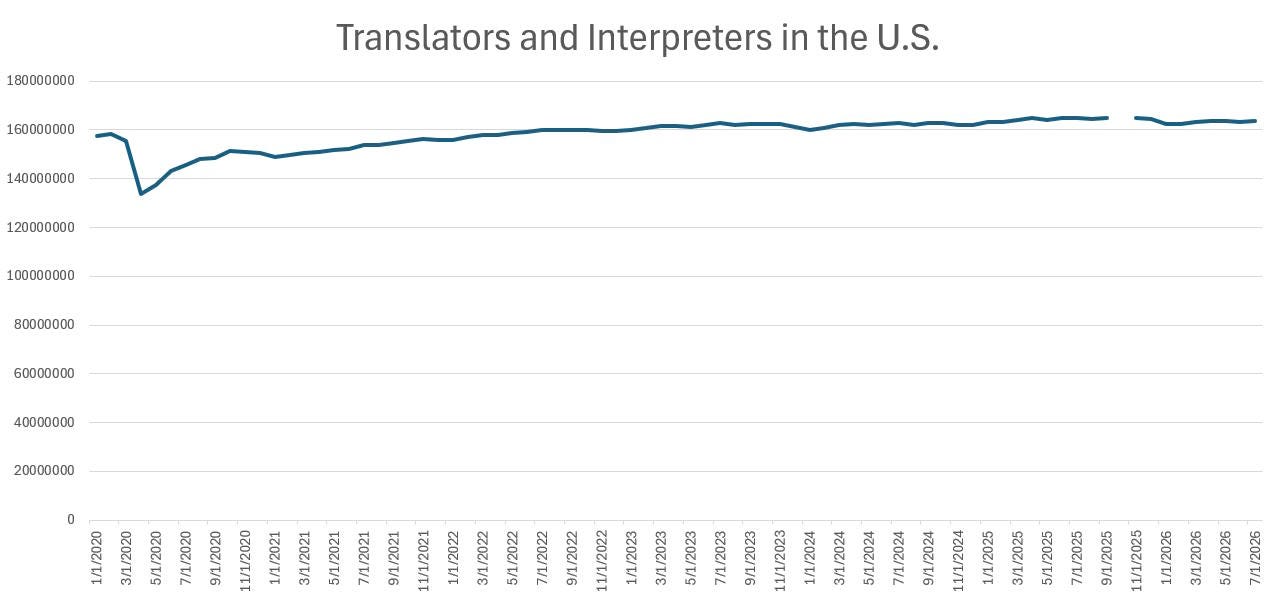
The most impressive example might be translators. It seems pretty obvious how AI could replace human translators, and yet it hasn’t done so yet:

Here’s a chart:

Source: Census Bureau

If you could go back to 2022, and tell people that in four years, AI would be solving frontier math problems, but we’d still have the same number of people working as translators, how many would have believed you?

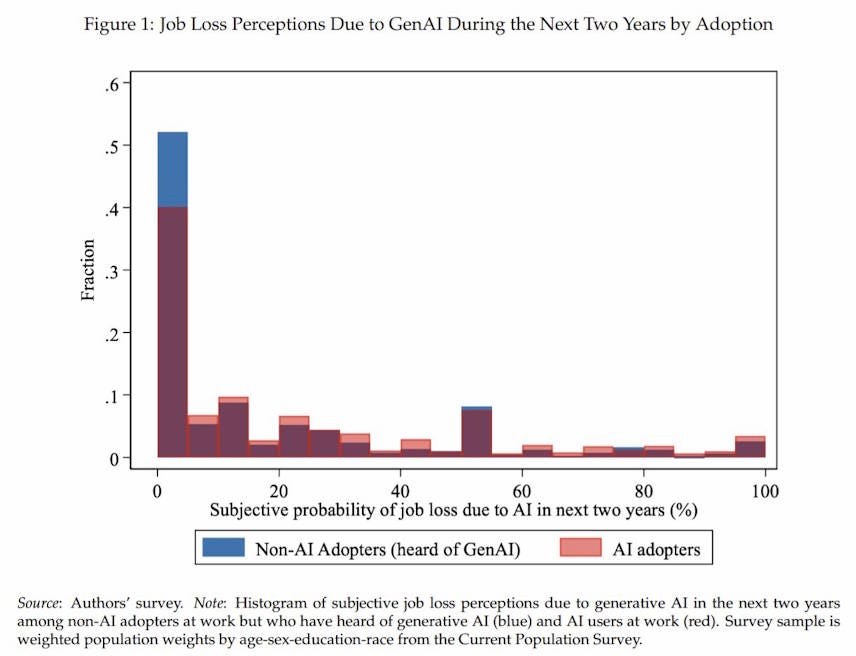
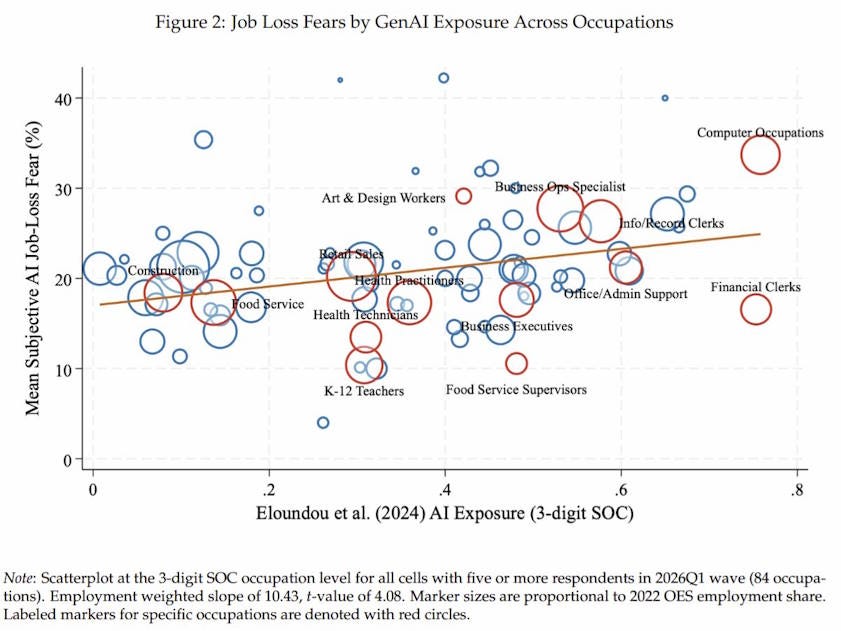
It turns out that it’s very natural for people to overestimate the degree to which AI will take their jobs. Hartley et al. (2026) have a really excellent paper called “Job Loss Fears in the First Years of Generative Artificial Intelligence”. Here’s a thread explaining the paper’s findings.

Basically, the authors find that fear of AI job replacement is extremely common:

And they find that the more people’s jobs are exposed to AI, the more they think their jobs are about to be replaced:

In fact, the more of their day people spend using AI at work, the more they’re afraid of being replaced!

And yet when the authors looked for a correlation between AI exposure and actual job loss, they found…absolutely nothing. People’s fears simply haven’t come true yet.

What’s going on? The authors hypothesize that people who use AI more start to understand its ability to replace the tasks they do at work. But as we keep finding, replacing tasks isn’t the same as replacing jobs. People keep finding new things to do in their roles at work — sometimes things AI can’t do yet, but often things that couldn’t even be done until AI made them possible!

It seems like we’re uncovering a consistent human blind spot here: People don’t actually know how they produce value at their jobs. Modern jobs are much more than a simple collection of tasks — they are pieces of a complex machine that produces value in ways that an individual worker often doesn’t even see.2 So when AI comes along and starts replacing people at various tasks, it just ends up making them more valuable as pieces of their corporate machines.

How long that situation will persist, of course, is an open question. AI leaders are starting to realize that it might take a very long time for the full effect of their inventions to be felt:

This is why the AI companies’ recent messaging pivot — many now say that AI will create jobs rather than destroying them — may be honest, rather than a cynical marketing ploy to calm public outrage.

But then there’s the question: Can this situation persist indefinitely? No one knows, of course. But my bet is that while many occupations will eventually be mostly replaced by AI, humans will still have plenty to do. I’ve argued that in order for AI to start replacing human jobs wholesale, it’ll have to get much more agentic — which will make it inherently more unreliable from a human point of view. So I predict that humans will always have jobs keeping AI agents on track.

Even if I’m wrong, though — even if the AI job apocalypse does eventually come — it doesn’t seem like it’s coming soon, and it certainly isn’t here right now. Everyone keeps thinking that AI is a job killer, and AI keeps on refusing to be what everyone expects.

Happy Labor Day!


Subscribe now

Share

1

Higher task-level productivity can destroy jobs by letting employers do more with less. It can create jobs by creating economic growth, which boosts labor demand. But I think Acemoglu et al. might overlook another source of productivity-driven job creation, which is variety. When carmakers became more productive, they became capable of pumping out more different makes and models of cars. This probably made consumers want cars more, because people enjoy variety — GM famously overtook Ford by offering more models, more frequent model updates, and more colors.

2

This is why jobs may feel like “bullshit” to the people doing them, even as they command high wages in the market.

Read the whole story
gangsterofboats
9 hours ago
reply
Share this story
Delete

The Right to Trial is Vanishing. Could Bolder Juries Save It?

1 Share
paul-st-louis-wide | Courtesy of CATO Institute

When Paul St. Louis voted as a juror in 2017 to convict Frederick Turner for his role in a methamphetamine dealing ring, St. Louis had no idea that prosecutors would stack the charges in such a way that Turner, a first-time offender, received a 40-year mandatory minimum sentence.

The judge presiding over the trial declared Turner's sentence "excessive" and "wrong," but had no choice but to impose it. Less than a year later, Turner, 38, was found dead in his cell at a high-security federal prison in Colorado.

Ever since, St. Louis has been haunted by Turner's death, and the knowledge in hindsight that there may have been more he could have done in his role as a juror.

"If I could go back in time, and if I knew Frederick faced 40 years, I would vote to acquit him," St. Louis said in a new jury-education campaign launched this week by the Cato Institute, a libertarian think tank. "I could have asked what sentence would be imposed. I could have drawn my own conclusions if no one would answer. And I could have voted my conscience."

The nonpartisan initiative, Your Verdict Counts, aims to educate jurors on three things the Cato Institute says they should know but are rarely, if ever, told: that jurors have the right to decide if a law is unjust or being applied unjustly, the right to ask what the consequences of a conviction will be, and the right to vote their conscience based on those factors without fear of punishment.

"Jurors are not just called to go in and check boxes and determine if somebody technically violated the law," says Matthew Cavedon, director of the Cato Institute's Project on Criminal Justice. "Their job is to use their conscience and their sense of justice, to figure out whether somebody deserves to have their lives, their liberty, or their property denied. That's a completely different task than the one that judges and lawyers often insist is all that a jury is supposed to do."

In addition to the website, the Cato campaign will include a series of in-person events in Richmond, Virginia. Cavedon said the Cato Institute chose Richmond for the initiative because Virginia allows convicted defendants to ask to be sentenced by a jury, rather than a judge—a rare if not wholly unique feature of its criminal justice system. Richmond also has a particularly zealous defense bar.

The act of acquitting or refusing to indict a criminal defendant based on moral objections to the laws or charges in question, regardless of whether the defendant is technically guilty, is commonly called "jury nullification," and it's a controversial subject in the legal profession.

As George Mason University law professor Ilya Somin wrote at The Volokh Conspiracy in 2018, nullification undermines the rule of law in a system where the criminal codes are more or less uniformly applied, but in the real world it has become, unfortunately,  "a counterweight to the enormous discretionary power already wielded by government officials."

The Cato campaign conspicuously avoids the term nullification, which Cavedon says gives a rebellious shade to a proper and traditional check on government overreach.

It's more important than ever for juries to exercise that power, the Cato Institute argues, because juries so rarely can anymore. A Pew Research Center report found that in 2018, only 2 percent of federal criminal cases went to trial. Lengthy mandatory minimum sentences give prosecutors so much leverage over defendants that turning down a plea deal and going to trial becomes an irrationally risky choice. Defendants who turn down plea deals and get convicted, such as Turner, get hammered at sentencing, a phenomenon that criminal justice advocates call the "trial penalty." The result is that the constitutional right to trial has largely vanished.

The Cato Institute argues that emboldened juries would be a safeguard in a justice system that has mostly taken away judges' ability to consider individual defendants at sentencing.

However, although jurors can't be punished for voting their conscience, it's practically verboten to talk about inside courthouses. Attorneys are usually barred from talking about nullification with juries, and doing so can be grounds for a mistrial.

In 2019, a divided 2nd Circuit Court of Appeals panel chastised a federal judge who complained about an overzealous prosecution and said the case before him "call[ed] for jury nullification."

Over the years, activists have even been arrested and convicted on jury tampering charges for handing out flyers about nullification outside courthouses, leading to First Amendment lawsuits. In 2022, the 2nd Circuit ruled that a New York man's free speech rights were violated when he was arrested outside a Bronx courthouse for doing so.

Despite courts' deep uneasiness with the concept, the Cato Institute argues that there is a long and strong tradition of American juries using their power to resist unjust laws and charges, from the acquittal of Peter Zenger in a famous 1735 libel case to northern juries' refusal to convict defendants of aiding fleeing slaves under the Fugitive Slave Act.

Likewise, Reason's Damon Root wrote in 2018 on the originalist case for jury nullification, finding that there's "good evidence that many 18th and 19th century Americans understood juries to possess the lawful power to reject guilty verdicts when the jurors believed the underlying law was unconstitutional."

The concerns that motivated those Americans, Cavedon says, are much the same as today's.

"There's such a feeling in America today that government is distant, and that especially lawyers and judges are just part of the elite class, making decisions without the good sense of the people. That's been a concern all throughout American history, and the jury is supposed to be the antidote," Cavedon says. "The jury is literally government by the people, and we have lost something in shifting the most important function of the government, criminal punishment, to behind closed doors, to negotiations between lawyers, to a quick sign-off by a judge. That is not the freedom and the democratic order that we were promised."

The post The Right to Trial is Vanishing. Could Bolder Juries Save It? appeared first on Reason Magazine.

Read the whole story
gangsterofboats
20 hours ago
reply
Share this story
Delete

New Delhi’s Strategy Shows Why Protectionism Fails

1 Share

This month, there will be over 400 Chinese officials in New Delhi—more than double the previous delegation in 2019—to discuss the future of Sino–Indian relations. For China, those relations have never been more favorable; India’s position on the world stage has declined, though not in ways caused by China, making the prospect of resumed and increased trade between the two nations increasingly likely.

A key development came in March 2026, when the Indian Union Cabinet amended Press Note 3, a rule in place since 2020 that required government clearance for investment from any country sharing a land border with India (the largest of course being China, which shares a 3,500-kilometer border with India). The removal of this barrier proved its effectiveness by the end of August: investors had brought ₹4,896 crore ($512 million) across 29 projects. This is a proof of concept that cannot be easily ignored.

But the greater significance is in where investment did not come from: China. After relaxing a rule that primarily affected China, investment instead came from Mauritius, Korea, Japan, Singapore, and the United States.

From the two factors—the small inflow, and the source nations—a reasonable conclusion can be drawn: global funds carrying incidental Chinese shareholders had been caught by mistake, and they were now unblocked.

The conclusion that should be drawn is that formal (“hard”) blockages to trade are only ever one part of a greater picture and should be understood alongside the informal (“soft”) blockages. India’s trade problem with China is habitually described as a deficit to be narrowed by negotiation—the lifting of tariffs, increasing market access, joint ventures, and so on. It is better understood as an asymmetry that negotiation cannot alter: India’s constant attempts to address this gap seem to have made it wider.

Bilateral goods trade reached $151.1 billion in the fiscal year ending March 2026, and, of that, imports to India from China were $131.63 billion, the highest India recorded from any country; meanwhile, exports to China were only $19.47 billion. The new fiscal year is following the same trend: June’s deficit alone was $15.3 billion.

What India buys from China falls into roughly four broad categories—electronics, machinery, organic chemicals and plastics—as well as the pharmaceutical agents upon which India’s generic drug industry depends. What India sells in return is very much the raw end of things: ores and slag, mineral fuels, and marine products. Exports have been growing—up 37% in the previous year—but that growth seems less impressive when the actual numbers are considered: from $14 billion to $19 billion.

The Sino–Indian trade profile is not, therefore, one between two comparable advanced economies, but between a supplier and a manufacturer, and because the Indian economy supplies the very items that China exports to India, it becomes a self-reinforcing cycle. As Indian industry grows, and the country becomes wealthier, it will buy more of the products China produces using the very raw materials it has bought from India.

This yawning deficit is, in large part, a product of two of India’s own policies that have pulled in opposing directions.

The first is security-focused: Press Note 3, mentioned above, was first introduced at the very beginning of the COVID-19 pandemic, and was originally aimed at preventing opportunistic pandemic-era acquisitions. As a consequence, hundreds of Chinese investment applications were banned, and business visas for Chinese engineers were subject to layer upon layer of vetting, at the ministerial level. The cost of doing business simply skyrocketed. In a strict sense, it achieved its goal: Chinese direct investment collapsed to a mere $67.34 million between 2021 and 2024.

The second was an industrial policy designed to build a modern industrial base for India at speed. The first industries to benefit from this were the assembly-based industries: phones, appliances, solar panels, and so on. Naturally, these industries are resource-intensive and require more components as they grow; as a result, the trade deficit with China, the main supplier for these components, ballooned from $44 billion in 2021 to nearly $85 billion in 2024 and even further to $112 billion in 2025.

Delhi has been laser-focused on course correction since late 2025. Former cabinet secretary Rajiv Gauba proposed dismantling the visa-vetting system, and shortly after in December the government launched a digital sponsorship platform, simplifying the process and no longer requiring ministerial recommendations. On the FDI side, Press Note 2, which was approved in March and has been in effect since May 2026, automatically processed noncontrolling stakes of up to 10%, while introducing a 60-day approval window for priority manufacturing sectors (including electronics, capital goods, and solar cells).

These are real liberalization efforts, noted approvingly by the Carnegie Endowment, which wrote, “The practical argument for reform was genuine. The system was deterring not just Chinese capital but also legitimate global investment.”

The problem persists, however: the barriers to Chinese investment have been lowered, but Chinese investment has not automatically flowed through.

The forthcoming BRICS summit, held in Delhi from September 12–13, will be a real opportunity for India to address this. Xi Jinping himself will be coming, his first visit to India since 2019, with the aforementioned 400 expected delegates. The size of the delegation speaks to the seriousness of the summit and the potential for both sides (in fact, all BRICS nations) to take advantage of the global trend among manufacturers to pursue a “China Plus One” policy of diversification in response to a fragile global economy.

As it stands, trade will grow between the two nations, because both economies are growing and complement one another. Unfortunately for India, the trade deficit will grow, too, unless some serious rebalancing is made.

Read the whole story
gangsterofboats
20 hours ago
reply
Share this story
Delete
Next Page of Stories