I write vigilante thrillers.
Because I do, I pay close attention whenever a popular novel or film appears that deals with the subject of vigilante justice. I’m interested as someone who has devoted much of his professional life thinking and writing about crime, justice, and moral responsibility as an investigative journalist, nonfiction author, and thriller novelist.
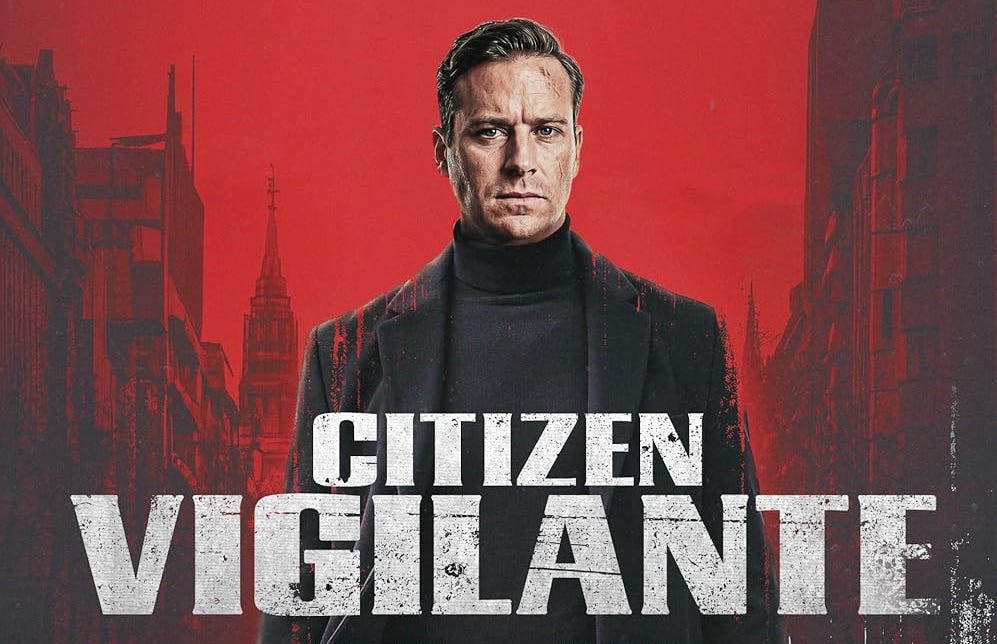
The disturbing, highly popular new film Citizen Vigilante rests on a terrific story premise: a vigilante who doesn’t merely hold to account predatory criminals but also their ideologically motivated criminal sympathizers—those who excuse and protect them from punishment. That’s a premise begging for serious exploration in our morally bankrupt era, when many institutions have become enablers of evil. (In fact, that’s precisely the premise of my Dylan Hunter vigilante justice series.) In Citizen Vigilante, filmmaker Uwe Boll focuses that same basic storyline on a timely subject: the many terrible unpunished crimes, including those committed by Muslim migrants, that are ravaging Europe—atrocities that fill headlines while governments, courts, and political elites appear unwilling or unable to respond effectively.
Unfortunately, after watching the film, my reaction was not admiration but revulsion. Its protagonist, Michael Sanders, is the polar opposite of the traditional vigilante hero, including my own, Dylan Hunter. Opposite psychologically. Opposite stylistically.
But, above all, opposite morally.
The critical distinction between justice and vengeance—between imposing moral accountability and inflicting indiscriminate, rage-driven slaughter—is what has made the vigilante one of fiction’s most enduring heroic archetypes.
Yet that is precisely the distinction Citizen Vigilante obliterates.
So why bother to review this ugly film at all?
First of all, because it’s become a cult phenomenon. Initially promoted by Elon Musk on X, it soared to the top of the “most-popular” lists on streaming services such as Amazon Prime (where it currently holds a 4.5 out of 5.0 viewer rating). More importantly, because the enthusiastic public reaction to the film—most ominously, from a growing number of self-identified conservatives—exposes something dark going on in people’s souls at this cultural moment. It suggests that many people, exhausted by rising social disorder and the atrophy of our legal and political institutions, are now willing to embrace almost anyone who reacts violently against perceived enemies, regardless of whether the violence is just.
Most importantly, because the public response to Citizen Vigilante reveals that many conservatives are now joining the far left on the road to nihilism.
The Vigilante Archetype
The lone-wolf vigilante is the age-old, symbolic champion of justice.
The typical pattern in vigilante myths and stories is that some terrible injustices either have occurred or are about to be perpetrated against innocent, helpless victims. The lawful authorities are either impotent to do anything about it, or they are active participants in the evil. A tough, independent loner of strong moral character and unusual talents for detection and/or mayhem (“a particular set of skills,” as the hero of the vigilante film Taken puts it) steps in, takes on the powerful forces of corruption, and rescues or avenges the victims, thus restoring a just moral order.
This indelible fictional archetype appears in transcultural myths and fables that go back hundreds of years. The medieval knight-errant evolved into such iconic vigilantes as Robin Hood and Zorro, whose countless descendants include Batman, Robert (The Equalizer) McCall, and Jack Reacher. The list includes most comic-book superheroes and many fictional private detectives.
Novelist and philosopher Ayn Rand particularly enjoyed fictional vigilante heroes. One of the movies she watched during her childhood in Russia was the 1920 Douglas Fairbanks silent-film swashbuckler The Mark of Zorro, about the legendary vigilante who single-handedly puts corrupt governmental officials to the sword. She repeatedly expressed her great admiration of Mickey Spillane’s famous private eye, Mike Hammer—a tough, violent vigilante detective who, eschewing legal rules and niceties, delivered “street justice” to criminals. In her short story “The Simplest Thing in the World,” Rand presents a fictional author, Henry Dorn, fantasizing about creating “a crusading blackmailer”—“a Robin Hood of blackmail.” This vigilante goes after people “that do horrible things, but just manage to remain within the law, so there’s no way of defending yourself against them.” And when a “hypocritical reformer . . . traps the [vigilante] hero and is about to expose him, the hero kills him. Why shouldn’t he?”
In Atlas Shrugged Rand even created a colorful, iconic vigilante of her own: the pirate Ragnar Danneskjold. Ragnar, acting explicitly as a kind of morally clarified Robin Hood, steals from the thieving government and returns the loot to those who had produced it. In one scene, he presents a gold bar to politically victimized industrialist Hank Rearden and explains his motives:
What I actually am, Mr. Rearden, is a policeman. It is a policeman’s duty to protect men from criminals—criminals being those who seize wealth by force. . . . But when robbery becomes the purpose of the law . . . then it is an outlaw who has to become a policeman.
That statement perfectly summarizes the vigilante hero’s mission. It’s no surprise, then, that the popularity of vigilante characters soars in circumstances and periods of moral chaos. We saw that with the hit films Dirty Harry and Death Wish during the early 1970s, a period of social upheaval and rampant crime. Whenever the law becomes diverted or corrupted from fulfilling its rightful purposes, who then performs government’s essential function of protecting the innocent from predators? Who stands as the sheepdog shielding the flock from the wolves?
The vigilante is that hero. His exploits dramatize the distinction between law and justice—and idealize justice holding law to account.
Such tales owe their cultural universality and longevity to the fact that they provide us much-needed moral and psychological catharsis.
In the real world, we endure many frustrating, systemic injustices about which we have little or no recourse. But in the vigilante story world, we take vicarious satisfaction as the hero rebalances the scales of justice and restores the moral order. We’re also inspired by the spectacle of a lone individual confronting powerful forces of entrenched evil and—through ingenuity, courage, skill, and moral intransigence—achieving victory and vindication of the good and right. This isn’t “escapism”; it’s fuel for the soul. We all need inspiration and encouragement to stand firm against the less dramatic evils and corruption we encounter in our daily lives. During my boyhood, vigilante stories certainly inspired me. Zorro, the Lone Ranger, and Batman played seminal roles in nurturing my budding passion for justice.
To be more than merely another thuggish outlaw, however, the vigilante hero must fight according to a strict, self-imposed code, rooted in the principle of individual moral accountability. He does not regard or treat people collectively, as undifferentiated members of tribes. Instead, he judges individuals as individuals, holding each person responsible only for the consequences of his own actions—and only to the extent of his own involvement.
That vision defines clear moral boundaries between actions that are either just or unjust. A fictional vigilante committed to acting within those ethical guardrails can be admired as a true hero.
But that is neither the vision nor the vigilante inhabiting the story world of Citizen Vigilante.
A Cinematic Atrocity
Before examining the movie’s moral vision, I must say a few words about the filmmaking itself. That’s because the moral chaos in Citizen Vigilante is amplified by chaotic storytelling.
The storyline, if it can be called that, is episodic rather than plotted: There is no story arc at all, only a series of violent vignettes strung together, often out of chronological sequence.
Details about the story’s setting and situation are revealed, not through plotted action or decent dialogue, but by a TV reporter occasionally reciting monologues about what’s happening and by “man-on-the-street” interviews of citizens cheering on the vigilante. And in constant, didactic soliloquies by the protagonist himself, who simply loves to talk.
Some of his political sermons appear on videos he sends to the media. Other monologues seem to be occurring during some sort of police interrogation, as he speaks to unseen people—except we never see him arrested, never see the interrogators, and never see him either released or jailed. These scenes are never explained; they’re simply inserted into the film willy-nilly, perhaps meant to be breathers between excruciating scenes of sex and gore. He delivers still other sternly self-important lectures to the bad guys, informing them why he’s going to kill them. Presenting the film’s message via endless monologues spared writer/director Boll the effort and production costs of conveying it through effective, coherent dramatization.
Then there’s the jaw-dropping illogic of many aspects of what passes for the plot. For instance, this supposedly cunning vigilante suspect, running and hiding from the law, never even wears gloves at the scenes of his crimes, leaving his fingerprints everywhere—such as all over the car of the judge he murders. Nor does he wear any disguises to hide his face from security cameras during his crimes. Perhaps he imagines that pixelating his face on the videos he sends to the media is good enough.
It’s also clear that no one in the production was in charge of editing continuity. For example, in a scene where three young predators, one of them a girl, are beating up a kid in a park, the girl inexplicably vanishes into thin air before the scene ends.
Then there’s the big SWAT team set piece. An Interpol agent, lacking any lawful arrest powers or local jurisdiction, is somehow in charge of a raid by the city’s SWAT team. Long minutes of screen time are wasted showing their vehicles navigating the streets en route to confront the vigilante. Finally, they arrive at his lair, with no explanation of how they discovered his identity and location. It takes that team additional minutes to climb a single flight of stairs; cutaway shots of the protagonist preparing his ambush drag out their approach interminably, killing time before the . . . killing time. The SWAT team behavior during the raid is also ludicrous: They stand in a room, unprotected, facing a metal wall fitted with two mounted automatic rifles, where they agreeably allow themselves to be mowed down. Then the Interpol guy sends in a second team to meet the same fate. Finally, more officers enter, cut open the metal door to the protagonist’s bunker, and then the cover of his (predictably) booby-trapped escape shaft—where they are (predictably) blown up.
It speaks volumes that the movie’s fans are willing to ignore such laughable deficiencies of basic film craft and storytelling in defense of its message.
And what about that message—the film’s thematic content? Here, it might be illuminating to compare Citizen Vigilante Michael Sanders with Dylan Hunter, the protagonist of my own vigilante novels, because both are supposed to be champions of justice. How do they measure up to the vigilante-justice archetype?
Michael Sanders versus Dylan Hunter
True to the vigilante justice tradition, Dylan Hunter—the eponymous hero of my thriller Hunter and its sequels—violently targets predators who have escaped just punishment. But in doing so, Hunter operates by a strict code of proportionate justice, scaling his retaliatory acts against criminals to the level and types of their crimes. More uniquely, he also exposes and then inflicts proportionate (though nonviolent) “poetic justice” upon the ideologues, activists, and institutional enablers who defend and shield those predators from accountability.
But he never kills anyone who has not been involved in murder, either as its perpetrator or coconspirator. He never risks the life of an innocent person to perform a vigilante mission nor would he ever harm a police officer; he would allow himself to be captured and jailed rather than use violence against innocent people or cops.
By contrast, Michael Sanders is a robotic killing machine who cynically and unnecessarily slaughters innocent people. He deliberately designs and builds a complex death trap for his police pursuers—then, after luring in a SWAT team, he proceeds to butcher them by the dozens, using machine guns and a bomb. (Director Boll goes out of his way to showcase the butchery of these innocent officers in a minutes-long, slow-motion gore-fest, featuring close-ups of exploding skulls and spraying blood.) Sanders engineers this carnage even though it’s clear that he could have avoided the confrontation or escaped and eluded capture . . . because that’s exactly what he did afterward. The bloodbath is precisely what he wanted.
Finally, Sanders murders not only a gang of (arguably deserving) teenage rapists but the Muslim family members of one of them—simply because they (like many families of criminals) make excuses for him. For instance, the supposed capital crime committed by the teenage rapist’s sister is her morally obscene social media post blaming the rape victim. But that post is no worse than the odious comments uploaded by millions of thoughtless people every day. Should all of them also be annihilated for their mere ideas?
His premeditated mass murders of non-criminals make Sanders no different than any of the predators and killers he feigns to find morally irredeemable. Here the contrast with Hunter, whom I created to represent the traditional vigilante justice archetype, is not merely tactical—the two characters occupy incompatible moral universes.
And they present profoundly different psychologies, too.
Many, though not all, vigilante tales present a psychologically damaged protagonist. Typically, he bears deep emotional wounds from a violent, traumatic past, which he sometimes self-medicates with drugs or alcohol (e.g., author Mark Dawson’s John Milton character). Then some emotionally triggering event propels him back to violent action, often motivated by revenge (John Wick, or James Reece in The Terminal List).
By my intention, Dylan Hunter is not a “damaged hero.” He grew up in a wealthy, stable, supportive family and was a superior student in school. He later worked for the government in capacities in which he repeatedly risked his life for his country. But he was betrayed and badly injured. He left his job, disappearing into anonymity to rebuild a new life and career.
That might seem consistent with the “damaged hero” profile, but I deliberately rejected that trope. Yes, Hunter is justifiably angry at what happened to him in the past and angry at injustices generally. But he is not mired in cynicism, rage, and emotional darkness. He’s an idealist who has established a new career as a crusading newspaper journalist. He lives and functions well, whether alone or around others (including his beloved pet cat). He enjoys big-band standards from the Great American Songbook and sustains a passionately romantic relationship with his girlfriend. Vigilantism is a course of action he has slipped into circumstantially, by degrees, in response to crimes against people who matter personally to him.
By contrast, Michael Sanders is depicted as emotionally damaged, partly due to an estranged relationship with his late, coldly indifferent father. “Cold” also describes every aspect of his manner and affect, which come across as robotic and repressed. We are told almost nothing about him as a person—only that he’s the wealthy heir to his father’s business as a property owner and manager. Somehow, in the heart of anti-gun Europe, he’s amassed a private arsenal that some smaller nations would envy. We meet him already amid his killing spree, so we have no clue about any personal motive for launching his bloody crusade.
He has no apparent friendships or emotional relationships. In place of the latter, he harbors a brothel in one of his buildings. In one scene, he visits it, selects one of the waiting prostitutes, and engages in graphic, purely transactional sex lasting several minutes—which is interrupted by his pique at noticing mold growing on one of the walls. I guess this was to show the viewer that Sanders has at least some standards, if only regarding building maintenance.
And that’s pretty much it: Sanders remains a cipher to viewers, his personal reasons or triggers for turning to vigilante violence never explained.
However, Sanders displays all the classic characteristics of a psychopath. Nothing about him is admirable. He lacks any hint of empathy. His only apparent satisfaction is wielding power over others—playing God to the point of gratuitously indiscriminate, premeditated, attention-seeking mass murder.
Years ago, during my criminal justice research and writing, I extensively studied psychopaths, serial killers, and mass murderers. I found that every one of those monsters embraced some pseudo-intellectual rationalization for his bloodlust and atrocities.
Those abstract rationalizations—usually imparted from the faculty lounges of university humanities departments or cribbed from psychology tomes—are excuses for what criminal profilers call “righteous slaughter.” It’s either “I couldn’t help it, because . . .” or “I was justified, because . . .” or “They deserved it, because . . .” But beneath the rationalizations, the underlying truth is that the psychopath enjoys wielding the power of life and death. Killing and sadism make a loser and misfit feel socially potent—a somebody. As the hero of his own self-dramatizing narrative, a psychopathic killer typically plans and prepares his slaughters with meticulous care, often dressing, arming, and acting like a soldier on some grandiose military action.
All of which describes Sanders to a “t.” He’s a textbook psychopath, on a cosplay “mission” to rid the world of migrant rapists . . . and their evil families . . . and police officers, who, of course, are part of the evil System . . . and even unsuspecting motorists, because they are worthless dupes of The System.
Sanders’s killing of an innocent driver best captures his psychopathy. He’s driving a judge whom he’s drugged, kidnapped, and planning to murder. During the ride, he delivers one of his tedious lectures—this one about how most people are just sheep who follow whatever rules they’ve been given. Sanders then deliberately runs a car carrying innocent passengers off the road, leading to a fiery fatal crash—solely to illustrate, grotesquely, an incoherent talking point.
Let that sink in. Here his victim isn’t a criminal, a migrant, a Muslim, or a government employee (a cop). Sanders—supposedly dedicated to vigilante justice and enraged by the victimization of innocents by Muslim migrants—casually murders a random motorist on a spur-of-the-moment whim without a hint of hesitation or remorse.
Since Citizen Vigilante’s release, director Boll has claimed that he didn’t intend his protagonist to be a “white knight”; instead, Sanders is supposed to exemplify the kind of antisocial backlash that may be unleashed when migrant crimes go unpunished. So, after the fact, Boll is contending that he meant Sanders’s rampage as a cautionary tale. But a film’s message is only what it presents onscreen, not what the filmmaker claims he meant to convey. And because Sanders’s point of view is the only one Boll presents, the message that viewers logically infer is that his killing spree is a justified reaction to migrant crimes.
A Cultural Harbinger
Justice and morality were the first casualties in this despicable film. Yet lots of self-described Christians and conservatives are cheering its psychopathic protagonist, simply because some of his targets are migrant Muslim rapists.
Visceral conservative sympathy toward Michael Sanders mirrors the sympathy many on the left feel toward Luigi Mangione, charged with assassinating an innocent corporate executive on a New York street. In both cases, premeditated murder is rationalized by ideology and politics. That so many across the political spectrum now applaud psychopaths who conduct ideologically motivated “righteous slaughter” should give us pause. It symptomizes the broader nihilism that’s been eroding the foundations of Western civilization over the past century.
That nihilism, begun as a product of the postmodern left, has generated many forms of social savagery and cultural decadence. Thugs have been enabled, empowered, and encouraged by what I’ve labeled “the Excuse-Making Industry”: progressive intellectuals who portray criminals as society’s “victims”; who manufacture deterministic rationalizations for their criminality; and who weave those rationalizations throughout the fabric of our social, legal, and political institutions. As a consequence, Western society no longer seems willing to defend itself against the barbarians.
Decent people are being pushed to the emotional breaking point by the uncontested rise of savages in our midst. History shows that periods of anarchic degeneration are invariably followed by periods of authoritarian repression as beleaguered citizens seek a strong man who will impose order and reestablish a functioning society. Those backlash periods almost always go to ugly extremes of indiscriminate violence, enforced conformity, even dictatorship.
Citizen Vigilante offers a harbinger of this kind of reaction. It manifests and exploits a worldview of aggrieved victimization and conspiratorialism shared by both the far left and a growing number of conservatives. Its antihero’s soliloquies, warning that we’re all being lied to and controlled, are meant to rationalize his massacre of ordinary police officers. To conspiratorialists, cops aren’t individual human beings—they’re anonymous apparatchiks protecting a corrupt system, so it’s justified to butcher them.
A Citizen Vigilante 2 is supposedly in the works, to be set in America. Perhaps Boll could dramatize the real-life, politically motivated “vigilante” Timothy McVeigh and his 1995 bombing of the Murrah Federal Building in Oklahoma City. Like Sanders, McVeigh was motivated by vengeful hatred of an “unjust” government, and he was viewed sympathetically by many conservative tribalists.
The ghastly handiwork of McVeigh and his coconspirators in that office-building bombing included the slaughter of 168 people and the injury and maiming of another 680. Among the dead were six members of the U.S. armed forces, scores of innocent people (including three pregnant women) working in innocuous government agencies, plus nineteen children—fifteen of whom were toddlers and babies as young as three months, peacefully napping in the building’s America’s Kids Day Care Center.
And what was McVeigh’s “moral” rationalization for his nihilistic mass murder of those present in that government building? “Think about the people as if they were storm troopers in Star Wars. They may be individually innocent, but they are guilty because they work for the Evil Empire.”
The “Citizen Vigilante” felt the same about his own targets.
So, Do I Really Advocate Vigilante Justice?
In a word, no. And Citizen Vigilante shows us why: because there’s a big difference between fiction and reality.
In fiction, an author like me can control all the elements of the narrative, including the behavior and motives of his created characters. I can limit and channel the actions of my vigilante hero so that they conform consistently to a clear moral code.
As a classic fictional vigilante hero, Dylan Hunter would never commit violence against anyone who has not himself initiated violence against innocent victims. He would never risk harm to innocent bystanders. Because he is an outlaw, his path puts him on a collision course with law enforcement; but he knows that he and the police are fighting the same battle for justice—that they are allies, not adversaries—so, he would never use violence against them, not even to avoid capture and prosecution. He accepts that risk as part of his mission. (In fact, much of the suspense in vigilante tales arises from his ingenious efforts to elude discovery and capture.)
But that’s fiction. In real life, even the most rational individual’s context of knowledge about the facts of a crime is necessarily limited—far more so than the abundant facts that can be discovered and proven in a courtroom, through police investigation, and under objective rules of evidence. So, his judgments about a criminal suspect’s innocence or guilt—or his degree of culpability, or any mitigating circumstances—could not be as fully informed.
And in deciding proportionately just punishments, even the most principled individual could not escape his own personal hierarchy of values, which would be his basis for determining the degree of harm inflicted by a criminal. Imagine your highest value; then imagine some criminal harming, desecrating, or destroying it. What would you think is “proportionate punishment”? And what might other vigilantes decide? Would those punishments be the same as those codified in legal standards and imposed by a jury and judge?
Finally, even assuming the possibility of a fully principled vigilante—like a Ragnar or a Hunter—few vigilantes would be as scrupulously principled. Tolerating vigilantism means abandoning objective social control over the use of force and the legal procedures to distinguish the initiation of violence from retaliatory violence. Once those legal constraints are obliterated, the certain outcome would be a relentless, unconstrained escalation of violence . . . rationalized by each perpetrator as being in pursuit of “justice.”
Which is exactly what we see in Citizen Vigilante.
Although a vigilante fantasy serves valid moral, esthetic, psychological, and cultural purposes, vigilante reality is something quite different. So, let’s enjoy the fantasy of vigilante justice. But if we are to foster a civilized society, systemic injustices must be addressed by systemic reforms—not by subjective, unilateral acts of violence.
Citizen Vigilante: A Just Verdict
Citizen Vigilante is an atrocious, incoherent mess. Its script wouldn’t pass a freshman screenwriting course, and its production values are risible. The film is intended as propaganda, as a message delivery system. And even though that message—about the dangers from criminal migrants—is an important one, it’s so crudely, illogically, and repugnantly presented that the point is lost.
Citizen Vigilante is worthless—except as a cautionary snapshot of the ominous moral trajectory of our culture. It glorifies reactionary tribalism and nihilistic violence, growing pathologies across the political spectrum. It obliterates critical ethical distinctions between vengeance and justice—between a Michael Sanders and a Dylan Hunter—between a cold-blooded psychopath and a code-driven protector.
And in these unsettled times, such distinctions matter, because a fictional vigilante hero may be the moral model our world desperately needs.
 Log in