 Log in


One of the many reasons I love literature is that it has the capacity to make me feel seemingly contradictory emotions simultaneously, or shortly thereafter. For example, the story of Cosette in Les Misérables: she’s neglected, abused, and endangered in ways that make the reader’s blood boil. Yet, in the middle of this storm, she remains resilient and capable of seeing the good in the world, continuing to strive to achieve her values (she really wanted that doll she saw at the store). Shortly after, she meets Jean Valjean, and the rest is history. Cosette’s value-orientation and refusal to give up makes the reader feel hope for her future while still being passionately angry at the situation she was in.
Literature can uniquely conjure that emotional tide in me, pulling and receding. The other day, however, I experienced a similar feeling during a real-world conversation I had with Pouya Nikmand, an immigrant from Iran, about his journey to freedom.
Pouya came to America a few years ago after surviving some of the most harrowing events imaginable. He was born in Iran but realized at a young age that his country of birth was inhospitable to human life—and to the kind of virtuous life he wanted to live. The Iranian regime was barbaric and placed no value on human life, treating individuals as disposable tools to achieve the “greater values” of Islam. As Westerners have begun to understand in light of recent protests, the regime seeks to control every aspect of Iranians’ lives and dispose of them as it sees fit.
But Pouya rejected that system and managed to escape—only to fall victim to modern-day slavery in Europe at the hands of a depraved man.
Pouya confronted two slave masters: the Iranian regime, which sought to enslave his soul, and the depraved man in Europe, who sought to enslave his body.
Through it all, Pouya kept in mind his ultimate ideal: to reach the West and live as a human being—as a creator and a producer, making his own way as an individual.
Ultimately, this immigrant’s resilience and value orientation led him to victory (with the help of great allies in America) and to a fulfilling life in the United States.
But his story is not over, and he still faces many challenges within the U.S. immigration system.
Nothing I say in this brief introduction can do justice to Pouya’s journey, so please watch our conversation below or read the transcript (I recommend doing both).
Pouya is now a writer. You can find him at outliving.substack.com.
Content warning: This conversation includes discussion of sexual abuse, physical abuse, and suicide.
This transcript has been edited for length and clarity.
Agustina: Pouya, thank you so much for being here and talking with me.
Pouya: Hi, Agustina. Thank you for inviting me.
Pouya, you are originally from Iran. Iran is on the news lately, with all these protests going on and people trying to end the regime and get some degree of freedom. But not many people truly know what it is like to live in Iran. Most people have this sort of abstract idea of what Iran is like.
But you are from Iran and you lived there for many years. Can you please share with us what life is like there?
I think it’s good that people don’t know how bad Iran is because if they really understood, they would be really traumatized. It’s beyond horrific. It’s a medieval regime that has been trying to push back on progress, push back on civility, push back on morality and goodness on all levels. And the people… everyone has participated in that to a large extent.
Thankfully, they have [withdrawn] their participation in recent years and we’re now seeing the fallout of the regime. I feel so sad at the same time for my own family who’s in Iran, for my friends, but also feel very hopeful that the regime could end.
According to some estimates, the number of people who the regime killed in Iran in the past few days has been more than the number of people Russia killed in Ukraine, civilians. And if we just can put the scale of that in your head, the fact that you see on the street people with machine guns, just mowing down protesters, they have no respect for humanity, for human life.
They have reached a level of insanity, the rulers in Iran… they’re completely divorced from reality. They think they’re living a holy war for the Islamization of the world. When I was a child in high school, we were forced to shout not only “death to America” but would be forced to shout: “one day we will occupy the White House.” And that was the goal of the regime. And obviously, it’s crazy and it failed.
In the 40-something year experiment of the regime, so many lives were lost, so many lives were either lost in death and torture or in quiet resignation and pain of poverty, of having no future. And I didn’t want to be a part of that. I did not want to live in a society that repressed me on every level, where I had to worry about every word that comes out of my mouth, where even walking on the street with my friends was not safe because morality police was looking at whether we were walking too close to each other if my friend was a girl. And they captured me and my friends a couple of times. There are lots of really traumatic stories. But at around the age of 14, I really understood that the people in the Iranian regime . . . they were trying to destroy stuff and they were driven by the destruction of people who did not observe the Sharia law.
Even people close to me, my parents, my grandparents, my relatives all basically participated in that. And it was really terrifying.
It sounds like it’s not just (as if it wasn’t bad enough) a regime that controls the economy, therefore bringing poverty. It seems like it’s a regime that wants to control every single aspect of your life. You mentioned the morality police. I have studied Saudi Arabia, where they have a similar concept and it does seem everything needs to be part of the state, this larger project of Islam, and there is no room for the individual and therefore for freedom. It’s inhospitable to human life, they treat human life as disposable. There, you’re not a human, you’re just a tool to push forward this “bigger project”— bigger than anyone— Islam. Is that more or less what’s going on?
That’s how they hold it in their minds, but on a practical level, they function as if they’re hunting animals. They function as if it’s a game where they have to squash dissenters. So we can see, unfortunately, some glimpse of that type of mentality in America where ICE [Immigration and Customs Enforcement] stops people just based on how they look and harasses them, questions them.
For them, it’s about go[ing] around and looking at whoever [they] can pick on. That kind of mentality was exactly the mentality of the morality police where there were police posts on every street and there were soldiers who would look at people and see who’s wearing an attractive shirt, who has put on makeup. Are there any boys and girls who are walking close to each other? And just really focusing on that, and saying “Aha! I got them!” and then run after them, put handcuffs on them, drag them on the street. It was gruesome. It was really gruesome. Next to where I lived, there were daily scenes of women being dragged on the pavement and screaming and being taken to police custody. Eventually, in 2022, one girl was killed that way, after she was arrested for a lack of proper hijab. [Pouya is referring to Mahsa Amini, who was a 22-year-old woman detained and assassinated by Iran’s morality police for allegedly not wearing the country’s mandatory hijab “properly.” Her death in police custody sparked nationwide protests and the global “Woman, Life, Freedom” movement against Iran’s repression.] When you observe them closely, you would see that it’s a game for them. It’s fun for them to hunt the dissenters, to hunt the people who are not “Islamic enough.” And that is how people operated, not only the morality police and the goons of the regime, but also my own family.
Once, [my neighbors] saw that I was going around with a girlfriend of mine, everyone was taking pictures, everyone was in our business, like they were just excited– like “my God, we found our neighbor talking to a girl!”. It was a game for them, and it was really ugly to see. But I have to say, a lot has changed since 2022. I mean, it was really therapeutic for me to see how an entire nation of 90 plus million people changed really quickly. To give you a sense of how quick and seismic the change was, [take the case of] my own grandfather.
He’s almost 80. The grandfather that I remember was going out on the street, threatening women who were wearing jeans, shouting at them, threatening to kill them, threatening to hit them. And he was getting some sort of adrenaline rush out of this, some sort of moral righteousness, like “I’m defending the morality of our country.” That, and also he was a tyrant over my mother and my aunts. And that same grandfather… I heard the story from my mom, that two women were being harassed for not wearing a hijab in Iran, two years ago. And he defended those two women and yelled to the harasser, “you don’t have the right to tell them what to wear. They have a right to decide what they want to do with their lives.” [He was] talking in the language of “rights,” talking about righteousness and morality, and I could not have even imagined that redemption is possible for someone even in their seventies, but it was possible. 90% of Iranians changed. They changed their ways and they saved their souls from the people who wanted to turn them into destructive, angry, resentful human beings.
So I think there are two things that are true at the same time: Most Iranians were complicit with the regime and, at the same time, it’s not over. The story was not over. Thankfully, there was redemption. And that’s what makes what’s happening in Iran really, really tragic, because this is not some sectarian difference within the regime … this is a declaration of independence from Islamic theocracy, from religious theocracy, and they’ve learned this painful lesson that there should be a separation between religion and state.
I’m following the situation in Iran. They deserve all of our moral support and I really hope they can finally end this regime and this absolute terror so that stories like yours stop happening.
You now live in the United States, so you got away from that regime. But a lot happened between then and now. It wasn’t that you got on a plane and you came to the U.S. and you live happily in the U.S. now. Let’s unpack your story. The first step in your journey was to get out of Iran. Your first stop was South Korea. Why did you go there first, and what happened to you during that time?
It was a complete accident. All developed countries have very similar immigration policies. The pathways to immigrate legally are extremely limited and out of reach for most people. I grew up with the sense that immigration is something that only the 0.1% of society, the richest, the most elite, could afford because it was so expensive. Even getting a student’s visa was extremely expensive. And I had no money. I came from a very poor family. I was raised in a slum in Iran among the most religious people. There was just simply no way.
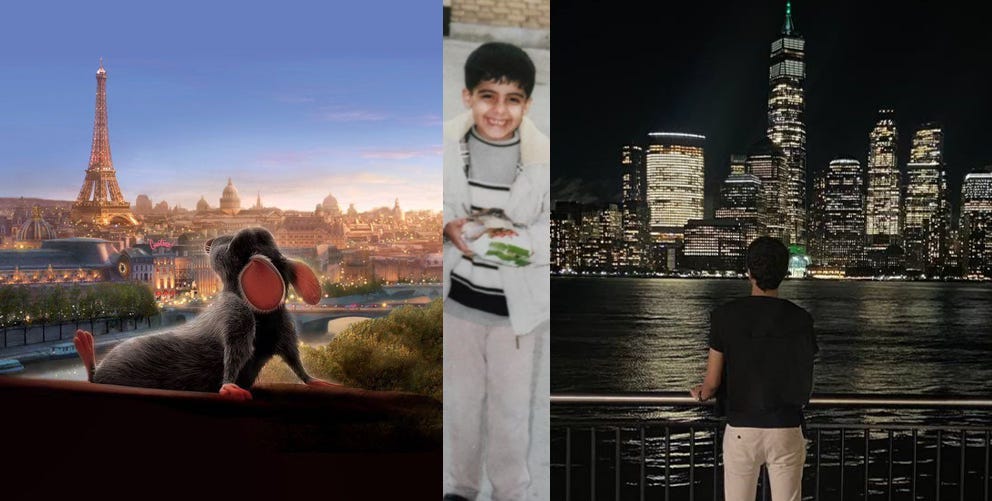
But I refused to give up. And I knew it was either I found a way to come to the West, come to live in America or Western Europe, or that was it for me. I did not want to live in Iran. And the reason for that is very simple. I had access to the internet, beginning when I was 11. And I watched the movie Ratatouille, which completely changed my worldview from a young age. I always saw Paris in the movie, an idealized image of the West. For me, where you can be anything [in the West]. Even as a rat, you could be a chef, become a chef in the best restaurant in Paris. No dream is out of [reach]. Because of that movie and because of so much other Western art, I grew up with a feeling, a sentiment that I could… That I’m not fundamentally different from people living in the West. I’m just like them. I just happened to be in a different country and it’s just a matter of time before I reached my homeland. So I started learning English at the age of 10 and teaching all by myself with zero help and through the internet. Because I was gay in Iran, I was extremely anxious of being hanged . . . I had a network of friends who were also gay. Any time the police arrested one of them, all of us would be under surveillance and arrested in time. I was always afraid of one of them being arrested. After I left Iran, some of them were arrested.
I knew that I couldn’t live in Iran. So I had no option. It was either leave, come to the West, or just die in Iran. And I refused to die. So given that I had no support from my family and no money, I looked around to see which embassy was the easiest one, the most friendly one to Iranians. And through some asking of people who applied for visas recently, it seemed like the South Korean embassy was the most lenient one. There was no American embassy in Iran and the European embassies are extremely strict. So they were completely out of the question. So I went with my documents and everything to the South Korean embassy and the officer took a look at my documents and saw that I didn’t have the money required for the visa. It was like around $10,000 back then, and she just looked at me and said “what do want me to do? You don’t have the documentation. Why are you even here?”. And she just gave me back my documents and shut the door in front of me. I was just frozen, because this was my last attempt. I had to spend the last of my money on the translation of documents and getting acceptance into a course in South Korea that could justify my visa. And I just stood behind the door until… I don’t know how many minutes passed. I think around 30 minutes later, the officer saw that I was still standing there, probably felt pity on me and took my documents and closed the door. And two weeks later, I got a visa. It was by pity. And she shouldn’t have given me that visa. I’m extremely thankful and alive because she did that, but she shouldn’t have because when I left Iran and arrived in South Korea (which is an amazing country and I love it), I learned that there is such a thing as a work permit and you need that before you seek employment as a foreigner.
I initially thought: “a work permit?” Strange. I’d never heard that. Probably it’s something like a driver’s license. So you go submit your photo and fill a form and get a work permit. No, it was not like that. I was turned away at the immigration office because I did not have the right visa. And I realized that I only have $500 in my pocket and that’s it. There is nothing more left for me.
Pretty soon, I was reduced to begging people on the streets for money. I got sick and I almost died. I survived because of the charity of a lady that was working at the pharmacy. And that’s where it was when a European businessman . . . these are all really gruesome details… He basically tried to buy me and realizing my condition and my poor clothes, he told me he wants to… he thinks I’m smart and he wants to fund my studies, but that was far from what happened.
After that, I was trafficked to Europe. And when I arrived to Europe . . . The reason why I accepted [his offer] was because I was poor and hungry and I ran out of money. It was very difficult. It was many degrees below zero and I didn’t even have gloves to wear and my hands were numb and I was hungry. And I thought to myself, “well, what can you do? Worst case scenario, I go to Poland—he was a Polish businessman—I go to Poland, it’s part of the EU, I could just go to a different country and seek asylum. He cannot stop me. But then after I arrived there...
Europe was going through a refugee crisis, and because of that the refugee system was extremely strict. Long story short, there was no option for me to seek asylum. So it was either stick to the abuser’s plan, to the traffickers’ plan, and do whatever he says, or be forcefully sent back to Iran by immigration police.
And the man basically kept me in his house as a slave for four years. I was… sorry, this is very difficult… I was raped for four years, and he was a closeted gay man. He was a very powerful businessman in Poland. He had connections all over the government, that’s how he got me a visa. He just called someone in the government and prepared it for me. I had no option to work, no option to escape, go to any other country, I.. That’s what I had to suffer for four years.
You and I have talked before, but I want to reiterate that I am at a loss of words about what happened to you. The degree of depravity of what was done to you is absolutely unspeakable. You were put in a position where you had an impossible choice to make— where you were either going to be a slave to the state in Iran and have them dispose of your body and soul, or be the slave of this monster in Poland.
Let’s discuss a little bit how you ended up in America after Poland. Can you say a little more about that?
When I was totally subjugated, it was evil beyond belief. I thought of taking my own life. Then I realized, I told myself that, [I could] actually obtain a work permit. Poland is actually one of the few countries that allows students to work. You just have to go and file for a work permit.
It took a year and a half to get the work permit. So it allows you to work and also allows you to travel and come back, it acts as a visa, like a green card. And during that year and a half, I was utterly crushed. I don’t want to go into the details of it, but suffice to say, I was kept as a servant. I had to make sure that the home was spotless. And whenever there was any smallest particle dust anywhere, I was assaulted violently and hit. [He would push] me into his bedroom and lock the door after and tell me if I moved and if I resisted, he’d have me deported.
The pressure of that hollowed me out after a year, but I was still too afraid of going back to Iran. I was between slavery and death in a dictatorship. And I knew if I went back to Iran, I wouldn’t be able to come back [to Europe] because I didn’t have the permit yet. And so once I got the permit, I just… I was just so fed up. I cannot… [I did not have] the strength that is required to endure this. I just went back to Iran. Knowing that I have the card, I can come back [to Poland].
And when I went back to Iran, I realized that my father worked for IRGC, which is the terrorist organization that works with the supreme leader to globalize Islamism and attack Israel and find terrorists in Iraq and Yemen and Syria. He worked for them in the economic arm. So he was not a military officer, he was a CEO of one of their economic branches.
When I went back to Iran, I saw that my parents were doing quite well and my father had a car and we had all new furniture. My father was really happy and told me he had reached a sufficient rank that he could just get me a job in IRGC. And [he said that] my future was completely safe in Iran. I was about to be one of the richer people in Iran. And I thought about it a lot. It took me a couple of months to make that decision. I realized the reason why I left Iran was not to live the same way, just with more wages. I wanted to live a fundamentally different way. This is not about having money because I probably would have been richer right now had I stayed in Iran. It’s about living. I thought about it. Why did I leave Iran in the first place? Was it just hatred of Iran? It was mainly love for the kind of lives people in the West are living, love for the openness, the life where you can set all of the terms yourself. You don’t have to serve under a dictator, where you are the master of your own life, master of your own ship, and you could fail miserably or you could succeed spectacularly.
The life where you can have friends that are living the same type of life. And it’s really hard to explain because the people who are born here, they’re like fish in water. They don’t recognize how incredible… given all of its difficulties and evils and wrongs that happen in the United States, how amazing the atmosphere is, how free the people are, how enjoyable their lives are every day. And that they don’t know what true suffering is. And that’s a good thing. And I wanted to live like that. And it did not mean a thing to me to be rich in Iran, even if I were a billionaire in Iran, I would not want to live in Iran.
I cannot really explain it. It’s more of a feeling. It is represented to me by the movie Ratatouille. It’s represented to me by a lot of Hollywood movies, by the music, by the art, by Silicon Valley technologies, the newest iPhone. These are the things that I want to live for.
When I was in Iran, one of the things that really convinced me that there was something wrong with the country was that I looked around me, I think I was 12 when I had this thought exercise. . . I looked around me, everything that I liked, just what seemed interesting to me as a child, I learned was coming from the West, most of them coming from Silicon Valley, particularly. I was extremely interested in the latest technology. And the first time that I saw a laptop, I think I was 15. I just couldn’t believe it. And the internet just blew my mind. I used to follow the latest technological and scientific breakthroughs. I fell in love with the academic culture in the West, and the fact that you’ll be on the frontier of knowledge. And there was something human about that. There was something about being on the frontier of creating a better day, a better life. Every single thing, even a garden that’s really been thoroughly kept and looks beautiful in Iran and has beautiful flowers, it turns out the tools of gardening were imported from outside Iran. So none of the things that made life possible were made in Iran.
Iran is not a place where creation happens. It’s where consumption happens. And I didn’t want to be a consumer. I wanted to be someone that either does or helps people create new things, who charts new paths. That probably was inculcated in me by watching and re-watching Ratatouille at the age of 10. But that is the deepest reason why I choose to live in the United States. I love living here and I would not trade it for anything.
There’s a point that Ayn Rand, who is a philosopher that you and I really appreciate, makes. What she says is that dictatorships can only survive by looting the creations of the free nations because only a free mind can create. So you see Russia who may have a decent army, Iran who may have some tools and some science behind their weapons, but that is all stolen creations and stolen knowledge from the West where the free minds can actually work. I can see how you wanted to be the creator, not the looter of that.
When I first read Ayn Rand, I realized that, whatever she was wrong about, she was totally right about dictatorships. I knew that from day one. And yeah, I didn’t think of it in Randian terms. I thought of it in Ratatouille terms. I wanted to be like Remy. And I didn’t want to be like some villain. I grew up in an extremely poor slum where theft and mugging were very common. I used to actually steal a lot when I was a child. And when I watched Ratatouille at the age of 10, one of the lessons of Ratatouille is that “a cook makes, a thief takes. You’re not a thief, Remy.” And so that was a moment when I decided I don’t want to ever steal again. I want to make things. And I just switched. . . I don’t know what would have happened to me if I had never watched Ratatouille. I probably would have continued stealing. It’s just very beautiful what art can do, change the course of your life.
The next big step that you took was to try to come to the United States. I think your journey trying to get here is telling of the difficulties to come here and be free. Tell us a little bit about what you had to go through to be able to get legal status in America.
I was in Europe under a student visa. That’s how I was trafficked and that’s what the trafficker was “paying” me in return for enslaving me and for keeping me there. After I graduated, I looked for opportunities outside. I did not want to be enslaved.
I suffered more than probably most people did. But the thing about me was that I did not want to remain that way. I wanted to get out. I wanted to reach my ideal, reach the state of being where I was flourishing, not suffering anymore. So I was very lucky that I was able to be hired by the University of Texas at Austin. They hired me as a researcher. I was to get a research visa, which is one of the easier visas to get with higher chances of success, especially given that it was a reputable university. I graduated and I went to get my visa at the U.S. embassy. The first time I was rejected in about 30 seconds. No explanations given.
So I tried again. And this time it was a sympathetic lady, a young lady officer. She looked at my files. She said, “I don’t know why you were rejected the first time. Everything looks good.” Then she was typing something on her computer. It took an hour of her typing. And she said, “I’m hearing from Washington that we need to put you on additional security screenings to make sure you’re not a terrorist… don’t worry, it’s going to take a few days, most likely two weeks. Just be back in two weeks and I’m going to have your visa ready.” I had at that time, 60 days left of my legal status in Europe.
[I thought] I should be fine. Days passed and I heard nothing from the U.S. embassy. And it turns out that when they tell you, “we’re going to do a background check,” they don’t have to get back to you. Even if you’re completely qualified, as the officer told me that I was, just because of the fact that I was from Iran, they just put it on infinite limbo. And I certainly understand America wanting to screen for potential terrorists. What was strange about it for me was that I had escaped Iran the moment I could. The moment I became an adult, turned 18, I escaped. I was not in Iran for more than a few months of my adult life.
I had studied in Europe and I had no ties whatsoever to any terrorist groups. I had renounced Islam since I was 10—not that that matters, but still I’m as thoroughly pro-West and as clean as you can get as an immigrant from Iran.
[At the embassy they said] just wait for us to call you. And that took one month, two months. And then I lost my legal status in Europe. I couldn’t go back to Iran, obviously, and I couldn’t go anywhere else because I had lost my legal status and couldn’t renew it, and I had to stay in Poland to get the decision from the embassy. I couldn’t get the decision in any other place.
So I stayed and I became undocumented in Europe and it was the most terrifying experience of my life. I have not been undocumented in the United States, but I can tell you that being undocumented is even scarier than being gay in Iran. Because if you hide yourself in Iran, it will be fine… but they will get to you in the West if you’re undocumented. You cannot hide from them. They know and they will get to you. And I could not sleep for more than two hours at a time because I was afraid whenever I heard footsteps behind my door, I was afraid of, “my God, are there immigration police? Are they going to come take me? What am I going to do? I don’t have a right to seek asylum. I’m just going to end my life right now. I don’t want to go back to Iran. I’d rather die here.”
It was extremely difficult. It was even more difficult than what I had gone through previously. At some point, I recovered. I was like, “okay, I can forget about the United States.” It really, really pained me that I had to leave [the possibility of coming to America] because there was no legal pathway for me to come here even though I was qualified for the existing visas. So I decided to apply to other universities in Europe. I got into good universities, but it turns out because I was undocumented, I could not get a visa. There was just no pathway for me. There was just no way. And they told me that I had to go back to Iran and I was not going back to Iran.
[My new university program] was in Germany and I couldn’t even go to Germany because if I crossed the border, that would be a crime. And I told myself, “you know what? I just cannot… I cannot comply anymore. What am I going to do? Live in fear forever in Poland, just in case the embassy calls me?” So I decided to just walk through the border and go to Germany and then be arrested there if need be. I don’t know. Spending time in German prisons, it’s just better than living in Iran. And literally a day before my planned trip, I got a call from the embassy that my visa was ready. 366 days after my visa interview, they finally opened my file, saw that I was not a terrorist.
And finally, after a year of background checks, they let me in. So that’s how I was able to land here. But this was not the end of my problems with U.S. immigration.
Getting here does not mean that everything is solved, especially if you’re on a temporary visa. How did you end up getting permanent status here?
I kept renewing my J-1 [visa] and I had it for five years. And I was not particularly worried. I was going to either change it to employment or seek asylum at worst because I had an asylum case. Luckily, I fell in love with a U.S. citizen and have been married for two years now, and we’ve been living happily together. That’s how I was eligible to get a green card. I’m not a citizen yet.
You’ve gone through unimaginable hardship, which we’ve tried to convey here, but nothing can do it justice. I think you were not seeking for anything “extraordinary,” you were just seeking to live like a human being.
I wanted to create things.
That should be what human beings get to do. Many people would have given up. I know this crossed your mind— and I can completely understand why— but many people would have ended their lives in the face of such unrelenting tragedy. Some other people would have probably gone back to Iran and become a millionaire doing absolutely evil and despicable work, but you did not want to do that.
During the darkest times, what kept you going? What motivated you to just continue and to keep holding on to the possibility of someday reaching freedom?
To be honest, Agustina… It is complicated. For the first few years, I was just too naive and childish to even grasp the nature of the evil that I was suffering from, the nature of someone who would completely subjugate me and rape me and me being completely helpless in a civilized society. I was walking as a normal person, but I was enslaved. I could not believe, first of all, a person who would do this. And second of all, a system that will put people in such situations. I have never in my life asked for handouts. I always made my own way. And I’m glad to work whatever job there is. And I just [want to] work my way up to becoming a pioneer in a field. I’m just asking to be able to work—just for that I was put in that situation. For the first few years, I was kind of in denial. I was like… I don’t know, maybe there’s miscommunication, maybe no one thought of it, maybe people just don’t know—which to a big extent is still true—how terrible the system is for a lot of people.
During the [pandemic], when everything was shut down (and Europe particularly was under lockdown for a long time), it finally got to me.
I had just put so much on my shoulders and finally my spine snapped and I became angry. It felt like I just lost belief in the promise of the West, the promise of a society that could be just humane and the promise of the world [being] open to me, whether I could be just one of the people in Silicon Valley, or just all over the world, who are pioneers and are living good lives and getting meaning out of their work and are free.
And the way I got it back (and I have an entire article on this), was I had to study in detail the history of the industrial society that we have right now. Just to go back and read. Everything in our lives, from electricity to the clear windows… There [is] an entire history of medicine, germ theory, and just everything that makes our lives rich and makes my survival possible. I was surviving on $3 a day and the fact that I could [do that], [meant that] that there was enough abundance in the world so someone [with] $3 a day can survive. That made me suddenly see all the hidden wonders, all the hidden, amazing testaments to humanity, to goodness, to people who created stuff and pushed all of us forward. I suddenly [went] from being in a world of me really seeing all the grievances that I was suffering from to also seeing all the amazing, benevolent blessings that I’m also a recipient of by [virtue of] people who are alive today and those not alive anymore. I had to tell myself, “you just have to be honest. I’m not asking you to deny and not see and forget all the bad things that have happened to you. I am asking you to be objective.” I think it took a long time for me, but just by going one by one, learning about the history of how progress came to be… I started reading some books, chiefly Victor Hugo’s Les Miserables, [I read it at] the right moment for me to kind of have an empathy for myself and belief in change.
After, I kind of became more aware of the incredible blessing of the society that we have, the pain became manageable. I was still in pain, but I felt in pain in a world essentially good and run by good people. And I think that is something that really allowed me to survive. That is something I rely on to survive to this day, because my troubles are not over.
The news that I heard last month is that some people in the Trump administration are looking into a plan to deport everyone from Muslim majority countries who entered under Biden, regardless of their legal status. So they are right now, as we speak, hatching a plan to deport all the legal immigrants who came from countries like Iran and other Muslim majority countries, even if they’ve done everything right, even if they’re legal immigrants. So my worries are not over to this day. I fear for my life. I fear someone’s gonna knock the door. Is ICE going to knock on the door and arrest me? And there are no legal protections anymore.
It is all because of the evil regime that I escaped. The crimes of those mullahs, the crimes of which I was the biggest victim of… I escaped them. I denounced them. I escaped the first moment I could. I did everything for eight years to be part of a Western civilized society.
And still because of guilt by association, because I was born in a country where I shared the same land with terrorists, even though I’ve been eight years away from them, I’m still going to be punished by association for the fact that I was born next to them. And it is hard, Agustina, sometimes to this day to believe that I’m really out of it, that I’m really out of the problems, that I’m not going to be deported back to Iran anymore. It is hard to believe that America is a country that still believes in the Declaration of Independence, that all men are created equal. It seems like the way the country is going is that I’m not created equal because I was born in a wrong country, even though I have done everything legally, even though I have done everything within my power to get away and denounce the evil of Islam. And it is to this day a big challenge, but I’ve decided that I’m not going to allow that to stop me from living my life. I want to live my life to the fullest without fear and tell my story to people like you and awaken people and rouse the nation’s conscience about what is happening. Not as a victim– I don’t want to be pitied. I want people to know me as someone who did not give up despite all the difficulties. I will not give up. I will never give up. You can kill me, but you cannot make me give up. I want people to think about whether this is the country they want to live in, whether they want to trash the Declaration of Independence or whether, especially now that we’re getting to the 250th anniversary of the Declaration, I think it’s more important than ever and it needs to be our guiding star. I hope my story can make people think whether it is true that we’ve strayed away from it.
As a new American, I am ashamed that our government is doing this. This is collective punishment, and seeing people as collectives and not as individuals who have made their own choices. You have denounced all the evil, you didn’t choose that, you were born there. You chose America consciously and just were born in the wrong place. I know how scary it is, and I know how unnerving it is with all of the lawlessness going on right now on the streets, but there are legal protections and you are still protected by many laws. I know that it may not seem that way, but you are. There are really good people fighting the legal battles to stop this for people like you to be able to live in peace and not in fear. I once heard someone say, “if you live in America in fear, you’re doing it wrong.” And I think that was true until recently. But if there are people in America with reasons to fear— peaceful people, people who just want to come here to trade like you— then America is doing something wrong.
I want people to know that deportation, especially for someone like me, equals death. I mean, what am I supposed to do? Am I supposed to take my husband’s hand and move to Iran with him as a gay couple? What am I supposed to do? Deportation is execution. It’s indirect execution. And it is really scary. It’s not just losing my home and my belongings, [it’s] losing my life. And I want people to know that not everyone can go back to their own country and start life all over again.
I know the situation looks really dire right now, but I do think that you will prevail. And this country will move forward because what we’re seeing right now is not America. This is not what America stands for, it’s an aberration. In my mind, you have many of the qualities that make an American. I was recently reflecting on one of the aspects that, to me, make an American philosophically. You’re not only an American if you were born in America (which is true despite what some may say), but if you adopt American values. An aspect of it is the courage and the bravery, saying “I will not be pushed around, I will not be crushed. I have rights, andI will fight until the end for my life,” which is what our Founding Fathers did. And I think that is very central to being an American. I see that in you— you are an American and you will be recognized as such at some point by our own government.
I can’t wait to be one. I’ve lived in East Asia. I’ve lived in Europe and the Middle East. I’ve talked to a lot of people from different walks of life. And I came here and let me tell you, there are lots of things about America that surprised me when I came here, even though it’s very diverse. The thing that surprised me the most was the spirit of justice that Americans have. What do I mean by that? I told [many people] about the evils I was suffering from. I told other people about the fact that I was enslaved, the fact that I was afraid of going back to Iran, the fact that I was about to starve to death. And they felt really bad for me. For example, my Korean teacher in South Korea, she was a very nice lady. After she knew that I was wearing a sweatshirt instead of a jacket because I couldn’t afford one, she kneeled down in front of me, held my hands and cried with me, hugged me. She said that she felt really sorry. She commiserated with me and that was good, but she didn’t do anything. Not because she didn’t want to, it was because it didn’t even occur to her that she could do something about this. Same with people in other countries, same with people in Europe.
But Americans, I mean, my God, when they hear what I was going through… before even, when they heard that my visa was rejected and I was undocumented in Europe, they were like, “how can we help you? How can we send you money?” They didn’t even know half of my story. They didn’t even know everything that I had suffered from. Americans, unlike people from other parts of the world, are not going to sit around and see injustice happen. They’re going to rise up against it. They want to do something about it. They want to end injustice as soon as possible. That is something that I’ve observed in Americans, that’s more [salient] than anywhere else in the world, the spirit of saying, “I can do something about this.” And that is what I love about the people of America. I think despite a lot of this happening, the people are better than that. That’s one of the things that gives me hope.
I see that in Americans, too. I think that it is done not out of duty to help those who suffer, but it’s at some level— maybe not explicitly, although some people explicitly— it’s more about saying, “I want to live in a world where this doesn’t happen, where these injustices are rectified. It’s in my self-interest for this to not happen. It’s in my self-interest for Pouya to be able to thrive.” And it also comes from this very Western, and particularly very American, view of the value of human life. Which is not the case in other countries, particularly Iran, that don’t see people as individuals, but as tools to achieve an alleged higher end.
I want to thank you so much for sharing your story. This was just a tiny percentage of your whole journey, so please tell the people watching where they can find you and learn more about you and your work.
I’m on Substack, at outliving.substack.com. The premise behind that [name] is … I’m going to outlive this regime, and it seems like it’s happening. This regime wasn’t able to take my life. And also outliving injustice generally. That is the American spirit that I love and I find in myself, that I wanted to strengthen. I’m not going to sit down and cry and give up. I’m going to outlive it. That’s where the name comes from. I encourage people to check it out.
Pouya, thank you so much.
Thank you, Agustina.


