Author’s note: This review contains spoilers.
What makes a story a timeless classic? According to John Steinbeck, “A great and lasting story is about everyone or it will not last.” For a story’s theme to be universal, it must be built with highly abstract, broadly applicable concepts, clearly embodied in vivid characters and dramatic action.
This is what Steinbeck aimed for in East of Eden, which, though it was published late in his life, he called “the first book”—one he had been practicing to write for thirty-five years. Its theme is the most universal and morally fundamental of all: the choice between good and evil. The recently released Netflix adaptation, unfortunately, only conveys that theme partially.
A core leitmotif of the story is the pattern drawn from the myth of Cain and Abel; one young man thinking his father loves him less than his brother and lashing out at his brother in response. This sense of rejection, or a lack of love, as a motivation for evil is an important subtheme. In the Cain and Abel parable, God prefers Abel’s offering, so Cain feels rejected and is angry. God tells Cain he can do better and to try again. But the precise wording is important, and it is discussed at length by some of the main characters. One of them, Lee (played by Hoon Lee), studies the original Hebrew and reports back to the others:
The American Standard translation orders men to triumph over sin [“do thou”], and you can call sin ignorance. The King James translation makes a promise in “thou shalt,” meaning that men will surely triumph over sin. But the Hebrew word, the word timshel—“Thou mayest”—that gives a choice. It might be the most important word in the world. That says the way is open. That throws it right back on a man. For if “Thou mayest”—it is also true that “Thou mayest not.” . . . Why, that makes a man great, that gives him stature with the gods, for in his weakness and his filth, and his murder of his brother he has still the great choice. He can choose his course and fight it through and win.
This conversation appears in the Netflix series, too, albeit in a shortened form.
More important for conveying the theme, the series faithfully traces several choices that characters face—times when they feel trapped but something or someone reminds them that they always have a choice. One of the main characters, Adam (Christopher Abott), is a particularly strong example. For instance, Adam barely interacts with his twin sons for the first ten years of their lives, leaving the family’s servant (Lee) to raise them. But a chance visit makes him wonder whether the four of them ought to be living on their own on a ranch—and he makes the first significant decision to advance their welfare, which is to move into town where the boys would have better schooling. Later, Adam realizes that he’s been making a version of the same mistake his father made with him by expecting his now-teenage sons to be a certain way rather than looking at who they are—and he tries to correct it. He is bound neither by his past errors nor by his parent’s errors; he can choose to be better, even if he does so imperfectly. The Netflix version of Adam shows this: a man who strives, errs, falls into a slump, and dusts himself off and tries again. Adam, despite his faults, chooses to work toward the good.
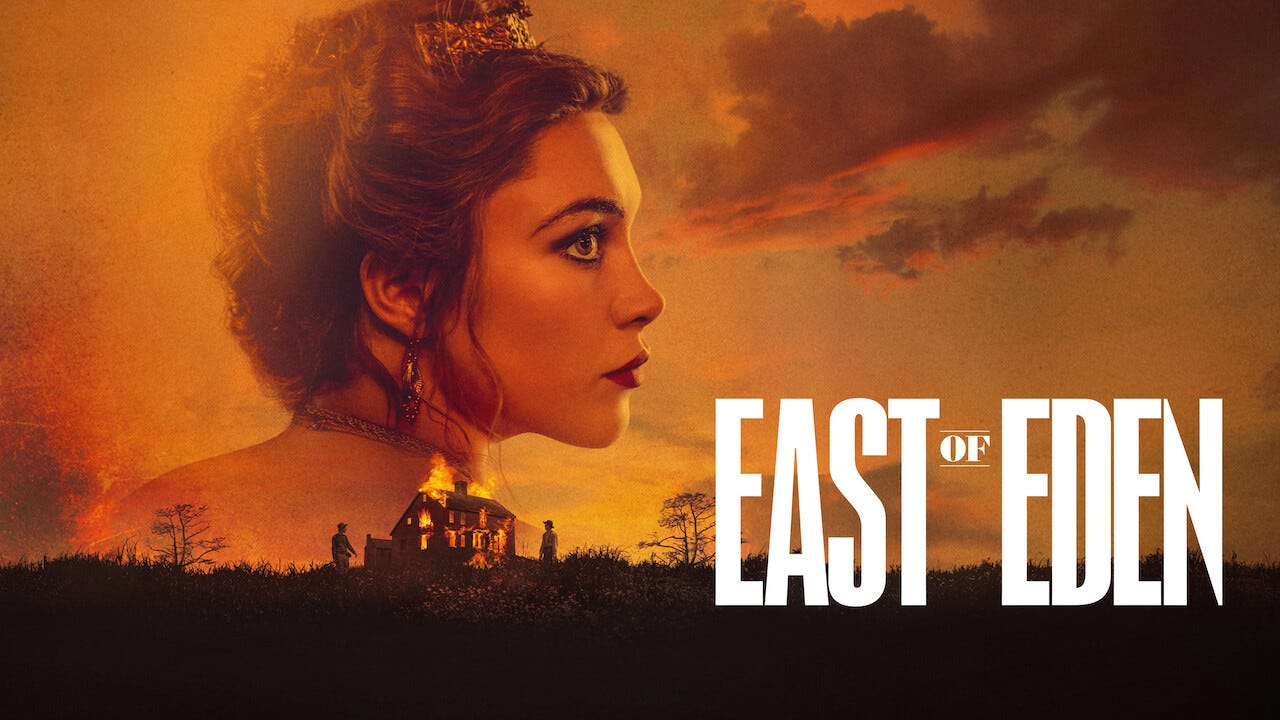
However, an important character complicates this idea in the novel and obliterates it in the series: Cathy Ames (Florence Pugh). She is introduced to us in the novel as a “monster” and lives up to it: She kills her parents, shoots her husband, poisons her employer, and generally ruthlessly manipulates anyone in her path, becoming the madam of a whorehouse who is feared by her girls and blackmails her clientele. For the first half of the show, Cathy is shown to be exactly this. Pugh flawlessly portrays the deceitful woman, able to seem charming and innocent one minute and coldly brutal the next. However, in the final two episodes, the audience is given reason to sympathize with her.
The show creates sympathy in two ways that the novel does not. First, it suggests that she is capable of actual love. Evil people cannot truly love because they lack the ability to admire the good in another—on some level, they recognize the good as a challenge or rebuke to themselves. In both the novel and the show, she pacifies Adam’s brother Charles (Mike Faist), who hates her, by sleeping with him. Adam and Cathy then move across the country, and Cathy never sees Charles again. But in the show, Cathy muses that she could have loved Charles, and in her final days she has visions of him acting as a lover, speaking to her softly, advising her, allowing her to caress his cheek. He speaks the words generated by her own paranoia as though he were trying to protect her. In the novel, this paranoia is more clearly shown to be a consequence of her own actions as she fears that one of her crimes will come to light.
The second method of creating sympathy is through the implication that she feels remorse. In the show, she is bothered by memories of her past crimes, seeing them flash before her and becoming upset. Then, there is her response when her son Aron (Joe Anders) sees her at the whorehouse after believing throughout his childhood that she was dead. He turns away from her, clearly upset, and leaves. She cries, whether out of hurt by his rejection or shame inspired by his condemnation. The scene is only described briefly in the novel, but in that scene she does not cry—she laughs.
That Cathy is less evil and more able to feel in this adaptation was not accidental. Screenwriter and executive producer Zoe Kazan said in an interview that she approached the character by asking, “What if we think of her not as the embodiment of evil but as a person who does really bad things? [laughs] And I think we learn more about ourselves if we don’t think about, like, ‘evil people’ as being that different from us.” (How similar evil people are to us depends on our own moral stature; the implication that we can learn about ourselves by considering evil people as being like us is not incisive commentary but a shocking confession.) The problem with Kazan’s interpretation is that Cathy is not the embodiment of evil in the literal sense, in the way that Sauron is in The Lord of the Rings (an entity who at times doesn’t even have a body; he is simply pure evil). She is evil through her own choices—which brings us back to the core theme of the novel: choice. Everyone has choices; Cathy had a plethora of them. And time and again she chose badly.
This is not to say that exploring a villain’s motivations always whitewashes them. But Steinbeck spends little time on Cathy’s motivations for a reason: They aren’t important to judging her or understanding her. He offers only one brief explanation for her actions: She felt that others “had something she lacked, and she didn’t know what it was.” This does not diminish her evil but ties it into his subtheme of rejection (real or imagined) as motivation for immoral acts; if Cathy lacks something everyone else seems to have, she anticipates rejection from them on those grounds. She then copes with that threat or imagined rejection by closing off certain parts of herself and seeking limited (usually financial) gain at everyone else’s expense. Redemption is possible, in this story as in life—but repeatedly, Cathy chooses to manipulate or hurt others. She becomes suspicious of every possible show of love or honesty, disbelieving, for example, that Adam really could have loved her.
The challenge of the ambitious author, one who desires to write a story of great scope and universal importance, is to embody his abstractions in characters who are larger than life yet seem real. As philosopher and novelist Ayn Rand put it in her treatise on aesthetics, a character “has to be an abstraction, yet look like a concrete; it has to have the universality of an abstraction and, simultaneously, the unrepeatable uniqueness of a person.” Steinbeck achieved this with Cathy, developing a woman who is shocking, compelling, and a paradigmatic case of evil. Kazan’s interpretation does not respect this achievement, and Pugh’s stellar acting makes the problem worse, not better, by perfectly portraying the muddled moral sense of Kazan’s creation rather than the extreme evil of the original.
What makes Steinbeck’s story universal is that it grapples with good and evil and comes out with the profound truth that we each get to choose between them again and again. Neither a deity nor our ancestors nor even our own pasts will save us or doom us, because timshel—thou mayest. It is a clarion call to strive toward virtue every moment of our lives, and it is a shame that the Netflix adaptation failed to portray this stark truth through the most intense character in its source material.
 Log in