69919 stories
·
2 followers

Ryanair vs. the European Union

1 Share

Ryanair, the Irish budget airline, is preparing to cut millions of seats and abandon multiple routes in 2026 because the European political and regulatory environment is making the low-cost model increasingly difficult to sustain.

In 1985, inspired by Southwest Airlines, the first major low-cost airline in the world, and following the liberalization of European airspace, Ryanair brought the low-cost model to scale in Europe, revolutionizing air travel across the continent. It did so through an efficiency-driven model that enabled the sale of extremely low-cost tickets in a market previously dominated by expensive legacy carriers.

Flying ceased to be a luxury and became a real possibility for ordinary citizens. The success of Ryanair’s model created competition and triggered a domino effect: certain European routes saw real price reductions of between 50% and 70%. Even traditional airlines were forced to adapt, introducing “light” fares and adjusting their pricing structures.

Today, low-cost airlines are responsible for carrying more than 500 to 600 million passengers per year in Europe.

However, 41 years later, Ryanair is preparing to cut around 3 million seats, corresponding to an estimated 75 to 90 routes across Europe. A combination of aggressive green ideology from the European Union and state-protected airport monopolies lies at the root of this decision.

The EU Emissions Trading System, or ETS, is the European Union’s carbon market, officially designed to combat climate change.

The EU sets a maximum cap on CO2 emissions that decreases every year, regardless of growth in air traffic. Airlines are required to purchase allowances for every ton of CO2 they emit.

In other words, while the supply of allowances decreases, demand tends to increase with the growth of aviation. This deliberately creates artificial scarcity, driving up the price of carbon, increasing costs for airlines, and ultimately harming consumers.

In March 2026, the CEOs of major European carriers issued a joint statement warning that the European Union and its passengers cannot continue to absorb the growing regulatory and cost burden. They noted that annual regulatory costs in European aviation have tripled since 2014 and are expected to reach €27.6 billion by 2030, with ETS alone accounting for around €5 billion.

Wizz Air, a Hungarian low-cost airline, also warned that the combination of ETS and bureaucracy risks creating a “decomposing economy” in Europe, undermining economic growth and the employment gains generated by low-cost aviation over the past three decades.

To make matters worse, state-protected airport monopolies compound the problem. In Spain, Aena, with 51% state ownership, controls nearly all major airports. In Portugal, ANA (Aeroportos de Portugal) benefits from a full monopoly granted by the state until 2062.

In Spain, the government maintains majority control over Aena and has repeatedly blocked meaningful competition, even ignoring recommendations from its own competition authority. In Portugal, the state privatized ANA in 2013 but granted it a 50-year legal monopoly over all mainland and island airports, a decision also criticized by the Portuguese Court of Auditors.

Without competitive pressure, these entities raise airport fees year after year, often well above inflation, while offering little to no incentives for low-cost airlines to maintain or expand regional and peripheral routes.

A worrying example of the consequences of this policy can be seen in the Azores. Located in the middle of the Atlantic, and only partially liberalized in 2015, the region had long depended on public carriers TAP Air Portugal and SATA (Sociedade Açoreana de Transportes Aéreos). Ryanair became an important driver of tourism growth, accounting for around 10% of overnight stays. However, in March 2026, the airline abandoned the six routes it operated.

Business leaders and the Ponta Delgada Chamber of Commerce warn that this represents the loss of a key economic engine, with an estimated impact of €140 to €160 million per year and a potential reduction of 1.5% to 1.7% of regional GDP.

It is interesting to note, however, that in the face of this hostile environment, Ryanair is shifting its aircraft to more aviation-friendly countries such as Italy, Greece, Hungary, and Morocco. These destinations have adopted more liberal policies: they have reduced or eliminated aviation taxes, offered incentives to regional airports, and avoided the creation of excessive monopolies.

This reallocation demonstrates that state intervention, disguised as unrealistic environmental virtue, cannot override economic reality, and its consequences are not confined to the regulated sector.

Liberalize the skies.

Read the whole story
gangsterofboats
1 hour ago
reply
Share this story
Delete

Elevating Evil People to Own Trump Is SOP

1 Share


Read the whole story
gangsterofboats
1 hour ago
reply
Share this story
Delete

A CNN Anchor Just Torched the Left’s Favorite Narrative About Trump

1 Share


Read the whole story
gangsterofboats
1 hour ago
reply
Share this story
Delete

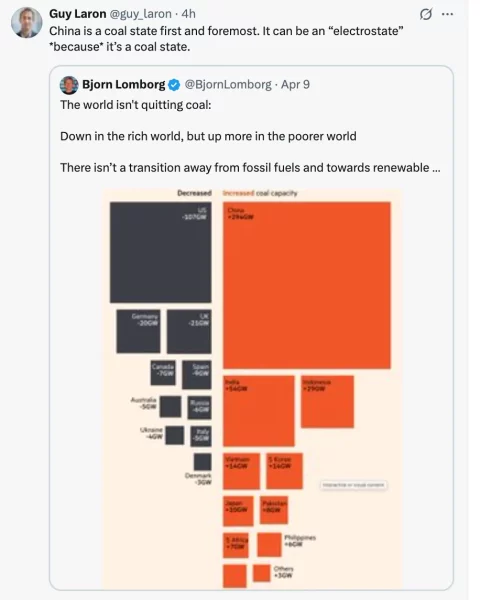
THE OLD ECONOMY HAS THE ADVANTAGE OF BEING REAL: From coalstate to electrostate. The revenge of the

1 Share

THE OLD ECONOMY HAS THE ADVANTAGE OF BEING REAL: From coalstate to electrostate. The revenge of the old economy.

Read the whole story
gangsterofboats
1 hour ago
reply
Share this story
Delete

THEY SUBSTITUTE VIOLENCE FOR ARGUMENT: Berkeley student throws coffee at TPUSA table promoting pro-

1 Share

THEY SUBSTITUTE VIOLENCE FOR ARGUMENT: Berkeley student throws coffee at TPUSA table promoting pro-life debate.

This is because, although they’re not actually very good at violence they’re worse at argument.

Read the whole story
gangsterofboats
1 hour ago
reply
Share this story
Delete

GEORGE MF WASHINGTON: When Hollywood Did It Right: Pirates of the Caribbean. Will Turner’s fire

1 Share

GEORGE MF WASHINGTON: When Hollywood Did It Right: Pirates of the Caribbean.

Will Turner’s fire is lit, his adventure begun, with the help of another classic story trope… the older wiser mentor figure who is at best wildly eccentric and at worst completely insane. This trope too goes back to the very beginning of Western storytelling, but we see it very clearly in many of today’s most popular mass entertainment franchises, some of which are still throwing off sequels, prequels and reboots, from “Star Wars” to “The Matrix” to “Point Break” to “Highlander.” The twist with “Pirates of the Caribbean” is that Johnny Depp did too good a job with Captain Jack Sparrow and accidentally whoopsied himself right into the lead role.

But that was merely a happy accident. Like “Star Wars” and all those other enduring movie examples which we could name, “Pirates of the Caribbean” is a classic male-oriented adventure in both form and function, and that is precisely why it worked so well.

Which brings me to the female lead, Elizabeth Swann, played by Kiera Knightley. Elizabeth is beautiful, of course, but also smart, funny and capable… she is for all intents and purposes a classic Hollywood “modern woman.” But here is the most critical piece, she is a modern woman within the context of the world in which she lives… a world that is a Georgian Era Patriarchy which exists on a distant island colony run with ruthless discipline by the officers and men of the Royal Navy. As such, the men in Elizabeth’s orbit do not cower before her superior intellect, nor are they driven to their knees by her unparalleled strength and wisdom. And she is certainly not a ninety-five pound Scarlett Johansson throwing two hundred and seventy pound men across rooms like they were Jenga blocks.

Elizabeth Swann is simply a woman, emotional and flawed and heroic, in all the ways we used to understand makes a woman, in the days before The Culture decided that being a woman was not enough.

And now I’m going to write something that should not be controversial, but which has become so here in our highly politicized “modern culture.” I’m going to write very clearly and deliberately so that I cannot be misunderstood… and yet I will be misunderstood, deliberately so, because the activists whose grift is based on pretending to misunderstand the most fundamental things about human nature can allow it to be no other way, lest their lucrative grift collapse entirely.

So, here goes… men and women are fundamentally different and often want different things from the entertainment they consume. Generally speaking, women are not as interested in adventure movies like “Pirates of the Caribbean” as men are, and are less likely to pay to see them in theaters. Notice I did not say all women are disinclined to see these kinds of movies, I said that generally speaking, men prefer them more than women do.

By the same token, the audiences for movies like “Hamnet” and “Wuthering Heights” are overwhelmingly female, something I have never heard anyone suggest is a societal problem that needs to be remedied by fundamental industry-wide changes in the way those movies are developed and made. And yet this is precisely what has happened at companies like Marvel, DC and Lucasfilm, where the stubborn refusal of women to attend action-adventure movies in the same numbers as men is treated like some kind of national emergency. When it comes to romantic dramas, on the other hand, we seem to understand that men and women want different things from the movies they consume… and that’s OK.

(Slight pause so that all those readers who have just fainted can be revived)

We good? Everyone still with me?

Keep your fainting couch nearby and read the whole thing.

Read the whole story
gangsterofboats
1 hour ago
reply
Share this story
Delete
Next Page of Stories