 Log in

Labor unions and the general public almost totally ignore the essential role played by falling prices in achieving rising real wages.

Economics textbooks often teach that a proper role of government is to intervene in markets to align incentives when the market fails. Markets work best when decision-makers bear the consequences of their choices. “Internalizing externalities” — say, making companies that discharge pollutants into a river pay to maintain it — is cited as a just cause for taxes, subsidies, and regulation. Most economists continue to teach, write, speak, and podcast as if this textbook prescription for government intervention is a reliable-enough description of reality.
But real-world government intervention routinely does the opposite. It takes costs and benefits that individuals would otherwise experience as consequences of their own choices and shifts them onto other people. In other words, the government regularly “externalizes internalities,” for which we pay the price.
Income Redistribution and Welfare
The most obvious example is taxation for purposes of income redistribution. Whatever the merits or demerits of a policy of redistribution, the essence of any such policy is that some people (the net recipients of tax revenues) live partially at the expense of other people (the net payers of tax revenues). Consistent application of the economic logic that powers textbook explanations of externalities leads to the conclusion that government-engineered income redistribution causes too many people to seek such redistribution (chiefly, by exerting less effort than they otherwise would to increase their own earnings), while at the same time causing high-income earners to exert too little effort at earning taxable income.
Absent redistribution, each person would be paid as income an amount closer to the value of what he or she contributes to the market economy — meaning, the market causes each person to internalize the costs and benefits of whatever amount of effort they choose to devote to earning income. But redistribution obstructs this market result; it artificially dims both the personal penalty for not working and the personal reward for working.
Tariffs and Trade Wars
Another example of the externalization of internalities is protectionism. Producers’ earnings in competitive markets reflect roughly the value of that product to consumers. When consumers spend their own incomes in whatever peaceful ways they choose, they personally pay the costs and reap the benefits of their choices. Producers that better please consumers are rewarded with higher profits — higher profits voluntarily paid to them by consumers. Markets, in other words, internalize on producers the value of their efforts to please consumers.
Protectionist tariffs and non-tariff barriers, by contrast, externalize this internality. By shrinking consumers’ range of choices, protectionism artificially increases consumer demand for the outputs of protected producers. Protected producers thus earn higher profits without creating more value for consumers. A consequence that belonged inside the producer-consumer relationship has been transferred outside it.
Protected firms free-ride on a portion of their fellow citizens’ incomes — the funds these citizens would otherwise have spent on imports. As a result of protectionism, producers exert less effort than otherwise to please consumers. Far from correcting a market failure, protectionism distorts markets. Protectionism externalizes an internality.
Occupational Licensing
A third example of a government policy that externalizes an internality is occupational licensing requirements.
Adults spending their own money for their own purposes have every incentive to assess the quality of different service providers’ offerings. Service providers who seem likely to supply unacceptably low quality don’t win new customers and fade from the market. Surviving suppliers will earn revenue based on how much consumers value the service. In a free market, each service provider — hairbraider, electrician, carpenter, florist, interior designer — has incentives to satisfy consumers to increase his own income.
In a competitive market, in other words, service providers gain or lose according to their own efforts, and no consumer is obliged to pay more than is necessary for that service. The consequences of service providers’ choices (even as they impact the consumer post-purchase) are internalized by the service providers.
Occupational-licensing regulations externalize this internality. Obstructing consumers’ ability to choose different service providers, and blocking new entries to the market, these regulations artificially increase the incomes of licensed suppliers, as all consumers are forced to pay more. Competition forces providers to bear the consequences of disappointing consumers; restrictive licensing weakens that discipline.
When Government Makes Things ‘Free’
“Democratic Socialists” talk of providing for “free” the likes of tuition, bus rides, and childcare, along with subsidized groceries and other goodies. But obviously these goods and services do not become zero-cost simply by decree. What these socialists have in mind, instead, is to arrange for some people — bus riders relieved of ponying up fares — to free-ride on the productive efforts of other people (namely, net taxpayers). The more distant the rider is from the monetary cost of ridership, the more disordered are the choices and incentives.
The same incentives apply to subsidized college programs. When someone else pays, the cost of making a decision is far from the person making the choice.
It’s no exaggeration to describe the Democratic Socialists’ economic agenda as one that prevents individuals from experiencing the full benefits and costs of their personal choices — as one, in short, that externalizes internalities.
A clear-eyed survey of actual government policies reveals that the economics-textbook description of governments as internalizers of externalities is completely backwards.




We're now three episodes into The Real Food Show, a YouTube cooking class hosted by Health and Human Services (HHS) Secretary Robert F. Kennedy Jr. And I'm hooked.
Don't get me wrong: In principle, I hate it. The government has no place being in the business of making cooking shows. And this one is rife with propaganda, including thanking President Donald Trump for the new U.S. dietary guidelines and casual mentions of things like fisheries regulation or an executive order on regenerative agriculture. Even if you can put aside the ick-factor of HHS trying to sneak political content to viewers like some parents might hide broccoli in muffins, this just makes it a worse show. As a cultural or entertainment product, it would be better off without random references to the likes of the Magnuson-Stevenson Act.
Besides, the presence of RFK Jr., who hosts each episode alongside a popular chef, doesn't add much. He spends most of each episode whisking eggs or doing some other sort of kitchen-helper task while the guest chef talks. Then he periodically bursts in with some propaganda while elbow-deep in chickpea salad.
Still, it's propaganda that I happen to mostly agree with. Some former dietary guidelines weren't great, and they were all too often influenced by corporate and agricultural interest groups. You should eat eggs. Fiber is good for gut health. Eating protein with meals is important, even if that message has gotten a little distorted between health experts' lips and the grocery aisle (protein Doritos, anyone?).
And do you know how long I have been ranting to anyone interested—which is, admittedly, very few people—about how Americans' ratio of omega-6 fatty acids to omega-3 fatty acids is all off? Answer: Since about 15 years ago, when I first read Susan Allport's The Queen of Fats, an ahead-of-its-time 2008 book challenging conventional wisdom about saturated fats and the root of American disease.
Now, this is dietary canon in the Trump administration's HHS. That's cool.
But it's also puzzling.
Not that long ago, talking about nutrition at all—and especially about things like nutritional yeast, or microbiomes, or cooking with apple cider vinegar (all mentioned in The Real Food Show)—was very liberal-coded. Republicans pilloried former President Barack Obama as a hopelessly out-of-touch elite for mentioning arugula. They mocked Michelle Obama and complained that she was interfering too much in people's personal lives when she told Americans to eat more vegetables and take walks.
Obama-era nutrition advice from the government wasn't perfect. For instance, it was somewhat stuck in a late–20th century fear of fats. Some of it was rooted in dubious science around nudging people to make smarter food choices.
But conservatives weren't just quibbling over whether people are better off drinking skim milk or whole milk, or where to place apples in school lunchrooms. They branded the whole idea of government giving dietary or health advice as nannyism and made a big show of drinking giant sodas and eating junk food. They equated manliness with meatiness, and freedom with not giving a heck about healthy eating.
Now, a Republican administration is trying to teach people how to cook an arugula salad with a homemade dressing. They're showing people how to swap the tuna in tuna salad for chickpeas and urging people to get eggs from regenerative farms.
The shift is fascinating. (I did a deep dive into the subject last summer in "Trad Wives and Tallow Fries: How the Wellness Wars Flipped Health and Food Politics Upside Down.") And, on one level, it's commendable, too. If government authorities are going to take a side in food politics—and in some ways, it's unavoidable, such as with things like school lunches or the Supplemental Nutrition Assistance Program—I'd rather them be on the side of good health.
RFK Jr. and his ilk are attempting to change the political valence attached to healthy eating and the narrative around caring about nutrition. That could be valuable in general, and specifically when it comes to changing the habits of conservatives, who are unlikely to be reached by the typical (that is: left-leaning) politicians who promote healthy eating.
Besides, going about it by putting out cooking shows is a lot better than levying sin taxes on sugary drinks and instituting bans on bad foods.
And the premise of this one is pretty cool: healthy but appetizing recipes that one can make quickly and on the cheap, using basic kitchen tools, served alongside little tidbits of information about nutrition science that help explain the why behind the ingredients being used. It comes off smart but not pretentious. Even a little bit folksy. And accessible—I came away wanting to make this food and also empowered to feel like I could (which is not the case with many cooking shows).
To be honest, I'm a little conflicted. I think that people eating more "real food" and learning about nutrition is really beneficial. But I also know how government works—and how these things have a way of mission creeping. Once authorities make up their minds to change American diets, it seldom stops at advocating for voluntary, individual actions alone.
I also worry about myopia in the Make America Healthy Again (MAHA) movement, of which RFK Jr. is a figurehead. Some MAHA types seem so invested in shifting away from earlier eras of nutrition advice that they embrace unproven fads, or demonize substances—like seed oils—about which the evidence is still mixed.
Look, I've also been on an anti-seed oil kick for a long time (it goes back to that omega-3/omega-6 balance I mentioned earlier). But if I'm wrong about that—and I may very well be—it only affects me and my household. When the government gives dietary advice, or promotes particular ingredients over others, it has a much broader reach.
So, sure, one might oppose the show for fiscal grounds (our tax dollars are funding this?) or from a high-level "this isn't the proper role of government" perch. To me, the biggest problem is practical: What if RFK Jr. and his cooking cohorts are wrong?
When you give advice the imprimatur of the federal government, a lot of people may take it as indisputable truth. But dietary authorities have been wrong before, and they'll be wrong again. They might even be wrong right now.
And let's say they're right. There's still a question of whether something like The Real Food Show can actually change habits.
The first episode, from July 30, has more than 309,000 views as of this writing—not a smash hit in internet terms but on par with the average viewership of some popular Food Network shows. But the second episode, posted three weeks ago, has just 159,000 views, suggesting perhaps some diminishing returns on interest. And what really matters, from a public health perspective, is not just whether people are watching but whether anyone's actually making these recipes and putting this advice into action.
There's not great evidence that teaching people to cook healthy meals makes much of a difference in health outcomes, at least not in the short term. And if in-person instruction doesn't move the needle all that much, what are the chances that YouTube videos will?
"There is a specific gap between the evidence base and what HHS has built," suggests Dorothy Brooks at Medical Daily. There's also been no indication from HHS of how they plan to assess this program. "Nothing in the [HHS] announcement indicates whether the series will be evaluated for reach or effect," Brooks points out.
Without measurable goals and benchmarks, this falls somewhere between a boondoggle and a vanity project.
Still, it's a fun one. And there are a lot worse things that RFK Jr. could be spending his time on, along with many worse ways that the federal government could be promoting public health. I'll keep watching, and I may even cook some of these recipes. But I'll also be sure to consume it with a hefty grain of (sustainably sourced) salt.
The post RFK Jr.'s MAHA Cooking Show Is Government Propaganda. I Kind of Love It? appeared first on Reason Magazine.

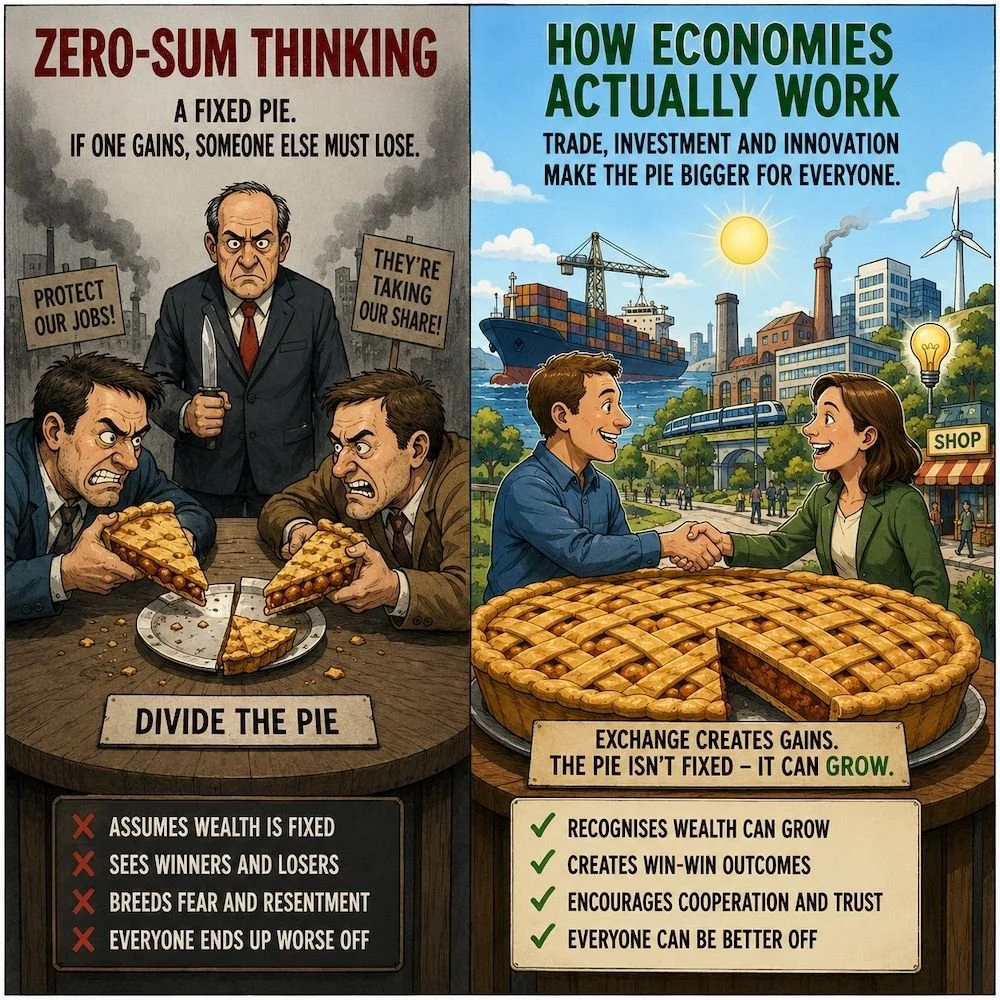
Most bad economics comes down to one mistake, repeated in different disguises. People assume the economic pie is fixed. If someone gains, someone else must lose. This is the zero-sum fallacy, and it is older than economics itself.
It is not hard to see where the instinct comes from. For most of human history, wealth really was fixed, at least in the short run. A tribe hunting and gathering on a fixed territory faced a limited supply of game and berries. If one family took more, another family took less. Zero-sum thinking was not a mistake in that world. It was an accurate description of it.
The trouble is that the same instinct survived the arrival of trade, production, and specialization, none of which existed on the savannah. Modern economies are not fixed pies. They are pies that grow when people trade, invest, and innovate. But the old intuition still runs deep, and it surfaces again and again in economic thinking, almost always wrong.
Take exchange itself. Many people believe that in any deal there must be a winner and a loser. If you buy a coat for £50, the assumption runs, either you overpaid or the seller undersold. In fact both sides gain, or the trade would not happen. You value the coat more than your £50, and the seller values the £50 more than the coat. Nobody loses. Two people become better off, and no third party is worse off either.
This is not a subtle point, but it contradicts something people feel to be true, so it is forgotten the moment the subject turns to trade between nations, or between rich and poor, or between borrower and lender.
Trade between countries is the clearest case. The old mercantilist idea, that a country grows rich by selling more than it buys, has been dead in economic theory for two centuries and alive in political rhetoric the whole time. It rests on the same fallacy as the coat example, scaled up.
If a British exporter sells machinery to a German buyer, both are richer for it. The transaction does not make Britain rich and Germany poor, any more than a bakery selling bread makes its customers poor. Yet the language of trade deficits and surpluses still treats exports as wins and imports as losses, as though a country's shop till were the measure of its wealth rather than what its people actually get to consume.
The same fallacy explains why speculators and middlemen are so often despised. The claim is that they add nothing, that they merely take a cut ofvalue created by others. But speculators who buy low and sell high are performing a service. They are moving goods from where they are less wanted to where they are more wanted, or from a time of surplus to a time of shortage.
A middleman who connects a producer in one country with a customer in another is solving a real problem, namely that the producer and the customer would otherwise never have found each other. Strip out the middleman and the trade very often does not happen at all. Nobody gains, least of all the producer.
Interest works the same way, and provokes the same reaction.
A lender who charges interest is often accused of getting money for nothing. But the lender is not getting nothing. He is giving up the use of his money for a period, at real cost to himself, and interest is his compensation for that cost and for the risk that he will not be repaid. The borrower, meanwhile, gets to use money now that he would otherwise have had to wait years to save. Both sides gain from the arrangement, which is why they enter into it voluntarily.
Taxation debates carry a milder version of the same error. It is often assumed that when a government raises the tax rate, it simply collects a larger share of a fixed amount of economic activity. In reality, higher rates change behaviour. Investment is deferred, activity moves elsewhere, and reported income falls. The size of the pie is not fixed while government decides how to slice it. The slicing itself changes the size.
None of this is difficult economics. It is mostly a matter of remembering that trade is voluntary, and that people do not enter into deals which make them worse off. But this simple fact keeps losing out to an older and more compelling one, the sense, wired into us over tens of thousands of years of a genuinely fixed world, that somebody's gain must be somebody else's loss.
Modern economies does not work that way, and has not for a very long time. Prosperity comes from exchange, not despite it. The countries and individuals who understand this outperform those who do not, and they have been doing so since long before economics had a name.
Madsen Pirie
Each Labor Day since 2021, I have written posts explaining how breaking down barriers to labor mobility can help many millions of workers around the world. The main points everything last year's post are just as relevant today. So I am reprinting it with some updates and modifications, many of them related to the awful deterioration in immigration policy over the last year:
Today is Labor Day. As usual, there is much discussion of what can be done to help workers. But few focus on the one type of reform that is likely to help more poor and disadvantaged workers than virtually anything else: increasing labor mobility. In the United States and around the world, far too many workers are trapped in places where it is difficult or impossible for them to ever escape poverty. They could vastly improve their lot if allowed to "vote with their feet" by moving to locations where there are better job opportunities. That would also be an enormous boon to the rest of society.
Internationally, the biggest barriers condemning millions to lives of poverty and oppression are immigration restrictions. Economists estimate that eliminating legal barriers to migration throughout the world would roughly double world GDP - in other words, making the world twice as productive as it is now. A person who has the misfortune of being born in Cuba or Venezuela, Zimbabwe or Afghanistan, is likely condemned to lifelong poverty, no matter how talented or hardworking he or she may be. If they are allowed to move to a freer society with better economic institutions, they can almost immediately double or triple their income and productivity. And that doesn't consider the possibility of improving job skills, which is also likely to be more feasible in their new home than in their country of origin.
The vast new wealth created by breaking down migration barriers would obviously benefit migrants themselves. But it also creates enormous advantages for receiving-country natives, as well. They benefit from cheaper and better products, increased innovation, and the establishment of new businesses (which immigrants create at higher rates than natives). Immigrants also contribute disproportionately to scientific and medical innovation, including vaccines and other medical treatments that have already saved millions of lives around the world.
The Trump Administration's massive assault on immigration of virtually every kind is predictably harming both migrants and native-born Americans, condemning hundreds of thousands of the former to a lifetime of poverty and oppression, and denying the latter the growth and innovation immigration facilitates. Most recently, thanks in part to a badly flawed Supreme Court decision, it has depriving hundreds of thousands of Haitians and others of legal status, thereby gravely harming both these migrants and the many US industries that depend on them.
Similar, though somewhat less extreme, barriers to labor mobility also harm workers within the United States. Exclusionary zoning prevents many millions of Americans - particularly the poor and working class - from moving to areas where they could find better job opportunities and thereby increase their wages and standard of living. Occupational licensing further exacerbates the problem, by making it difficult for workers in many industries to move from one state to another.
Breaking down barriers to labor mobility is an oft-ignored common interest of poor minorities (most of whom are Democrats), and the increasingly Republican white working class. Both groups could benefit from increased opportunity to move to places where there are more and better jobs and educational opportunities available. Much can be done to curb these problems through a combination of political action, and litigation under both federal and state constitutional law.
As with lowering immigration restrictions, breaking down domestic barriers to labor mobility would create enormous benefits for society as a whole, as well as the migrants themselves. Economists estimate that cutting back on exclusionary zoning would greatly increase economic growth. Like international migrants, domestic ones can be more productive and innovative if given the opportunity to move to places where they can make better use of their talents.
Many proposals to help workers have a zero-sum quality. They involve attempts to forcibly redistribute wealth from employers, investors, consumers, or some combination of all three. Given that virtually all workers are also consumers, and many also have investments (e.g. - through their retirement accounts), zero-sum policies that help them in one capacity often harm them in another. Breaking down barriers to labor mobility, by contrast, is a positive-sum game that creates massive benefits for both workers and society as a whole; it similarly benefits both migrants and natives.
The same is true of breaking down barriers to the mobility of goods. Tariffs and other trade restrictions harm many more workers than they benefit, by increasing prices (which disproportionately hurt lower-income workers), and increasing the cost of inputs used by domestic industries (leading to lower employment levels and wages). In February, the Supreme Court struck down Trump's massive and unconstitutional IEEPA tariffs in a case I helped litigate. But the administration has sought to replace them with equally illegal and harmful tariffs enacted under various pretext, such as combating "forced labor" or addressing "balance of payment deficits." Litigation on these policies is ongoing.
Some on the left point out that, if investors are allowed to move capital freely, workers should be equally free to move, as well. It is indeed true that, thanks to government policies restricting labor mobility, investment capital is generally more mobile than labor. It is also true that the restrictions on labor mobility are deeply unjust. In many cases, they trap people in poverty simply because of arbitrary circumstances of birth, much as racial segregation and feudalism once did. The inequality between labor and capital, and the parallels with segregation and feudalism should lead progressives to put a higher priority on increasing labor mobility.
At the same time, it is worth recognizing that investors and employers, as a class, are likely to benefit from increased labor mobility, too. Increased productivity and innovation create new investment opportunities. The biggest enemies of both workers and capitalists are not each other, but the combination of nativists and NIMBYs who erect barriers to freedom of movement, thereby needlessly impoverishing labor and capital alike. Despite conventional wisdom to the contrary, even current homeowners often have much to gain from curbing exclusionary zoning policies that block the construction of housing needed by workers seeking to move to the region.
On the right, conservatives who value meritocracy and reject racial and ethnic preferences, would do well to recognize that few policies are so anti-meritocratic as barriers to mobility. The case for ending them also has much in common with the case for color-blind government policies, more generally. A number of other conservative values also reinforce the case for curbing both domestic NIMBYism and immigration restrictions. Right-wingers would also do well to recognize that most workers benefit from free trade, and are harmed by protectionism.
There are those who argue against increasing labor mobility, either on the grounds that existing communities have an inherent right to exclude newcomers, or because allowing them to come would have various negative side-effects. I address these types of arguments here, and in much greater detail in Chapters 5 and 6 of my book Free to Move: Foot Voting, Migration, and Political Freedom. As I explain in those earlier publications, nearly all such objections are wrong, overblown, or can be ameliorated by "keyhole solutions" that are less draconian than exclusion. In addition, the vast new wealth created by breaking down barriers to mobility can itself be used to help address any potential negative effects. In the book, I also push back against claims that mobility should be restricted for the benefit of those "left behind" in migrants' communities of origin.
In recent years, there has been important progress on reducing exclusionary zoning. Several states have also enacted occupational licensing reform, which facilitates freedom of movement between states. But there is much room for further improvement on these fronts. And when it comes to international migration, we are in a period of horrific regression.
Workers of the world, unite to demand more freedom of movement!
The post Help Workers by Breaking Down Barriers to Labor Mobility appeared first on Reason Magazine.

The post Portsmouth, Dover and the fury of the masses appeared first on spiked.
Next Page of Stories