 Log in



The Enhanced Games, in which elite athletes were allowed under medical supervision to use various pills and injections to boost their performance, took place in Las Vegas over Memorial Day weekend. The Games were hyped by organizers as "the future of sport – where science, athleticism, and progress inspire superhuman achievement." Not surprisingly, the Luddites at the U.S. Anti-Doping Agency dismissed the event as a "dangerous clown show that puts profits over principle."
With respect to superhuman achievements, the Games were, to be honest, something of a dud. On the other hand, many of the enhanced older competitors did better than their younger selves.
So what enhancements did the competitors use? Organizers did not release individual athletes' regimens but did, prior to the Games, reveal that 91 percent used testosterone, 79 percent used human growth hormone, 62 percent used stimulants such as Adderall, 50 percent used metabolic modulators, 41 percent used erythropoietin (EPO), and 29 percent used an anabolic steroid agent such as Deca-Durabolin. The athletes who chose enhancements were on a shortened protocol of nine weeks instead of 20 weeks as initially designed by the organizers. To be eligible, all of the enhancing compounds must have been approved by the Food and Drug Administration. (Worth noting: A 2017 World Anti-Doping Agency study found that nearly 44 percent of elite athletes had surreptitiously used performance enhancements in the past year.)
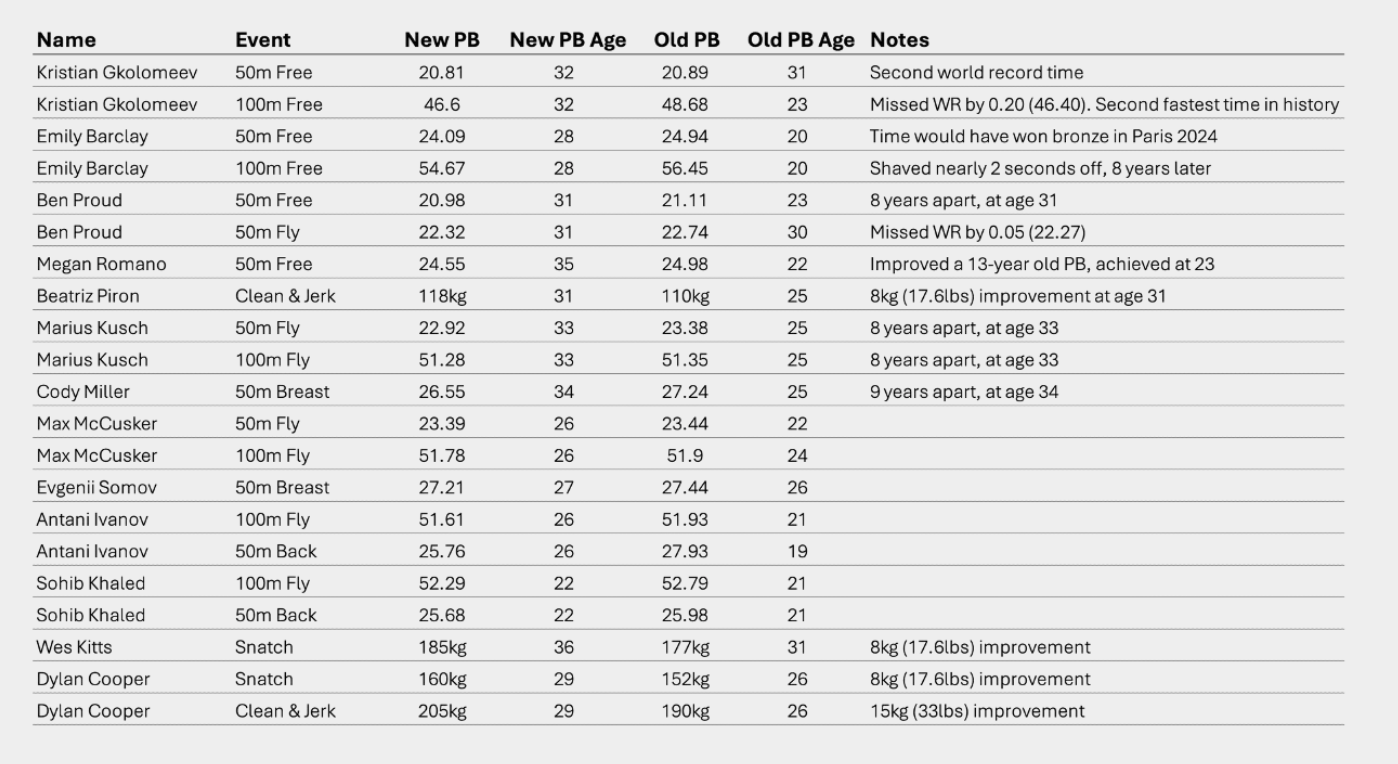
So why was it a "dud"? The organizers had hyped the Games, suggesting that some of their roster of enhanced athletes would break world records in swimming, track, and weightlifting. In fact, Greek swimmer Kristian Gkolomeev, age 32, was the only competing athlete who beat the world record in his sport, the 50-meter freestyle swim. His time of 20.81 seconds beat Australian Cameron McEvoy's record time of 20.88 seconds set in March this year at the age of 31. Gkolomeev's official personal best is 21.44 seconds, set back in 2018 when he was 25 years old. Since he was openly taking various pharmaceuticals aiming to improve his performance, his record swim will not be recorded in the official records.
The organizers of the Enhanced Games also highlighted that 21 personal-best results were broken by 13 of the participating athletes. The average gap between an athlete's previous personal best and their new one set at the Games was 6.4 years. Enhancements, as expected, significantly boost athletic performance.
Notably, three winners at the Enhanced Games were "clean," that is, they used no World Anti-Doping Agency–banned enhancements to improve their performances. The biggest factor in their victories was their youth compared to most of their competitors. For example, swimmer Hunter Armstrong and sprinters Tristan Evelyn and Fred Kerley are respectively 25, 28, and 31 years old.
Recent research reports that the average age for Olympic medalists in sprint swimming competitions for men and women is, respectively, 27 and 26 years old. Armstrong's time at the Enhanced Games for the 50-meter backstroke was 24.21 seconds while his personal best time was 23.71 seconds in 2022 when he was 21 years old. Armstrong's competitors were Shane Ryan (32), Antani Ivanov (26), and Sohib Khaled (22). Competing without enhancements, Khaled's new personal bests at the Games suggest that he is not yet at his peak as a swimmer.
A 2024 study reported that the "median peak age is 27 years old" for Olympic track and field athletes. Evelyn's time for the 100-meter dash at the Enhanced Games was 11.25 seconds while her personal best was 11.14 seconds back in 2021. At the Enhanced Games, Evelyn (age 28) competed against Shania Collins (29), Taylor Anderson (31), Jasmine Abrams (32), Shockoria Wallace (32), and Denae McFarlane (25).
Fred Kerley's time of 9.97 seconds in the 100-meter dash at the Enhanced Games was impressive, especially considering that he is 31 years old. However, that time did not beat his personal best of 9.76 seconds set back in 2022, nor Usain Bolt's world record time of 9.58 seconds in 2009 when he was 22 years old. Kerley's competitors were Emmanuel Matadi (age 35), Marvin Bracey-Williams (32), Mouhamadou Fall (34), Reece Prescod (30), and Mike Bryan (33).
At the first Extended Games, older age and enhanced treachery were no guarantee of victory over youth and exuberance.
The post The Enhanced Games Proved Enhancement Works But Youth Works Better appeared first on Reason.com.



BUT THEY WERE LECTURING PEOPLE ABOUT BEING “DIVISIVE” TODAY:
British police officers kicks a Henry Nowak protester as he’s pinned down on the ground by several other officers pic.twitter.com/TjaaLauPZQ
— Visegrád 24 (@visegrad24) June 2, 2026
Related:
According to the New York Times, the biggest problem with the murder of Henry Nowak is that it's being "increasingly politicized."
Something tells me that wasn't their first reaction after George Floyd died while on a metric ton of fentanyl. pic.twitter.com/R6Wvjdkmu3
— Greg Price (@greg_price11) June 2, 2026
UPDATE:
A police officer involved in the arrest of Henry Nowak has resigned from shame – yet the top brass remain.
Alexis Boone (L) Sam de Reya and Robert France (R) continue in their respective six-figure roles at @HantsPolice. They all need to apologise and resign. pic.twitter.com/mzI1eVyx1U
— Suffragent (@Suffragent_) June 2, 2026
They will kneel for a fentanyl-addicted American career criminal, but not for an innocent 18-year-old British boy.
Absolutely diabolical. https://t.co/PMS38dLU9W
— Morgan 🦋 (@MorganPCALLB) June 2, 2026
We’re still here on the front lines of the Southampton protest. The police are still holding the line. It appears they are attempting to kettle protesters in, even as night falls.
But the patriots are still out here, angry over the loss of Henry Nowak. pic.twitter.com/vShxoaO4CU
— Young Bob (@YoungBobRB) June 2, 2026
This is so much worse than George Floyd. https://t.co/RKlgfRvLt5
— Eric Matheny 🎙️ (@ericmmatheny) June 2, 2026
MORE: Henry Nowak: PM Starmer speaks, cop quits. “Henry died on the street, while being read his rights as an accused criminal. No longer able to speak, the last words Nowak heard were ‘you have the right to remain silent.’ Back to the Prime Minister. Starmer piles on to the idea that the real problem with the Nowak case was not his brutal, unprovoked murder, or the callous indifference shown by the responding police to the dying Nowak. No, the real problem is the (small “c”) conservative reaction to these events.”

On Monday, in a New York Times op-ed, Sen. Bernie Sanders (I–Vt.) announced plans to introduce the American A.I. Sovereign Wealth Fund Act "in the coming weeks." Sanders' bill would give Americans a "direct ownership stake" in the country's largest AI companies by creating "a sovereign wealth fund through a one-time 50 percent tax" of company stock.
While specifics of the legislation haven't been shared, Sanders says the bill will "give the public a direct role in determining the future" of AI, rather than its use being "dictated by a handful of Big Tech oligarchs." Sanders' proposal would also allow the federal government to use its "voting shares and an equal representation on each company's board" to block decisions and policies it deems harmful.
Sanders' plan builds on similar calls to action from academics and the leaders of OpenAI, Anthropic, and xAI—three of the country's largest AI companies—advocating for a formalized process that provides Americans direct payments from the industry. President Donald Trump issued an executive order last February directing the secretaries of the Treasury Department and the Commerce Department, as well as the assistant to the president for economic policy, to "develop a plan" for a sovereign wealth fund and submit it to the president within 90 days.
Details of this fund have yet to be released. The Treasury Department and the Commerce Department did not respond to Reason's request for comment.
To bolster his argument, Sanders cites Norway's Government Pension Fund Global and the Alaska Permanent Fund Corporation as examples worth following, though both of them are funded by revenue from oil and gas drilling, which Sanders vehemently opposes.
Sanders' plan that a wealth fund should provide "direct payments to the American people" rests solely on the example of Alaska's permanent fund. In 1976, Alaska passed a constitutional amendment and a subsequent series of laws guaranteeing a payout from the state's wealth fund to anyone who resides in the state for at least 12 months. Today, payouts from the $86 billion fund fluctuate from year to year as the government siphons money from it to bolster its coffers. Still, compared to a typical low-cost index fund, Alaska's wealth fund performs admirably, but with much higher management fees, according to Bankrate data.
Norway's fund, meanwhile, restricts its lawmakers from spending more than 3 percent of the fund annually, and the country has struggled to remain "apolitical" in its investments, as politicians and the public haggle over which initiatives and companies are ethical enough to fund.
And while Sanders frames "tech oligarchs" as modern-day robber barons, he proposes an idea commonly used by real oligarchs and authoritarians across the world to prop up illiberal regimes, illegally funnel money, and wield unchecked power over their citizens.
In Russia, President Vladimir Putin is draining the country's National Wealth Fund for his war in Ukraine, against the advice of the nation's financial monitors. Iran uses its National Development Fund to finance terrorist groups such as Hezbollah, Hamas, and its shadow police force, while Saudi Arabia's wealth fund is regularly used to facilitate human rights abuses, according to a 2024 report from Human Rights Watch. While it's unlikely that an American wealth fund would be used this nefariously, recent cases of fraud show it's not unreasonable to assume that an unappropriated pot of hundreds of billions of dollars could tempt officials.
Sanders also appears to fundamentally misunderstand that AI is benefiting most Americans, not just the ultrarich. A retirement report from Fidelity Investments found that through the first quarter of 2026, the average 401(k) account balance was up 11 percent from the previous year.
It's also creating nonmaterial gains. AI detection tools can identify breast cancer earlier and more accurately, while bilingual conversational agents have been shown to improve students' language and vocabulary at an early age. If every advancement in AI is subject to government approval, as Sanders proposes, it's unlikely that breakthroughs like these would be achieved at the pace and scale society demands.
Thankfully, it's unlikely that the bill will pass. Still, Sanders' comfort in proposing the idea indicates that more lawmakers from both sides of the aisle want to regulate and slow down a technology that, as Sanders writes, could be "the most transformational technology in the history of the world."
The post Bernie Sanders' AI Wealth Fund Bill Shows That He Doesn't Understand AI or Wealth appeared first on Reason.com.
Next Page of Stories