 Log in

Planora, a new room planner option conceived by a team of three Swedish architects, is a beautifully produced, analogue tool to help conceptualise your new space



… is from pages 58-59 of the 1962 Gateway edition of University of Georgia economist David McCord Wright’s unfortunately now-neglected 1951 book, Capitalism:
One of the most widespread criticisms of the modern economic market is that capitalistic advertising is not always truthful. Who, however, could maintain that political speeches are always truthful? Again, products, it is said, are often “sold” to the public rather than spontaneously demanded by it. Is this not often true of political programs? Next people will say that certain capitalist businessmen have special influence over the market. But do not certain political leaders have special influence over the political market? Finally some people will object that they are forced to choose among the alternatives presented to them and cannot simply have anything they wish…. But also in political life are not most of us obliged to choose among the candidates presented to us in a given campaign rather than “running our own man”?
The post Quotation of the Day… appeared first on Cafe Hayek.
A man may take to drink because he feels himself a failure, but then fail all the more completely because he drinks.
~George Orwell, “Politics and the English Language”
There is a curious irony about the path trodden by many veterans of the Obama administration, including Ben Rhodes, the former deputy national-security advisor for strategic communications. The administration they served and the logic of its retrenchment policies unwittingly helped to ignite the devastating conflict that has roiled Gaza and the region beyond for the past two years. But the lesson that many former Obama deputies have drawn from this tragic episode is to forswear American intervention more completely.
Having come of age in the shadow of 11 September 2001, the younger Obama officials were disenchanted with American hard power and “forever wars,” and so they set about extricating their country from the forbidding labyrinth of the Middle East. Committed to “nation-building at home,” the Obama presidency sought to distance the United States from the territory stretching from the Persian hinterland to the Mediterranean, and as America stepped back from these tormented lands, Obama and his vice-president Joe Biden foresaw what they called a “receding tide of war.” Instead, the black flags of the Islamic State filled the security vacuum left by the American withdrawal from Iraq, while Iran’s bid for regional hegemony grew increasingly menacing and belligerent. The popular uprising against Syria’s barbaric Assad dictatorship was left almost entirely unaided, and the agony of that country’s civil war was allowed to take its grisly course.
The Islamic Republic of Iran was the main beneficiary of these years of American retreat. Its heavily armed proxies and clients in the Levant surrounded Israel in the hope of catalysing a war that would ultimately destroy the Jewish state. By the time that war broke out on 7 October 2023, it was obvious that Obama’s hankering for a post-American world had made the Middle East much more dangerous, and that this ought to have discredited the administration’s analysis. Instead, that analysis has been perversely reinforced, sweeping the Obama veterans into paroxysms of rage against American power and those indigenous forces still upholding the American regional order.
The age of Obama marked a significant shift away from the reflexive sympathy for Zionism that was once standard-issue among American liberals. A new and more critical perspective of Israel—and of American power writ large—has been bleeding from the radical fringes of the postcolonial Left into the centre-left since the collapse of the Oslo process and the Iraq War. Behind his naturally cautious and cerebral style, President Obama’s frosty relations with the Jewish state recalled those of John Foster Dulles and the Arabists in the State Department during the 1950s, who believed that the Israeli alliance needlessly complicated a more bountiful US relationship with the Muslim Middle East.
Having delivered Israel the largest aid package in its history, Obama did not attempt to jettison this special relationship, but he downgraded it, and his strategic retrenchment and outreach to Iran incurred great distrust and consternation in Jerusalem. That in turn produced resentment of Israel within Democratic circles, particularly after Israeli prime minister Benjamin Netanyahu addressed a joint session of Congress in 2015 at the invitation of Republican speaker John Boehner and used the occasion to attack Obama’s Iran policy.
The sullen attitude towards Israel among Democrats has not diminished in the decade since Obama’s departure from the White House. To the contrary, it has swelled, most conspicuously in the aftermath of the Hamas massacre of Israelis on 7 October 2023 and the subsequent war in Gaza. This antagonism has been personified by Ben Rhodes, who has become increasingly bitter on the subject, attacking Israel’s moral credentials as well as its value to America’s national interests.
In a lengthy essay published in the New York Times on 1 December, Rhodes gives voice to those on the political Left outraged by the Democratic establishment’s residual affinity towards Israel. His polemic is a tissue of omissions, half-truths, and outright falsehoods that culminates in the usual left-wing litany of supposed Israeli crimes and transgressions. Still, it usefully captures the spirit of revolt spreading within the party against the old ideas and ideals of liberal Zionism. If not arrested, this new dispensation augurs a broken covenant between the Democratic Party and the state of Israel.
 Brian Stewart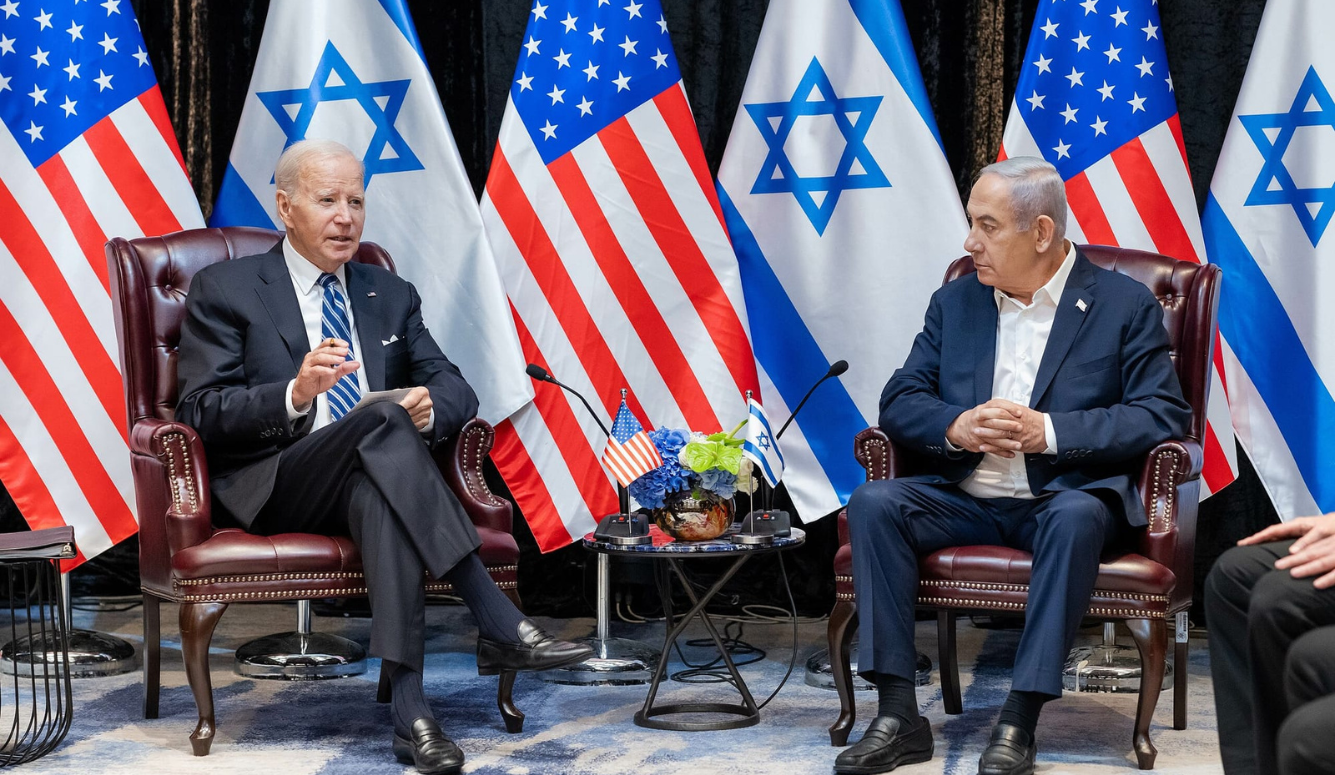
Rhodes begins his essay by scorning the “hug Bibi” strategy that he says animated the Biden administration after 7 October when the American president travelled to Israel and held Netanyahu in an embrace. Rhodes omits a crucial element of this strategy—that America’s alliance is meant to restrain Israeli leaders as much as it is meant to reassure them—and, instead, he discerns a darker motivation. The Biden embrace was not just a gesture of solidarity, he contends, it was an expression of complete strategic alignment that led to America “smothering Netanyahu with unconditional support.”
Rhodes’s assessment of Biden’s strategy is so negative that one almost forgets it was penned by a prominent Democrat. Inveighing against the Biden administration’s complicity in an “intolerable reality”—the destruction of Gaza—he fails to even acknowledge that Hamas launched this deplorable conflict in the first place and refused to end it by surrendering and releasing the hostages it had seized. He also does not bother to suggest how Israel might have repaired its shattered deterrence or retrieved its captives by measures short of war or how that war might have been fought differently. Doing so would have required firm but nuanced arguments in favour of a just war in a fallen world that Rhodes is evidently not prepared to make.
Unsurprisingly, there is also no reckoning in Rhodes’s essay with Hamas and its fanatical ideology, or with the inconvenient fact that this ideology exercises a powerful hold over Palestinians in Gaza and the West Bank. The Palestinian branch of the Muslim Brotherhood is not a remotely normal movement or regime—like its kindred jihadist organisations throughout the umma, it is a cult of martyrdom engaged in a cosmic struggle against the enemies of God. According to its adherents, attacking infidels and removing them from the House of Islam is a religious duty. How is Israel expected to coexist with an eliminationist foe that pledges to annihilate international Jewry in apocalyptic terms?
Jeffrey Herf
Hamas doesn’t care about the welfare of Gazans, and it doesn’t pretend to care. Not even during the most intense periods of combat did Hamas offer them protection in its elaborate maze of tunnels it had constructed with the international aid it had stolen. It built arsenals and bunkers inside and beneath civilian infrastructure—mosques, hospitals, and schools—and it oppressed its own people with savage brutality. When a prominent member of Hamas’s political bureau was asked during the conflict about extending a minimum of protection to civilians, he replied that this was the responsibility of the United Nations. This reasoning may be inhumane but it is not illogical. The suffering of Gazans (and Palestinians more broadly) redounds to the benefit of Hamas in the intra-Palestinian struggle and to the detriment of Israelis in the all-important arena of global opinion.
Hamas Official Mousa Abu Marzouk: The Tunnels in Gaza Were Built to Protect Hamas Fighters, Not Civilians; Protecting Gaza Civilians Is the Responsibility of the U.N. and Israel #Hamas #Gaza pic.twitter.com/LlIVcQX6dt
— MEMRI (@MEMRIReports) October 30, 2023
Rhodes also misstates the degree of support that President Biden provided to Israel in the wake of 7 October. Contemporary Democrats’ spirit of equivocation about Israel revealed itself gradually in the Biden administration’s posture and policy. Initially, a burst of assistance was sent to the wounded and vulnerable Jewish state as it prepared for war. The US president, a stalwart Zionist, rallied to its defence and deployed US military assets to the Eastern Mediterranean to deter further attacks.
But as the death toll in Gaza climbed, it didn’t take long for the US administration to lose its stomach for the fight. At a press conference in December 2023, Biden was already castigating Israel for its supposedly “indiscriminate bombing” in Gaza, and this position solidified as hard political facts came into view. By February 2024, fully half of self-proclaimed Biden voters were calling Israel’s military campaign against Hamas a “genocide.” And as the presidential election approached, Biden yielded to pressure from below and suspended arms shipments. Vice-president Harris, for her part, publicly warned Israel not to undertake the Rafah operation needed to stop arms smuggling across the Egyptian border. This is where the IDF finally discovered and eliminated the Hamas chief Yahya Sinwar. Whatever one makes of this disjointed US policy, it cannot be fairly described as unconditional support.


